
Robinhood's Recent Insider Share Sale: Signals of Deteriorating Investor Confidence or Strategic Capital Restructuring?
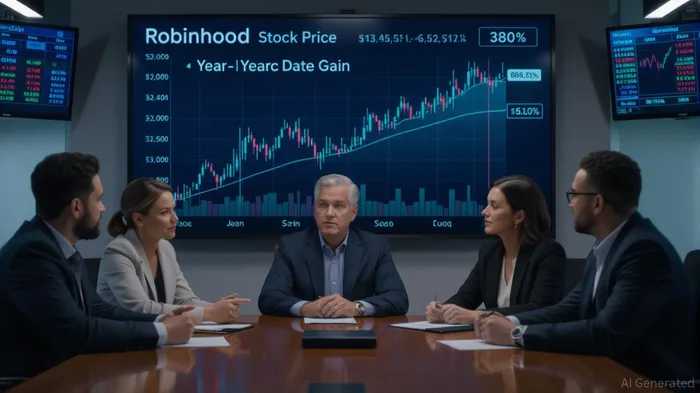
Robinhood Markets (NASDAQ: HOOD) has become a focal point for debates over insider trading and corporate governance, following a wave of high-profile share sales by executives in 2025. The company's CEO, Vladimir Tenev, alone liquidated $50.93 million in shares through July 2025 transactions, while other top leaders—including the CFO, CTO, and Chief Legal Officer—divested millions under Rule 10b5-1 trading plans[1]. These actions, occurring amid a 380% stock price surge over the past year[1], raise critical questions: Are these sales a sign of waning confidence in Robinhood's long-term prospects, or a calculated strategy to optimize personal wealth amid a rapidly evolving fintech landscape?
Insider Sales: Governance Compliance or Market Signal?
Robinhood's insider activity is largely structured through Rule 10b5-1 plans, which automate trades to avoid accusations of market timing[1]. This legal framework, while designed to insulate executives from governance scrutiny, does not eliminate investor skepticism. For instance, Tenev's July 2025 sale of 385,485 shares—yielding $39.3 million—occurred just weeks after the company reported Q2 2025 results showing 45% year-over-year revenue growth to $989 million[2]. Such timing could be interpreted as executives capitalizing on a strong stock rally, rather than signaling operational distress.
However, the sheer volume of insider sales is striking. Between June and September 2025, RobinhoodHOOD-- executives collectively sold over $1.1 billion in shares[3], dwarfing the $1.96 million in insider purchases by Christopher D. Payne, the sole executive to buy stock during this period[3]. This imbalance contrasts with the company's public emphasis on innovation, including the acquisition of Bitstamp and the launch of Robinhood Banking[2].
Financial Performance: A Strong Foundation for Strategic Diversification
Robinhood's Q2 2025 results underscore its financial resilience. Revenue growth, driven by a 46% increase in options trading revenue and a 25% rise in net interest income, outperformed analyst expectations[2]. The company's funded customer base expanded to 26.5 million, and platform assets nearly doubled to $279 billion[2]. These metrics suggest a firm with robust growth momentum, potentially insulating executives from governance concerns tied to short-term performance.
The Bitstamp acquisition, though costly ($65 million in 2025 integration expenses[2]), aligns with Robinhood's strategy to dominate institutional crypto markets. Such bets require long-term capital, yet insider sales have not curtailed the company's $1.5 billion share repurchase program[4], indicating a balanced approach to capital allocation.
Academic Insights: Insider Trading and Retail Investor Sentiment
Academic research complicates the narrative around insider sales. A 2025 study notes that retail investor attention can reduce information asymmetry, potentially offsetting governance risks posed by insider activity[5]. However, the same study warns that retail investors—now 35% of Robinhood's user base—are more susceptible to behavioral biases, such as herd behavior, which could amplify market volatility in response to insider transactions[5].
Conversely, governance scholars argue that frequent insider sales, even when compliant with regulations, erode trust in leadership[6]. For Robinhood, which markets itself as a democratizing force in finance, this risk is acute. While the company's Board of Directors emphasizes fiduciary responsibility in governance documents[1], the disconnect between executive wealth management and shareholder interests remains a potential liability.
Strategic Capital Restructuring or Governance Red Flag?
The answer likely lies in nuance. Robinhood's insider sales reflect a mix of personal financial planning and strategic positioning. Tenev's Rule 10b5-1 plan, for example, was executed during a period of strong earnings and product innovation[3], suggesting confidence in the company's trajectory. Meanwhile, the absence of corporate restructuring—unlike peers such as Meta PlatformsMETA--, whose opaque insider policies have sparked governance debates[7]—further supports the case for strategic, rather than reactive, divestments.
Yet, the lack of insider buying cannot be ignored. In markets where retail investors dominate, leadership transparency is paramount[7]. Robinhood's executives, by prioritizing liquidity over alignment with shareholders, risk perceptions of self-interest over stewardship.
Conclusion: A Cautionary Optimism
Robinhood's insider sales are neither a definitive warning nor a ringing endorsement. The company's financial performance and governance frameworks provide a strong foundation, but the concentration of executive wealth extraction—despite record share repurchases—highlights a governance tension. For retail investors, the key takeaway is to view these transactions in context: a stock with explosive growth and transformative ambitions, but also a leadership team navigating the complexities of personal finance in a public company.
As Robinhood expands into banking, prediction markets, and tokenization[2], the market will likely judge its executives by their long-term bets, not just their short-term exits.





Comentarios
Aún no hay comentarios