
Robinhood's S&P 500 Inclusion and Bernstein's $160 Price Target: A Catalyst for Long-Term Growth?
Robinhood Markets Inc. (NASDAQ: HOOD) has reached a pivotal milestone with its inclusion in the S&P 500 index, effective September 22, 2025[1]. This development, coupled with Bernstein's bold $160 price target, has ignited speculation about the fintech giant's long-term growth potential. For institutional investors, the question is whether this marks a strategic inflection pointIPCX-- or a fleeting market rally.
Strategic Institutional Investor Positioning
Robinhood's S&P 500 inclusion is more than a symbolic achievement—it is a structural catalyst for institutional demand. Index-tracking funds are obligated to purchase shares of newly added constituents, creating immediate liquidity and reducing volatility[2]. According to a report by Forbes, this mechanism historically drives short-term price appreciation, as passive strategies automatically adjust portfolios[1]. For RobinhoodHOOD--, this translates to enhanced visibility and a broader investor base, including pension funds and endowments that prioritize S&P 500 exposure[3].
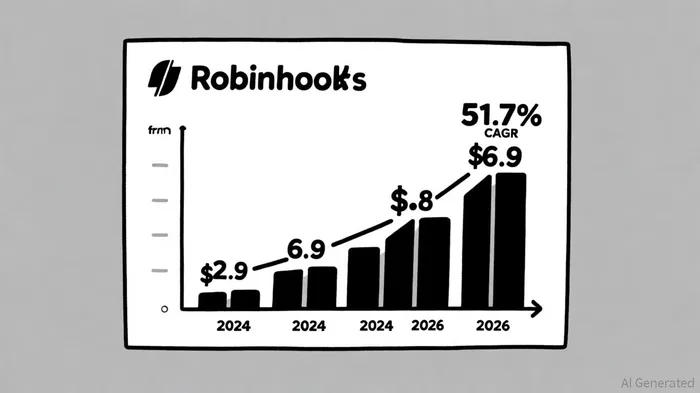
The inclusion also signals financial stability. To qualify, Robinhood needed a market capitalization above $22.7 billion and profitability in consecutive quarters—a barometer of operational resilience[3]. This credibility is critical for institutional investors wary of fintechs' regulatory risks. Bernstein's “Outperform” rating further reinforces this narrative, with analysts projecting revenue growth from $2.9 billion in 2024 to $6.8 billion by 2026[1]. Such scalability aligns with institutional mandates to allocate capital to high-growth, defensible businesses.
Revenue Scalability: From Retail Trading to Financial Superapp
Robinhood's ascent is underpinned by its ability to scale beyond zero-commission trading. The company now captures 12% of U.S. retail trading revenue (up from 7% in 2023) and holds 5.5% of equity trading market share, doubling since 2023[1]. However, its true growth engine lies in diversification. The Gold subscription program, with 3.5 million members, monetizes user engagement through premium features like real-time data and margin trading[1]. Meanwhile, crypto trading and retirement accounts (IRAs) expand its addressable market, appealing to a generation of investors seeking integrated financial solutions[1].
Bernstein's $160 price target hinges on these verticals. The firm assumes a 51.7% compound annual growth rate (CAGR) in revenue, driven by crypto volume and wealth management adoption[1]. This trajectory mirrors the playbook of successful fintechs like PayPalPYPL-- and Square, which leveraged network effects to dominate adjacent markets. For Robinhood, the “superapp” vision—combining trading, crypto, and financial services—creates a flywheel effect, where user retention and cross-selling drive margins.
Risks and Regulatory Overhangs
Despite the optimism, risks persist. Payment for order flow (PFOF), which funds Robinhood's free trading model, remains a regulatory gray area. The SEC's scrutiny of PFOF could force the company to pivot to alternative monetization strategies, potentially impacting margins[1]. Similarly, crypto trading faces an uncertain legal landscape, with state-level bans and federal oversight posing operational challenges[1].
Institutional investors must weigh these risks against Robinhood's agility. The company's rapid adaptation to regulatory shifts—such as its tokenization initiatives—demonstrates a capacity to innovate under pressure[1]. However, execution remains key: scaling new services without compromising user trust will determine whether the $160 target is achievable.
Conclusion: A Catalyst for Long-Term Growth?
Robinhood's S&P 500 inclusion and Bernstein's price target represent a convergence of market validation and strategic momentum. For institutional investors, the stock offers exposure to a fintech with scalable revenue streams and a defensible user base. Yet, the path to $160 is contingent on navigating regulatory headwinds and executing its superapp vision.
In the short term, index inclusion will likely drive inflows and liquidity. Over the long term, success depends on Robinhood's ability to monetize its ecosystem while maintaining its disruptive edge. As Bernstein notes, the company's growth trajectory “reflects the evolving needs of a digitally native investor base”—a demographic that could redefine financial services for decades[1].





Comentarios
Aún no hay comentarios