
Robin Energy's $7.5M Equity Offering and Pre-Market Share Decline: A Strategic Crossroads in a Booming Renewable Sector
The renewable energy sector has entered a transformative phase, driven by technological innovation, policy tailwinds, and shifting investor priorities. Against this backdrop, RobinRBNE-- Energy's recent $7.5 million equity offering and its pre-market share decline present a case study in capital efficiency and market sentiment dynamics. While specific details on the offering's structure remain opaque, broader sector trends offer critical context for evaluating the company's strategic calculus.
Investor Sentiment: A Sector on the Rise
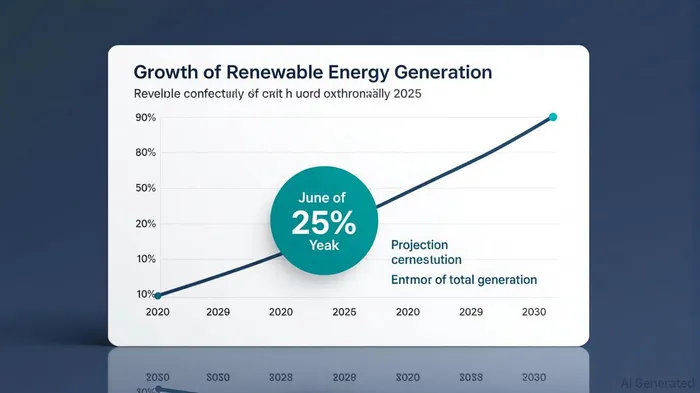
Investor appetite for renewable energy has remained resilient, even amid macroeconomic volatility. According to a report by The Los Angeles Times, renewable energy accounted for 25% of U.S. power generation in June 2025, up from 18% in 2024, with Texas and California leading the charge in wind, solar, and storage capacity [2]. Globally, projections indicate renewables could supply over 45% of electricity by 2030, fueled by declining costs—solar and wind are now the cheapest new-build sources in most regions [1]. These fundamentals have sustained robust investor sentiment, with utilities and states prioritizing renewables despite regulatory headwinds under the Trump administration [2].
However, this optimism is not universal. Equity offerings in the sector have faced mixed reactions, particularly when perceived as dilutive or lacking clear value propositions. Robin Energy's pre-market share decline, though not directly tied to the $7.5 million offering, may reflect broader skepticism about capital allocation in an increasingly competitive landscape.
Capital Efficiency: Balancing Growth and Returns
Capital efficiency remains a critical metric for renewable firms, where upfront costs are high but long-term returns are attractive. The U.S. Department of Energy notes that wind power alone provides over 150 gigawatts of installed capacity, sufficient to power 40 million households [3]. Yet, scaling projects requires significant investment, and Robin Energy's equity raise suggests a focus on expanding its footprint.
The challenge lies in aligning such capital raises with investor expectations. While the sector's growth trajectory justifies risk-taking, market participants are increasingly discerning about how funds are deployed. For instance, the declining costs of renewables mean that projects must demonstrate rapid scalability and operational efficiency to justify new equity. If Robin's offering is perceived as overpriced or misaligned with these priorities, it could exacerbate share price volatility.
Strategic Implications for Robin Energy
Robin Energy's move must be evaluated through the lens of sector-wide dynamics. On one hand, the company is tapping into a market poised for explosive growth, with global renewable capacity set to surge in the coming decade [1]. On the other, it faces pressure to prove that its capital expenditures will yield returns commensurate with the risks. The pre-market share decline may signal investor concerns about dilution, competitive positioning, or execution risks—issues that could be mitigated by transparent communication and clear milestones.
Moreover, the broader renewable sector's reliance on state-level investments (rather than federal support) introduces geographic and policy risks. Companies like Robin must navigate these uncertainties while maintaining operational agility.
Conclusion
Robin Energy's $7.5 million equity offering underscores the dual-edged nature of capital raising in a high-growth sector. While the renewable energy landscape offers unparalleled opportunities, the company's success will hinge on its ability to deploy capital efficiently and align with investor sentiment. As the sector evolves, firms that balance aggressive expansion with disciplined financial management will likely emerge as leaders.





Comentarios
Aún no hay comentarios