
Roba's Revolution: Democratizing Robotics and Reshaping a $218B Industry
The Problem: Fragmentation and Exclusivity
For decades, industrial robotics has been dominated by proprietary systems from firms like ABB and Fanuc, which require specialized expertise, costly infrastructure, and years of R&D to deploy, according to a McKinsey report. This exclusivity has stifled innovation, leaving SMEs and startups on the sidelines. Meanwhile, the demand for automation is accelerating: labor shortages, sustainability mandates, and the rise of AI-powered tasks are pushing industries to adopt robotics at an unprecedented pace, as noted in a Forbes article.
Roba's Solution: The "Hugging Face of Robotics"
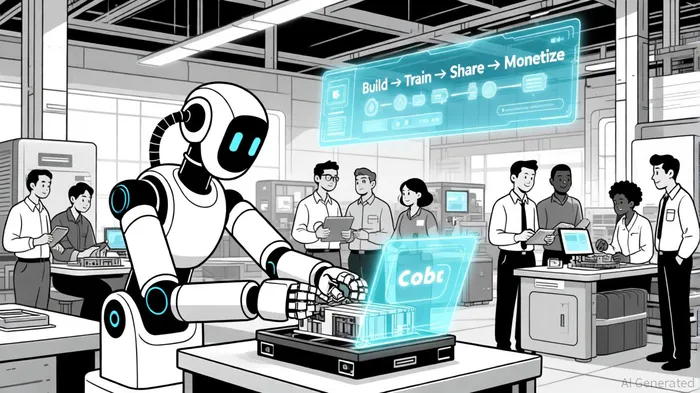
Roba is shattering this status quo with a no-code, open-source platform that simplifies robotics development into a four-step workflow: Build → Train → Share → Monetize, according to a TechStartups article. By unifying tools, data, and AI frameworks under a single ecosystem, Roba eliminates the need for fragmented, proprietary systems. Its core components-ROBA Studio (for simulation and development), ROBA Creator Hub (a marketplace for sharing and monetizing robotic assets), and ROBA Link (an integrative layer for third-party tools)-create a seamless experience for developers, from hobbyists to enterprises, the TechStartups article explains.
What sets Roba apart is its blockchain-driven economic model. Creators retain ownership of their robotic designs and earn $ROBA tokens through a decentralized marketplace, incentivizing innovation while aligning the interests of developers and users, the TechStartups piece notes. This approach mirrors the open-source AI revolution led by platforms like Hugging Face, democratizing access to cutting-edge technology and fostering a community-driven innovation cycle described in the same coverage.
Market Impact: A $218B Disruption
The implications are profound. By 2030, the industrial robotics market alone is expected to grow from $87.1 billion in 2024 to $162.7 billion, fueled by AI integration and the rise of collaborative robots (cobots), an Accio report projects. Roba's platform is uniquely positioned to capture a significant share of this growth by addressing two critical pain points: cost and complexity.
- Cost: Traditional robotics systems can cost millions to deploy, with hidden expenses for maintenance and reprogramming. A McKinsey report estimates that Roba's Robotics-as-a-Service (RaaS) model allows businesses to access automation without upfront capital, slashing costs by up to 70%.
- Complexity: Roba's no-code interface empowers non-technical users to design and deploy robots, democratizing innovation in sectors like healthcare (e.g., surgical robots) and agriculture (e.g., autonomous harvesters), as highlighted in the TechStartups coverage.
Moreover, Roba's focus on interoperability ensures compatibility with existing infrastructure, enabling legacy systems to integrate with AI-driven robotics seamlessly. This adaptability is a key differentiator in an industry where 64,542 cobots were installed in 2024 alone, reflecting a 12% year-over-year increase, according to the World Robotics Report 2025.
Long-Term Implications: Beyond Automation
Roba's disruption extends beyond cost savings. By fostering a community of citizen developers, the platform is accelerating innovation cycles and enabling hyper-customized solutions. For example, in healthcare, diagnostic robots saw a 610% growth in 2024, driven by demand for precision and efficiency, the World Robotics Report 2025 found. Roba's ecosystem allows medical professionals to design and deploy specialized robots tailored to niche applications, from minimally invasive surgery to AI-powered diagnostics.
Sustainability is another frontier. Robotics is already reducing energy consumption through lightweight materials and bionic grippers, as reported in the World Robotics Report 2025, and Roba's platform could amplify these efforts by enabling SMEs to develop eco-friendly automation solutions. As industries race to meet UN sustainability goals, the ability to rapidly prototype and scale green technologies will be a critical competitive advantage.
Risks and Challenges
No investment is without risk. Roba faces competition from established players and emerging startups, and technical hurdles-such as improving semantic understanding and physical manipulation in AI-driven robots-remain, the McKinsey report cautions. Regulatory uncertainty around AI ethics and data privacy could also slow adoption. However, the platform's first-mover advantage in open-source robotics and its tokenized economic model provide a strong moat against these challenges.
Conclusion: A Must-Own Asset in the Automation Era
As the robotics industry hurtles toward a $375.95 billion market by 2034, Roba is not just a participant-it's a catalyst. By democratizing access to automation, the platform is empowering a new generation of innovators to solve global challenges, from labor shortages to environmental sustainability. For investors, this represents a rare opportunity to back a company that's not only riding the wave of AI and automation but actively shaping its future.
The question isn't whether robotics will transform the world-it already is. The real question is: who will lead the charge?







Comentarios
Aún no hay comentarios