
RLUSD: Unlocking Liquidity for BUIDL and VBILL Holders in the New Era of Institutional DeFi
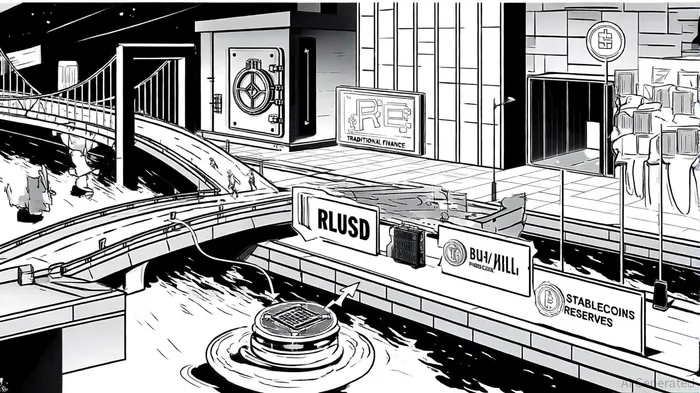
In the rapidly evolving landscape of decentralized finance (DeFi), liquidity remains the lifeblood of innovation. For institutional investors, the ability to convert assets into cash—or its digital equivalent—without friction is paramount. Ripple's RLUSD, a USD-backed stablecoin designed for institutional-grade use, is emerging as a critical tool in this ecosystem. By enabling instant redemption for tokenized funds like BlackRock's BUIDL and VanEck's VBILL, RLUSD is notNOT-- just a stablecoin—it's a liquidity bridge between traditional finance and DeFi.
The RLUSD Advantage: Bridging Real-World Assets and On-Chain Flexibility
RLUSD's strategic value lies in its ability to unlock liquidity for holders of tokenized real-world assets (RWAs). BlackRock's BUIDL and VanEck's VBILL, which represent exposure to short-term U.S. Treasury assets, now allow investors to redeem their tokenized shares for RLUSD via smart contracts on a 24/7 basis[1]. This integration, facilitated by Securitize's platform, means investors can access on-chain liquidity without sacrificing their exposure to RWAs. For example, a fund manager holding BUIDL tokens can convert them into RLUSD during market volatility and then deploy the stablecoin into DeFi protocols like Aave's Horizon RWA Market to earn yield[2].
This functionality is particularly compelling in a market where DeFi TVL has surged by 72% year-to-date, driven by the adoption of RWAs as collateral[4]. RLUSD's role as a programmable, compliant stablecoin ensures that institutions can navigate both traditional and decentralized markets with confidence. Unlike algorithmic stablecoins, RLUSD is fully backed 1:1 by high-quality liquid assets (cash and U.S. Treasuries) under a New York Department of Financial Services (NYDFS) Trust Company Charter[3]. This regulatory clarity is a stark contrast to the instability seen in other stablecoin ecosystems, making RLUSD a safer bet for risk-averse institutions.
Institutional Adoption: Partnerships and Infrastructure
Ripple's partnerships with major custodians like BNY Mellon further solidify RLUSD's institutional appeal. BNY Mellon's role in managing RLUSD's reserves provides an additional layer of trust, as the bank's infrastructure ensures transparency and security[3]. This alignment with traditional financial systems is a strategic move, as institutions demand interoperability between legacy systems and blockchain-based solutions.
Moreover, RLUSD's integration with RippleNet and the XRPXRP-- Ledger (XRPL) enables fast, low-cost cross-border transactions, addressing a pain point for global investors[5]. For instance, Dubai's use of RLUSD in real estate tokenization demonstrates its versatility beyond crypto ecosystems[5]. These use cases highlight RLUSD's potential to become a universal liquidity tool, bridging geographies and asset classes.
Comparative Strengths: RLUSD vs. USDCUSDC-- and USDT
While USDC and USDTUSDT-- dominate the stablecoin market, RLUSD's institutional-grade design positions it as a direct competitor in regulated markets. Unlike USDC, which faces scrutiny over its commercial bank reserves, RLUSD's 100% cash and U.S. Treasury backing under NYDFS oversight offers a higher degree of transparency[1]. Additionally, RLUSD's multi-chain support (69 blockchains) and interoperability with DeFi protocols like Aave's Horizon RWA Market provide a broader utility set[2].
The stablecoin's mint-and-burn mechanism ensures its 1:1 peg to the U.S. dollar remains stable, even during periods of extreme volatility. This reliability is critical for institutions seeking to hedge risk or restructure portfolios without exiting the crypto ecosystem[4].
Future Outlook: A New Paradigm for Institutional DeFi
As tokenized RWAs gain traction, RLUSD's role in facilitating liquidity will only grow. With a market capitalization exceeding $700 million[5], the stablecoin is already demonstrating its scalability. Ripple's plans to expand RLUSD's integration on the XRP Ledger further underscore its ambition to dominate institutional DeFi.
For investors, the implications are clear: RLUSD is not just a stablecoin but a foundational asset in the next phase of DeFi. By enabling seamless transitions between tokenized funds and on-chain liquidity, it empowers institutions to participate in decentralized markets while maintaining regulatory compliance.





Comentarios
Aún no hay comentarios