
RLUSD's Multichain Expansion and Its Implications for XRP's Institutional Adoption: Strategic Infrastructure and Regulatory Alignment as Catalysts
In late 2025, Ripple's strategic infrastructure development and regulatory alignment have positioned its U.S. dollar-backed stablecoin, Ripple USD (RLUSD), as a linchpin for institutional adoption of XRPXRP--. By expanding RLUSD to EthereumETH-- Layer 2 (L2) networks and securing dual regulatory oversight, Ripple is creating a robust framework that bridges traditional finance and decentralized ecosystems. This analysis explores how these moves are catalyzing XRP's utility in institutional-grade applications, from cross-border payments to DeFi.
Strategic Infrastructure Development: Multichain Expansion and Interoperability
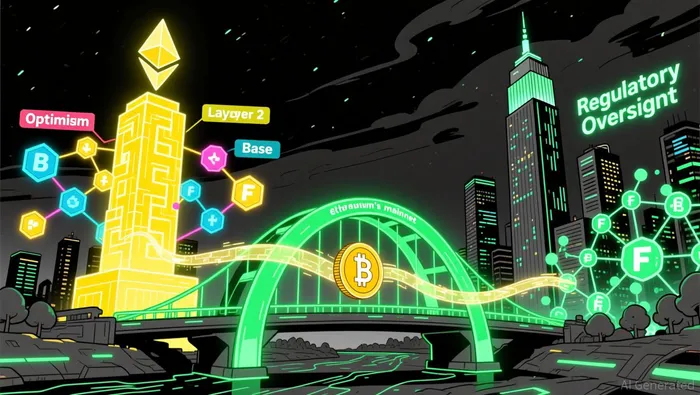
Ripple's multichain strategy for RLUSD is centered on interoperability and liquidity. The stablecoin has been deployed on Ethereum L2s such as OptimismOP--, Base, Ink, and Unichain via Wormhole's Native Token Transfers (NTT) standard. This approach eliminates the need for wrapped tokens, enabling native cross-chain movement of RLUSD while preserving regulatory compliance. For XRP, this infrastructure creates synergies: Hex Trust's issuance of wrapped XRP (wXRP) allows XRP holders to pair it with RLUSD for swaps, lending, and payments across chains.
The technical integration with Wormhole's NTT standard is particularly significant. By avoiding synthetic assets, Ripple ensures that RLUSD remains a "native" token on each chain, enhancing its utility in DeFi protocols and institutional workflows. This expansion also aligns with broader trends in blockchain infrastructure, where L2s are increasingly seen as scalable solutions for enterprise use cases.
Regulatory Alignment: Dual Oversight and Global Recognition
Regulatory alignment has been a cornerstone of Ripple's institutional push. RLUSD is issued under a New York Department of Financial Services (NYDFS) Trust Charter and is now pursuing an OCC charter. This dual oversight-state and federal-positions RLUSD as the first stablecoin with such a regulatory framework, addressing institutional concerns about compliance and risk management.
Globally, Ripple has secured recognition in key markets like Dubai and Abu Dhabi, reinforcing RLUSD's cross-border utility. These developments are critical for XRP's adoption, as they demonstrate Ripple's ability to navigate complex regulatory environments-a trait that institutional investors prioritize. The resolution of Ripple's SEC case in August 2025 further solidified this alignment, leading to a 11% spike in XRP's price and a wave of spot ETF applications.
Institutional Partnerships and Real-World Use Cases
Ripple's institutional-grade infrastructure is being leveraged through strategic partnerships. The acquisition of Hidden Road to form Ripple Prime-a crypto-owned global prime brokerage-has enabled institutions to engage with XRP via clearing, financing, and OTC trading. RLUSD serves as collateral on trading desks, further embedding the stablecoin into institutional workflows.
Real-world applications are also emerging. A pilot project with Mastercard, WebBank, and Gemini used RLUSD on the XRP Ledger to settle credit card transactions instantly, replacing traditional ACH transfers. This demonstrates XRP's role in high-speed, low-cost cross-border payments-a use case that aligns with institutional demand for efficiency. Additionally, partnerships with entities like BlackRock and VanEck have selected RLUSD as a redemption rail for tokenized Treasury funds, signaling growing trust in its utility.
Future Outlook: Scaling Institutional Utility
Ripple's roadmap for 2026 includes expanding RLUSD to additional chains and securing final regulatory approvals for its OCC charter. These steps will likely attract more institutional capital, particularly as XRP's utility in DeFi and cross-chain applications grows. The integration of wXRP with RLUSD also opens avenues for yield-generating strategies, further diversifying XRP's use cases beyond speculative trading.
However, challenges remain. Regulatory scrutiny in other jurisdictions and competition from stablecoins like USDCUSDC-- could testTST-- Ripple's momentum. Yet, the company's focus on compliance-by-design and multichain interoperability provides a strong foundation for long-term adoption.
Conclusion
RLUSD's multichain expansion and regulatory alignment are not just technical upgrades-they are strategic moves that address institutional pain points. By combining scalable infrastructure with dual oversight, Ripple is transforming XRP into a regulated, programmable asset capable of supporting real-world finance. For investors, this represents a compelling case for XRP's institutional utility, driven by infrastructure innovation and regulatory clarity.






Comentarios
Aún no hay comentarios