
Rivian vs. Tesla: Why the Undervalued EV Play Offers Higher Growth Potential in 2026
Valuation Disparity: A Tale of Two EVs
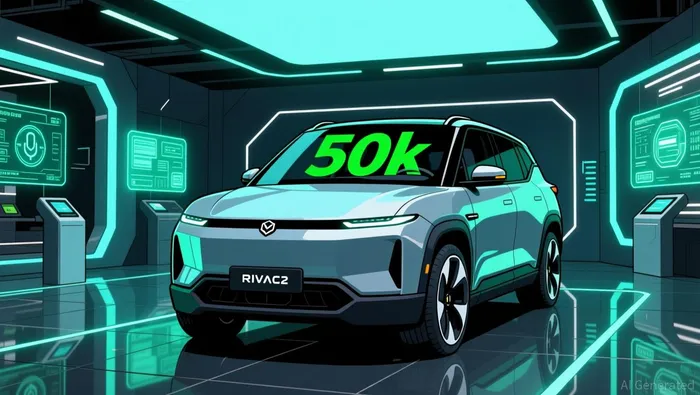
Tesla's astronomical valuation is underpinned by its dominance in the EV market, diversified revenue streams (including energy storage and software), and a forward EV/EBITDA ratio of 97.5x. However, this metric is expected to normalize to 62.5x over the next five years, reflecting market skepticism about sustaining such high multiples. Meanwhile, Rivian's EV/EBITDA ratio stands at -7.04, with analysts projecting a forward multiple of -0.2x by 2026, indicating a path toward breakeven EBITDA. This improvement is driven by the R2, a midsize SUV priced under $50,000, which is expected to launch in Q1 2026 and deliver stronger gross margins than Rivian's current R1 models.
The price-to-sales (P/S) ratio further highlights the valuation gap. Tesla trades at 16x sales, while Rivian's P/S ratio is significantly lower, making it appear more affordable despite its unprofitable status. This discrepancy is not merely a reflection of financial performance but also of market perception: Tesla is seen as a cash-generative juggernaut, while Rivian is viewed as a high-risk, high-reward bet on its ability to scale affordably.
Product Roadmaps: Affordability vs. Diversification
Tesla's 2026 roadmap centers on expanding its high-margin software and autonomy offerings. The Cybercab, an autonomous robotaxi set to launch in June 2026, represents a 1.5 trillion opportunity in the ride-hailing market. Additionally, Tesla plans to introduce a "Model Y Standard" priced in the low $30,000s and a refreshed Model 3 Long Range RWD for China. These moves aim to sustain demand in a post-tax-credit environment but rely heavily on existing brand loyalty and infrastructure.
Rivian, by contrast, is pivoting toward mass-market accessibility. The R2, its first vehicle priced below $50,000, is designed to scale production to 215,000 units annually, a critical step toward profitability. Beyond vehicles, Rivian is expanding into micromobility (e-bikes and cargo quads) and industrial robotics via its Mind Robotics spinout. These initiatives align with a broader vision of becoming a "transportation technology platform," not just an automaker. Analysts note that Rivian's voice-based AI and Level 3 autonomy features, set to debut alongside the R2, could differentiate it in a crowded EV market.
Revenue Projections and Risk Factors
While Tesla's 2026 revenue remains opaque, its 37 billion cash reserves and software-driven margins provide a buffer against industry headwinds, including expiring tax credits. Rivian's 2025 revenue of $4.7–$4.9 billion is expected to grow to $9.6 billion by 2030, but 2026 will test its ability to offset declining demand for premium EVs. The R2's success is pivotal: If it captures 1% of the U.S. SUV market, Rivian could generate $10 billion in annual revenue.
However, risks abound. Tesla's diversified ecosystem and brand strength make it a safer bet, while Rivian's reliance on the R2 and external funding introduces volatility. Yet, for investors willing to tolerate short-term uncertainty, Rivian's roadmap offers a more scalable path to profitability.
Conclusion: The Case for Rivian
The valuation gap between Tesla and Rivian reflects divergent growth strategies. Tesla's dominance is secure, but its multiples suggest diminishing returns for new investors. Rivian, though unprofitable, is undervalued relative to its 2026 potential. Its R2 launch, affordability focus, and expansion into robotics and micromobility position it to capture a broader share of the EV ecosystem. While Tesla's robotaxi and software bets are transformative, they operate in a saturated market. Rivian's ability to redefine itself as a mass-market platform-rather than a niche automaker-could yield outsized returns for those who recognize its undervaluation today.







Comentarios
Aún no hay comentarios