
Rivian's Strategic Turnaround and AI-Driven Future: Unlocking Investment Catalysts in the EV Innovation Era
The electric vehicle (EV) industry is at a pivotal inflection point, where technological differentiation and operational efficiency are reshaping competitive dynamics. Rivian AutomotiveRIVN--, once a niche player in the EV space, has embarked on a bold strategic transformation that positions it at the intersection of hardware innovation and software-driven value creation. By leveraging artificial intelligence (AI) and autonomous driving technologies, RivianRIVN-- is not only redefining its product offerings but also unlocking new revenue streams and margin expansion opportunities. For investors, this evolution represents a compelling case study in how strategic reinvention can catalyze long-term value creation in a capital-intensive sector.
A Strategic Pivot: From Hardware to Software-Defined Platforms
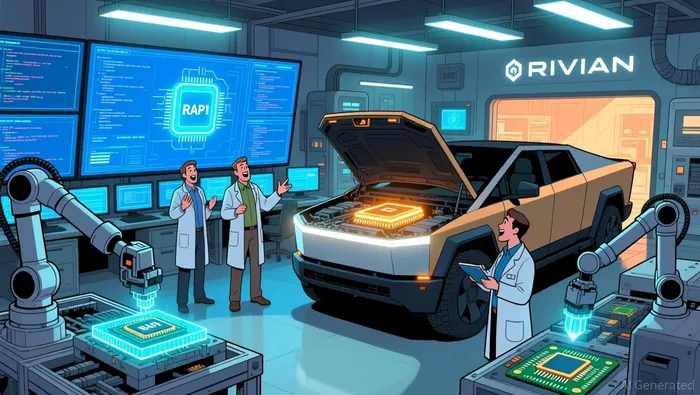
Rivian's 2025 strategic turnaround is anchored in its transition from a hardware-centric automaker to a vertically integrated software-defined platform. This shift is exemplified by the company's development of the Rivian Autonomy Processor (RAP1), a proprietary silicon chip designed to execute "physical AI" tasks critical to autonomous driving according to reports. By reducing reliance on third-party suppliers like Nvidia, Rivian is not only lowering vehicle costs but also capturing more value from its supply chain-a critical step in improving profitability according to analysis. This vertical integration mirrors the strategies of tech-driven automakers such as TeslaTSLA-- and Apple, which prioritize control over both hardware and software ecosystems to maximize margins according to industry reports.
 The financial implications of this pivot are significant. Rivian's Autonomy+ software platform, which offers both one-time purchases and recurring subscription models for advanced driver-assistance features, aligns with the high-margin Software as a Service (SaaS) model favored by investors according to market analysis. This approach not only diversifies revenue streams but also creates a sticky relationship with customers, enhancing lifetime value. According to a report by Bloomberg, Rivian's Software & Services revenue surged 324% year-over-year in 2025, driven by partnerships like its $1 billion collaboration with Volkswagen according to financial reports. Such partnerships underscore the scalability of Rivian's AI-driven offerings and their potential to generate cross-industry synergies.
Monetizing AI: A New Revenue Frontier
Rivian's AI initiatives extend beyond cost optimization to direct monetization. The company's next-generation autonomy platform, unveiled during its "Autonomy & AI Day" in December 2025, integrates lidar, cameras, and radar to enable hands-free driving in future models like the R2 according to technical details. This platform is not merely a technical achievement but a strategic lever for revenue generation. By offering tiered access to autonomous features-ranging from basic driver-assistance to full self-driving capabilities-Rivian can capture incremental payments from customers willing to pay for enhanced safety and convenience according to industry analysis.
The subscription-based Autonomy+ service further reinforces this monetization strategy. As noted by CNBC, Rivian's CEO emphasized that the company is shifting from adopting existing autonomy systems to building an end-to-end solution using in-house engineering and custom silicon according to company statements. This approach not only differentiates Rivian from competitors but also creates a moat around its AI capabilities, reducing the risk of commoditization. For investors, the recurring revenue potential of such services is a key catalyst, as it transforms Rivian's business model from one reliant on vehicle sales to a hybrid model that mirrors the high-margin dynamics of software companies according to market analysis.
Financial Realities and Operational Challenges
Despite these promising developments, Rivian's path to profitability remains fraught with challenges. The company reported a net income deficit of $1.17 billion and a free cash flow deficit of $421 million in Q3 2025 according to financial reports. These figures highlight the capital intensity of scaling AI-driven technologies and the need for disciplined cost management. However, Rivian's strategic focus on vertical integration and software monetization could mitigate these risks over time. By reducing dependency on external suppliers and capturing more value from its ecosystem, the company is laying the groundwork for improved operational efficiency and margin expansion according to industry analysis.
Long-Term Value Creation: A Transformative Phase
Rivian's strategic reinvention is emblematic of a broader trend in the EV industry: the convergence of automotive and technology. The company's investments in AI and autonomy are not just about staying competitive but about redefining the value proposition of EVs. As noted in a report by StocksToTrade, Rivian's "bold leap forward" in AI integration has already begun to reshape investor perceptions, with analysts suggesting that its valuation could be re-rated upward as its software capabilities mature according to market analysis.
For long-term investors, the key question is whether Rivian can sustain its innovation momentum while achieving financial discipline. The company's partnership with Volkswagen, its proprietary silicon development, and its SaaS-driven monetization model provide a strong foundation. However, execution risks-such as delays in scaling autonomous features or regulatory hurdles-remain. Those willing to navigate these uncertainties may find themselves positioned to benefit from a transformative phase in the EV sector.
Conclusion
Rivian's strategic turnaround represents a masterclass in leveraging AI to drive both operational efficiency and revenue diversification. By integrating custom silicon, building end-to-end autonomy platforms, and adopting SaaS monetization, the company is addressing the core challenges of the EV industry while unlocking new value streams. While financial deficits persist, the long-term potential of Rivian's AI-driven ecosystem is undeniable. For investors, the critical takeaway is that Rivian's journey is not just about surviving in a competitive market but about redefining what it means to be a leader in the next generation of mobility.







Comentarios
Aún no hay comentarios