
Rivian’s Strategic Response to Expanding EV Market Challenges
The electric vehicle (EV) industry is entering a pivotal phase as subsidies and regulatory tailwinds that once fueled rapid growth begin to wane. For RivianRIVN--, a company synonymous with rugged adventure vehicles and niche market appeal, the expiration of U.S. federal tax credits in September 2025 and rising production costs present existential challenges. However, the automaker’s recent operational restructuring and the imminent launch of its R2 SUV signal a strategic pivot toward long-term competitiveness. This analysis evaluates whether Rivian’s moves position it to thrive in a post-subsidy era, balancing cost-cutting measures, product innovation, and industry headwinds.
Operational Restructuring: A Necessary but Painful Reset
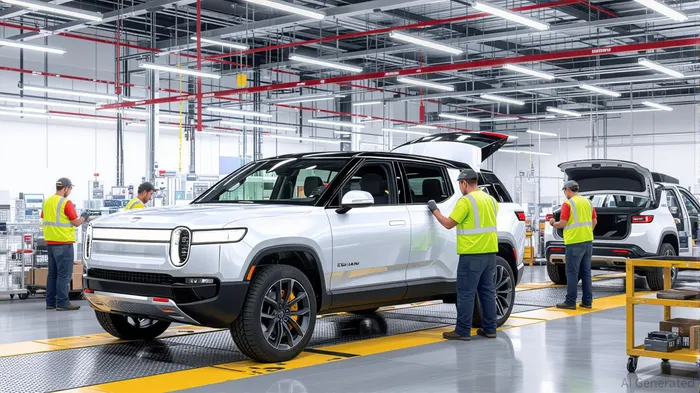
Rivian’s decision to lay off 225 employees (1.5% of its workforce) in the U.S. and Canada, coupled with a temporary shutdown of its Normal, Illinois factory to install a new assembly line for the R2, underscores its commitment to streamlining operations [1]. These measures, while disruptive, reflect a broader industry trend of cost rationalization. According to a report by BloombergNEF, automakers globally are prioritizing operational efficiency as EV margins shrink amid rising material costs and supply chain volatility [4]. Rivian’s restructuring also includes a financial partnership with Volkswagen Group, which could inject $5 billion into the company and accelerate technology development [5]. This collaboration, however, is not without risks; Rivian’s reliance on Volkswagen’s scale may dilute its brand identity, a concern for investors accustomed to its “adventure vehicle” positioning.
The R2: A Make-or-Break Bet on Mass Market Appeal
The R2 SUV, priced at $45,000, represents Rivian’s most aggressive foray into mainstream consumer markets. Analysts at Needham highlight the R2’s potential to expand Rivian’s customer base, directly competing with the TeslaTSLA-- Model Y and FordF-- Mustang Mach-E [1]. The vehicle’s projected 50% lower production costs compared to the R1 lineup—a result of second-generation design improvements and sourcing efficiencies—could enable Rivian to achieve positive gross margins for the first time [3]. However, production scalability remains a critical hurdle. Rivian’s Illinois plant, with an annual capacity of 155,000 units, may struggle to meet demand in 2026, particularly if the Georgia plant, expected to boost output, is delayed until 2028 [1].
Financial Performance and Industry Headwinds
Rivian’s third-quarter 2024 results underscore the urgency of its transformation. The company reported a $1.1 billion net loss and a 35% revenue decline to $874 million, attributed to production disruptions and a shortage of components in its Enduro motor system [2]. While the firm anticipates modest positive gross profit by late 2024, its 2025 delivery guidance (40,000–46,000 units) falls short of 2024’s 51,579 units, signaling a contraction in growth [1]. The expiration of the $7,500 federal tax credit—a policy shift that could cost Rivian up to $100 million in regulatory credits—further complicates its financial outlook [1].
The broader EV market is also grappling with macroeconomic headwinds. Rising interest rates and inflation are dampening consumer demand for discretionary purchases, while trade tensions over Chinese EVs and tariffs threaten global supply chains [5]. In this context, Rivian’s ability to differentiate itself through innovation—such as its adventure-oriented branding and partnerships—will be crucial.
Long-Term Competitiveness: Opportunities and Risks
Rivian’s strategic bets hinge on three key factors:
1. Cost Efficiency: The R2’s lower price point and production costs position it to capture price-sensitive consumers, a segment critical for long-term profitability.
2. Regulatory Navigation: The company’s restructuring and partnership with Volkswagen may mitigate risks from policy shifts, though regulatory uncertainty—such as potential changes to California’s emissions standards—remains a wildcard [2].
3. Market Expansion: Analysts project the R2 could unlock European and emerging markets, where Rivian’s brand equity is currently limited [1].
However, Rivian faces stiff competition. Tesla’s dominance in the midsize SUV segment, coupled with legacy automakers like GMGM-- and Ford accelerating their EV transitions, means the R2 must achieve rapid scale to justify its investment.
Conclusion: A High-Stakes Transition
Rivian’s operational restructuring and R2 launch represent a calculated gamble to survive and thrive in a post-subsidy EV landscape. While the company’s cost-cutting measures and strategic partnerships address immediate financial pressures, its long-term success will depend on executing a flawless R2 rollout and scaling production without sacrificing margins. For investors, the R2’s performance in 2026 will be a litmus test for Rivian’s ability to evolve from a niche player to a mass-market contender.
Source:
[1] Rivian Lays Off 225 Workers in U.S., Canada [https://www.auto123.com/en/news/rivian-layoffs-slowdown-electric-tax-credits/73167/]
[2] Rivian reports $1.1 billion Q3 net loss after sales slide [https://www.autonews.com/rivian/an-rivian-reports-q3-earnings-after-sales-production-struggles/]
[3] 99.2 [https://www.sec.gov/Archives/edgar/data/1874178/000187417824000061/ex-9923q24shareholderletter.htm]
[4] EV Market Forecast: Top Trends for EVs in 2025 [https://www.nasdaq.com/articles/ev-market-forecast-top-trends-evs-2025]
[5] Rivian [https://www.thetruthaboutcars.com/category/reviews/rivian/]





Comentarios
Aún no hay comentarios