
Rivian's Strategic Positioning for the R2 Launch and AI Expansion in 2026: A Dual-Track Approach to Electrification and Industrial AI
The R2: A Gateway to Mainstream Electrification
Rivian's R2, a mid-sized SUV priced at approximately $45,000, represents a calculated pivot toward affordability and accessibility. According to an Electric Vehicles.com report, the R2 will feature a next-generation battery using LG-sourced 4695 cylindrical cells, offering six times the energy capacity of the R1's 2170 cells. This advancement not only supports a 300-mile driving range but also enables bidirectional charging via a proprietary Energy Management Control Module, allowing the vehicle to power an entire home, the same report adds.
Production infrastructure is already in place to scale this vision. RivianRIVN-- has completed a 1.1 million-square-foot Body Shop and General Assembly Building, alongside a 1.2 million-square-foot Supplier Park, to streamline R2 production, according to a Newsable report. The new Georgia plant is expected to add 400,000 annual units of capacity, further underscoring the company's commitment to volume growth, the same report notes. With validation builds slated for late 2025 and deliveries beginning in early 2026, the R2 is positioned to become Rivian's most commercially viable model yet, the report concludes.
Mind Robotics: Pioneering Industrial AI
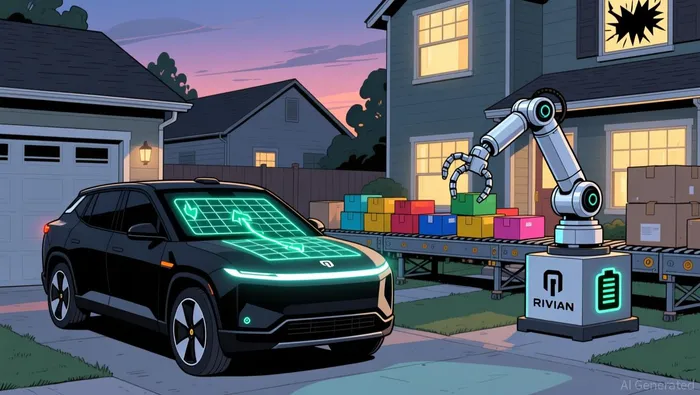
While the R2 targets consumer markets, Rivian's foray into industrial AI through Mind Robotics aims to unlock entirely new revenue streams. As stated by the company in a recent announcement, Mind Robotics-a $110 million seed-funded venture-will leverage Rivian's operational data to build a "robotics data flywheel," integrating autonomous driving and physical AI technologies. This initiative aligns with broader industry trends, as manufacturers increasingly adopt AI to optimize logistics, inventory management, and automation.
The strategic rationale is clear: Rivian's expertise in autonomous systems for its R1 and R2 models provides a foundation for industrial robotics. By creating a standalone entity, the company can pursue partnerships and innovations without diluting its core automotive business. This move also diversifies Rivian's value proposition, positioning it as both an EV manufacturer and a provider of AI-driven operational solutions.
Synergies and Financial Backing
Rivian's dual-track strategy is further bolstered by its partnership with Volkswagen, which has committed $2.5 billion in capital support, including $2 billion in 2026, the Newsable report says. This funding will accelerate R2 production and underpin Mind Robotics' development, mitigating financial risks during the critical scaling phase. Additionally, the R2's lower-cost architecture-refactored from the R1's performance and utility-ensures profitability even at higher volume, the same report adds.
The Volkswagen alliance also provides access to global markets, with the R2 likely to be co-developed for European and Asian consumers. This international reach, combined with the R2's V2H capabilities, positions Rivian to tap into the growing "energy vehicle" niche, where EVs serve as mobile power sources for homes and businesses.
Long-Term Growth Potential
For investors, the key question is whether Rivian can execute on both fronts without overextending. The R2's affordability and infrastructure investments suggest a focus on unit economics and market share, while Mind Robotics offers high-margin opportunities in industrial AI. Together, these initiatives create a flywheel effect: data from the R2's operations can refine AI algorithms, and AI advancements can, in turn, enhance autonomous driving and manufacturing efficiency.
However, risks remain. The EV market is highly competitive, and Rivian's premium R1 models have yet to achieve profitability. The success of the R2 will depend on its ability to differentiate itself from Tesla's Model Y and Ford's Mustang Mach-E. Meanwhile, industrial AI is still an unproven revenue stream, requiring significant R&D and customer adoption.
Conclusion
Rivian's 2026 strategy represents a bold repositioning. By launching the R2 and spinning off Mind Robotics, the company is betting on two of the most transformative forces of the 21st century: electrification and artificial intelligence. For long-term investors, the challenge is to assess whether Rivian can balance these ambitions with financial discipline. If successful, the company could emerge not just as an EV pioneer but as a leader in the next industrial revolution.





Comentarios
Aún no hay comentarios