
Rivian's Strategic Pivot to Level 4 Autonomy and Robotaxi Potential: A Long-Term Investment Thesis
Rivian Automotive has emerged as a bold challenger in the autonomous mobility sector, leveraging cutting-edge AI, custom silicon, and vertical integration to position itself at the forefront of Level 4 autonomy and robotaxi innovation. As the global robotaxi market is projected to reach $100 billion by 2035, Rivian's strategic investments in hardware, software, and data-driven learning could unlock significant long-term value for investors.
Technological Innovation: Building a Self-Driving Ecosystem
Rivian's 2025 "Autonomy & AI Day" revealed a roadmap centered on a custom-designed 5nm chip, the RivianRIVN-- Autonomy Processor (RAP), which powers its third-generation Autonomy Compute Module (ACM3) and supports an end-to-end Large Driving Model (LDM). This AI-centric approach mirrors the training methodologies of large language models, enabling continuous improvement through real-world data. 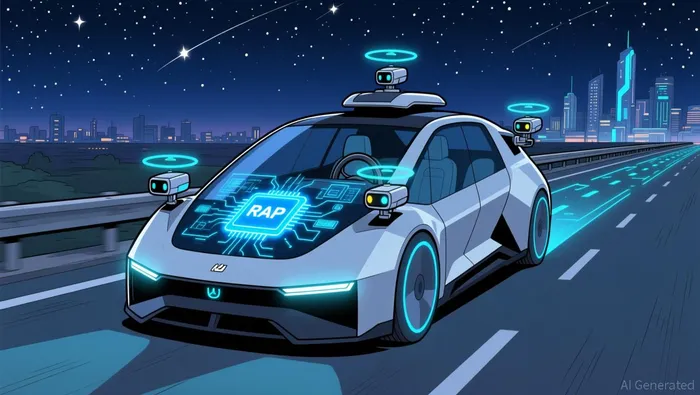 By 2026, the LDM aims to enable "Universal Hands-Free" driving on over 3.5 million miles of roads in North America, covering most marked U.S. roads.
To achieve Level 4 autonomy-fully automated driving under specific conditions-Rivian is integrating lidar and radar into its upcoming R2 models, set for late 2026. These sensors complement its existing camera-based system, providing 3D spatial data for enhanced object detection. This multi-sensor strategy aligns with industry best practices, as seen in Waymo's operations, and positions Rivian to compete with Tesla's FSD and Waymo's driverless networks.
Market Positioning: Competing with Giants, Pricing for Growth
Rivian's Autonomy+ subscription service, priced at $2,500 upfront or $49.99/month, offers a cost-effective alternative to Tesla's $8,000 FSD package. This pricing strategy could accelerate adoption, particularly as Rivian's Universal Hands-Free feature launches in early 2026. The company's CEO, RJ Scaringe, has hinted at future partnerships in the rideshare space, suggesting potential expansion into robotaxi services. While no formal collaborations have been announced, Rivian's custom 5nm chip, developed in partnership with Arm and TSMC, ensures hardware scalability for both personal and shared mobility applications.
The robotaxi market is highly competitive, with Waymo already operating in 10 cities and Tesla planning a June 2026 launch. However, Rivian's vertical integration-building in-house hardware, software, and AI models-reduces reliance on third-party suppliers and could lower long-term costs. Analysts note that Rivian's data flywheel, where improved autonomy features drive higher subscription revenue, could create a self-reinforcing growth cycle.
Financials and Strategic Risks
Rivian's Q3 2025 financial results showed a 78% year-over-year revenue increase, driven by automotive sales and software/services revenue. For 2026, analysts project revenue of $6.87 billion, fueled by the R2 SUV's lower price point and higher production volumes. The R2 is critical to Rivian's margin expansion and market share gains, particularly against Tesla's Model Y.
However, risks remain. Rivian's in-house autonomy stack development, while ambitious, lacks third-party supplier support, increasing R&D costs and technical hurdles. Additionally, the robotaxi market is crowded, with Chinese firms like WeRideWRD-- and Baidu Apollo Go also scaling rapidly. Rivian must execute its 2026 timelines flawlessly to avoid falling behind competitors.
Long-Term Investment Potential
Rivian's strategic pivot to software-defined vehicles and AI-driven autonomy aligns with the broader shift toward autonomous mobility. Its Universal Hands-Free feature, combined with a recurring revenue model via Autonomy+, could generate high-margin growth. If Rivian successfully transitions to Level 4 autonomy by 2026, it may capture a niche in both personal and shared mobility, particularly in North America.
For investors, Rivian represents a high-risk, high-reward opportunity. The company's ability to scale its AI and hardware innovations, secure partnerships, and navigate regulatory hurdles will determine its long-term success. As the robotaxi race intensifies, Rivian's vertical integration and aggressive timelines position it as a compelling contender in the autonomous mobility sector.





Comentarios
Aún no hay comentarios