
Rivian's Strategic Momentum in EV Innovation and Market Share Gains
In the high-stakes arena of electric vehicles, where innovation and execution are the twin engines of success, RivianRIVN-- has carved out a unique niche. The company's recent trajectory—marked by disciplined R&D spending, strategic partnerships, and a bold product roadmap—offers a compelling case study in how operational resilience and technological differentiation can drive long-term value. For investors, the question is not just whether Rivian can survive the EV sector's turbulence but whether it can thrive as a leader in a market still in its infancy.
The R&D Paradox: Efficiency Without Compromise
. Instead, it has shifted from exploratory spending to optimizing existing platforms. This pivot is evident in the development of the R2 and R3 models, which are designed to be more affordable and scalable than the R1T and R1S. The R2, , targets the mass-market segment, a critical battleground for EV adoption. By leveraging shared software-defined architectures and modular platforms, Rivian is reducing per-unit costs while maintaining its signature adventure-centric design.
The company's partnership with Volkswagen Group, formalized in November 2024, amplifies this strategy. The joint venture, Rivian and Volkswagen Group Technologies, combines Rivian's software expertise with Volkswagen's manufacturing scale. This collaboration is not just about cost-sharing; it's about creating flexible, global platforms that can adapt to diverse markets. For investors, this partnership signals a shift from a niche player to a strategic innovator with cross-industry credibility.
Operational Resilience: From Cost-Cutting to Profitability
Rivian's operational adjustments in 2024–2025 have been as transformative as its product strategy. . More importantly, .
, . These funds are being directed toward the Georgia plant, . Rivian's ability to balance cost efficiency with capital investment is a testament to its operational rigor, a rare combination in the EV sector.
Charging the Future: Infrastructure as a Differentiator
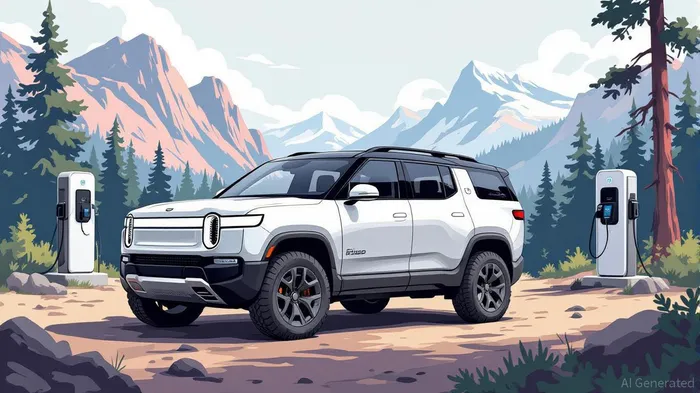
While many EV companies focus on vehicles, Rivian has doubled down on infrastructure. , . This network, strategically located in national parks and remote trails, aligns with Rivian's brand identity and addresses a key pain point for EV adoption: range anxiety in off-road and rural settings.
Adopting Tesla's North American Charging Standard (NACS) further enhances Rivian's infrastructure appeal. By enabling access to , Rivian is addressing interoperability concerns and broadening its customer base. For investors, this move is a signal of pragmatism—Rivian is no longer just competing on product but on ecosystem.
The Road Ahead: Risks and Opportunities
Despite its momentum, Rivian faces headwinds. Supply chain disruptions and production delays remain risks, particularly as it scales the R2 and R3. The EV market is also becoming increasingly crowded, with TeslaTSLA--, FordF--, and legacy automakers accelerating their software-defined strategies. However, Rivian's partnerships, particularly with Volkswagen, provide a buffer against these challenges. The joint venture's focus on modular platforms and AI-driven autonomy (via the Rivian Large Driving Model) positions the company to stay ahead of the curve.
Investment Thesis: A Long-Term Play
For long-term investors, Rivian represents a blend of innovation and operational discipline. Its R&D-driven differentiation—particularly in software-defined vehicles and charging infrastructure—creates a moat in a sector where commoditization is a risk. The company's strategic partnerships and cost-efficient scaling further enhance its resilience.
However, patience is key. Rivian's path to profitability is not linear; it requires navigating production bottlenecks and market volatility. Investors should monitor its ability to meet R2 production targets and sustain gross margins as it scales. Those willing to ride out the near-term noise may find themselves positioned for a significant upside as Rivian's mass-market strategy gains traction.
In the end, Rivian's story is not just about building electric trucks and SUVs. It's about redefining what an EV company can be—part technologist, part infrastructure builder, and part ecosystem architect. For investors with a multi-year horizon, the question is not whether Rivian can win, but whether they can afford to ignore it.





Comentarios
Aún no hay comentarios