
Is Rivian's Recent Stock Decline a Strategic Entry Point Amid AI and R2 Launch Catalysts?
The recent volatility in Rivian AutomotiveRIVN-- (RIVN) shares has sparked debate among investors about whether the decline represents a contrarian opportunity. With the company navigating a challenging EV sector while advancing ambitious technological and product roadmaps, the question of value hinges on balancing near-term risks against long-term innovation potential.
A Volatile December and Catalysts for Reassessment
Rivian's stock price in December 2025 exhibited sharp swings, closing at $19.71 on December 31 after peaking at $22.45 on December 19. A reported 8.54% drop in late December was attributed to manufacturing delays and recalls, which temporarily eroded investor confidence. However, the company's proactive over-the-air fixes and transparent communication mitigated some of the fallout. This volatility underscores the stock's sensitivity to execution risks but also highlights its potential for rebound amid positive catalysts.
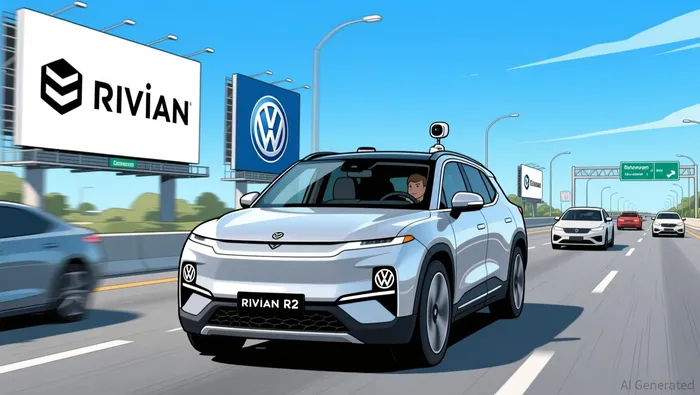
One such catalyst is the R2 SUV, slated for delivery in the first half of 2026. Priced at $45,000 (with production costs targeting $32,000 via a 50/50 joint venture with Volkswagen), the R2 aims to democratize Rivian's brand and expand its market share. Analysts project that the R2 could reduce Rivian's cost of goods sold by 45%, positioning it to compete more effectively in the mass-market EV segment.
AI and Autonomy: A Differentiation Play
Rivian's strategic focus on AI and autonomy further strengthens its long-term appeal. In Q3 2025, the company announced an event dedicated to Autonomy & AI, where it unveiled a custom RivianRIVN-- Autonomy Processor and an affordable autonomous driving subscription package. These developments align with broader industry trends, as AI-driven features become critical differentiators in a maturing EV market.
The company's investment in AI also addresses a key sector-wide challenge: cybersecurity in connected vehicles. By integrating advanced autonomy systems, Rivian is positioning itself to meet regulatory demands and consumer expectations for safer, smarter vehicles. This technological edge could prove invaluable as the EV sector evolves.
Financial Realities and Sector Headwinds
Despite these positives, Rivian's financials remain a cause for caution. The company reported a Q3 2025 P/E ratio of -$6.7, reflecting continued losses. Year-to-date, Rivian's free cash flow burned $421 million, with capital expenditures reaching $447 million. Total debt climbed to $5.74 billion by late 2025, while cash reserves fell to $5.29 billion from $7.86 billion in 2024. These metrics highlight liquidity pressures and operational inefficiencies.
Contrarian Case for Value
For contrarian investors, Rivian's challenges may represent a buying opportunity. The stock's beta of 1.796 indicates high volatility, but this also means sharp corrections could precede significant rebounds if the company executes its roadmap. Analysts remain split, with 33% recommending a "Buy" and 52% a "Hold," suggesting a range of views on its potential.
Rivian's joint venture with Volkswagen and its AI-driven innovation provide a foundation for long-term growth. If the R2 achieves its cost and demand targets, it could catalyze a shift from losses to profitability. Projections indicate net income could narrow from -$4.75 billion in 2024 to -$0.73 billion by 2029, hinting at a path to sustainability.
Risks and Final Considerations
The key risks include execution delays for the R2, intensifying competition from Tesla, BYD, and legacy automakers, and sector-wide demand stagnation. Rivian's reliance on tax incentives and its high cash burn rate further complicate its trajectory.
However, for investors with a multi-year horizon, Rivian's strategic bets on AI, autonomy, and mass-market electrification could pay off. The recent stock decline, while painful, may offer an entry point to capitalize on these long-term themes-provided the company can navigate its near-term hurdles.





Comentarios
Aún no hay comentarios