
Rivian's R2 SUV and Its Role in the EV Recovery Narrative
The electric vehicle (EV) market in 2026 is at a pivotal inflection point, marked by shifting investor sentiment, intensifying competition, and the post-tax-credit reality of consumer demand. For RivianRIVN--, a company once hailed as a disruptor but later scrutinized for its financial sustainability, the launch of the R2 SUV represents a critical opportunity to reassert its position in the EV recovery narrative. This analysis evaluates whether Rivian can regain investor confidence and market share through the R2's product diversification and strategic positioning, drawing on recent financial performance, competitive dynamics, and industry trends.
The R2: A Strategic Pivot to Affordability
Rivian's R2 SUV, set to debut in the first half of 2026, is a midsize electric vehicle priced at $45,000-a-stark departure from the brand's premium R1 lineup according to pricing details. This pricing strategy directly targets the midprice EV segment, where Tesla currently dominates with approximately 50% market share. The R2's specifications-ranging from a single-motor rear-wheel-drive configuration to a tri-motor AWD variant capable of 0–60 mph in under 3.0 seconds-underscore its versatility for both urban and off-road use. Additionally, the vehicle's compatibility with both CCS and NACS (Tesla-based) charging standards positions it as a pragmatic choice for a broad consumer base.
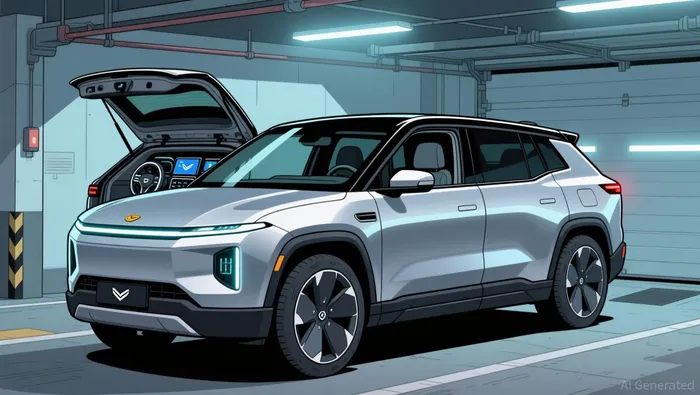
The R2's design also reflects Rivian's commitment to innovation, featuring a powered rear window that retracts into the tailgate and a dual-glovebox interior layout. These features, combined with a projected range of over 300 miles per charge, aim to differentiate the R2 from competitors like the Toyota bZ XLE and Honda Prologue. By producing the R2 at its Normal, Illinois, facility, Rivian is also leveraging economies of scale to improve gross margins, a critical factor in its financial recovery.
Investor Confidence: A Fragile but Growing Narrative
Rivian's stock has surged by over 41% year-to-date in 2025, trading near a two-year high, driven by improved financial metrics and strategic partnerships. The company's Q3 2025 earnings report marked a milestone: its first-ever consolidated gross profit of $24 million, signaling a shift toward profitability. A $5.8 billion investment from Volkswagen has further extended Rivian's cash runway to 2028, while providing access to engineering expertise for zonal architecture integration into future Audi and Scout models according to investor reports. Analysts like Wedbush's Dan Ives have labeled 2026 an "inflection year" for Rivian, citing its pivot to software-driven revenue through the RAP1 AI chip and "Autonomy+" subscription service.
However, challenges persist. Despite Q3's 78% year-over-year sales growth, Rivian still reported a $1.2 billion loss and $421 million in negative free cash flow according to financial data. The expiration of federal EV tax credits in September 2025 has created a "demand cliff," forcing Rivian to compete on product merit and cost efficiency rather than incentives. While the company's sales rose 14.1% from October 2025 and 7.6% year-over-year in November 2025, it remains a distant second to TeslaTSLA--, which captured 56.7% of new EV sales in the same period.
Competitive Positioning: Navigating a Crowded Market
Rivian's R2 is designed to counter Tesla's dominance in the midprice segment, where the Model Y and other offerings hold a commanding position. CEO RJ Scaringe has acknowledged that the U.S. EV market lacks supply-side diversity, a gap the R2 aims to fill. Unlike Ford and other automakers that have scaled back EV investments in favor of hybrids, Rivian is doubling down on innovation. Its zonal architecture system-reducing electronic control units and wiring-has already attracted $1 billion in equity from Volkswagen and improved manufacturing efficiency.
The R2's higher-volume production is expected to spread fixed costs across more units, further enhancing gross margins. This strategy contrasts with Tesla's vertical integration model and Ford's hybrid pivot, positioning Rivian as a mid-tier innovator with a unique value proposition. However, the R2's success hinges on its ability to scale production without compromising quality, a challenge that has plagued EV startups historically.
Risks and the Road Ahead
While the R2 represents a strategic leap forward, Rivian faces significant risks. The post-tax-credit environment has intensified pricing pressure, and the company's recent financial losses highlight its vulnerability to market volatility. Additionally, the EV market's overall share has declined to 5.4% of total new vehicle sales in November 2025, reflecting broader industry headwinds. Rivian's reliance on software-driven revenue-while innovative-also introduces uncertainty, as consumer adoption of subscription models remains unproven at scale.
Conclusion: A Calculated Bet on Recovery
Rivian's R2 SUV is more than a product launch; it is a calculated bet on the company's ability to diversify its offerings, improve financial resilience, and capture a larger share of the midprice EV market. With its competitive pricing, innovative design, and strategic partnerships, the R2 has the potential to bolster investor confidence and drive sales growth. However, Rivian's success will depend on its ability to execute on production scalability, maintain cost efficiency, and differentiate itself in a market increasingly dominated by Tesla and traditional automakers. For investors, the R2 represents a pivotal chapter in Rivian's EV recovery narrative-one that could either solidify its position as a mid-tier innovator or expose the limits of its long-term strategy.





Comentarios
Aún no hay comentarios