
Is Rivian Poised for a Breakout in 2026 with the R2 Launch?
The electric vehicle (EV) market, once a beacon of unbridled optimism, has entered a phase of recalibration. For companies like RivianRIVN--, the path to sustained growth now hinges on navigating execution risks, technological differentiation, and shifting consumer dynamics. As the company prepares to launch its R2 model in early 2026, the question of whether this midsize SUV can catalyze a breakout year demands a rigorous assessment of Rivian's strategic bets, financial resilience, and competitive positioning.
Growth Potential: The R2 as a Strategic Pivot
Rivian's R2 represents a calculated pivot toward mass-market accessibility. Priced at approximately $45,000, the R2 is designed to bridge the gap between the company's premium R1T and R1S models and a broader consumer base according to Matrix BCG. This positioning aligns with a critical industry trend: the shift toward more affordable EVs as demand for luxury-priced models plateaus. By targeting a segment with higher volume potential, Rivian aims to replicate the success of Tesla's Model 3, which has long been its best-selling vehicle.
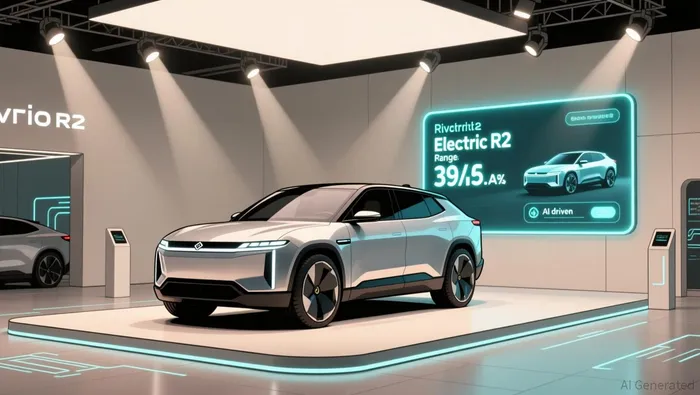 The production roadmap further underscores this ambition. Initial manufacturing will occur at Rivian's Illinois facility, with output expected to transition to a new Georgia plant by 2028. This facility, capable of producing 400,000 vehicles annually, signals a long-term commitment to scaling production. Complementing the R2, the R3 and R3X variants-slated for 2027-will further diversify Rivian's portfolio, targeting compact and performance-oriented segments.
Beyond hardware, Rivian's investment in AI and software monetization adds another layer of growth potential. The company's in-house Rivian Autonomy Processor (RAP1) and voice-activated AI assistant are designed to generate recurring revenue through subscriptions and licensing. This strategy mirrors Tesla's approach to software-driven margins, though Rivian's focus on Level-4 autonomy and vertical integration could carve out a unique niche.
Financial Health: A Mixed Picture
Rivian's 2025 financial results reveal both progress and vulnerabilities. In Q3 2025, the company reported $1.6 billion in revenue and a narrower-than-expected loss of $0.65 per share, driven by 13,201 vehicle deliveries. These figures, while positive, were overshadowed by a 5.23% stock decline in after-hours trading, reflecting investor skepticism about long-term profitability.
The fourth quarter, however, exposed significant headwinds. Deliveries fell 31% year-over-year to 9,745 units, partly due to demand being pulled into Q3. For the full year, Rivian delivered 42,247 vehicles, down from 51,579 in 2024. This decline highlights the fragility of demand in a market where incentives have historically driven adoption.
Despite these challenges, Rivian's balance sheet remains robust. The company ended Q3 2025 with $7.1 billion in cash, bolstered by a $6.6 billion loan from the U.S. Department of Energy in November 2024 and a $1 billion investment from Volkswagen Group in 2025 according to company disclosures. Over the past decade, Rivian has raised $10.5 billion in total funding, providing a financial buffer for R&D and production scaling. However, the path to profitability remains uncertain, particularly as the R2's cost structure and pricing strategy will need to balance affordability with margin preservation.
Competitive Positioning: Innovation vs. Execution Risks
Rivian's strategic partnerships and technological investments position it as a formidable player in the EV arms race. The $5.8 billion joint venture with Volkswagen Group is a cornerstone of this strategy, offering access to supply-chain expertise and cumulative cost savings of over $2.25 billion by 2026. This collaboration also accelerates the development of next-generation platforms, aligning with Rivian's long-term innovation goals.
The company's focus on AI and autonomy further differentiates it from competitors. The RAP1 chip and software-defined platform are designed to enable Level-4 autonomy, a feature that could attract tech-savvy consumers and fleet operators. Rivian's voice-activated AI assistant, meanwhile, hints at a broader vision for in-vehicle digital ecosystems-a space where Tesla and traditional automakers are also vying for dominance.
Yet, Rivian faces stiff competition from Tesla, Ford, and General Motors, all of which are expanding their product lines and refining cost structures. The expiration of federal tax credits in 2025 has also intensified pricing pressures, forcing Rivian to balance accessibility with profitability. Additionally, scaling production to meet R2 demand will require overcoming operational hurdles, including supply-chain bottlenecks and quality-control challenges.
Conclusion: A Calculated Bet on 2026
Rivian's R2 launch represents a pivotal moment in its journey. The vehicle's affordability, combined with the company's AI-driven monetization strategy and strategic partnerships, creates a compelling value proposition. However, the path to a breakout year is fraught with risks, including slowing EV demand, execution challenges, and a fiercely competitive landscape.
For investors, the key question is whether Rivian can translate its technological ambition into sustainable profitability. The R2's success will depend not only on its ability to attract price-sensitive buyers but also on Rivian's capacity to optimize production costs and leverage software-driven margins. If the company can navigate these challenges while maintaining its innovation edge, 2026 could indeed mark a turning point. But in a market where execution often trumps vision, the stakes have never been higher.





Comentarios
Aún no hay comentarios