
Rivian's Custom AI Chip and L4 Autonomy: A Strategic Path to Outpace Tesla and Capture the Future of Mobility
The race for autonomous driving dominance is intensifying, with Rivian AutomotiveRIVN-- emerging as a formidable challenger to Tesla's entrenched Full Self-Driving (FSD) system. By leveraging a vertically integrated AI-driven autonomy strategy, RivianRIVN-- is positioning itself to redefine the future of mobility. This analysis evaluates how Rivian's RAP1 AI chip, lidar integration, and data flywheel model could catalyze long-term value creation in the EV and robotaxi markets, while challenging Tesla's vision-based approach.
RAP1: A Quantum Leap in AI Hardware
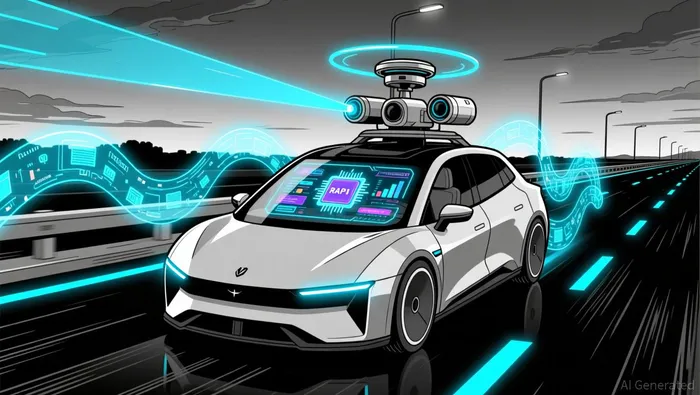
Rivian's custom RAP1 chip represents a pivotal innovation in autonomous driving hardware. With a processing power of 800 trillion calculations per second-50 times greater than its predecessor-the RAP1 enables real-time handling of 5 billion pixels per second, surpassing Tesla's current FSD hardware in computational throughput. While Tesla's FSD system relies on a vision-based architecture with eight cameras, Rivian's multimodal sensor suite includes 11 cameras, five radar sensors, and a single lidar, providing richer spatial data for edge-case detection. This sensor fusion approach, combined with RAP1's 5nm architecture, positions Rivian to achieve SAE Level 4 autonomy more reliably than Tesla's camera-centric model, which critics argue may struggle in low-light or adverse weather conditions.
Lidar Integration: A Strategic Differentiator
Rivian's decision to incorporate lidar into its autonomy stack directly counters Tesla's long-standing rejection of the technology. CEO RJ Scaringe has emphasized lidar's role in providing "three-dimensional spatial data and redundant sensing," which is critical for achieving L4 autonomy. Unlike Tesla's neural networks trained on camera data alone, Rivian's Large Driving Model (LDM)-a generative AI system trained on real-world driving data-benefits from lidar's precise ground-truth measurements, enhancing its ability to predict and respond to complex driving scenarios. Analysts note that lidar adoption is accelerating in L4 robotaxi applications, with sensor fusion becoming a dominant strategy for safety and reliability according to market research. Rivian's early commitment to lidar integration thus creates a hardware differentiation that could outpace Tesla's vision-only roadmap.
Data Flywheel: Training for the Long Haul
Rivian's data flywheel model is another cornerstone of its autonomy strategy. By collecting and processing data from its sensor-rich vehicles, Rivian aims to iteratively refine its LDM, mirroring the training methodologies of large language models. This approach contrasts with Tesla's fleet-learning model, which prioritizes scalability but may lack the granular data richness of lidar-enhanced datasets. Rivian's AI-centric platform, Rivian Unified Intelligence (RUI), further integrates third-party apps and models, creating an ecosystem that could attract developers and partners. The company's emphasis on underpromising and overdelivering-evidenced by its phased rollout of Universal Hands-Free (UHF) and "eyes-off" driving-builds trust with consumers and regulators, a critical factor in scaling autonomous systems.
Financial and Market Strategy: Pricing Power and Scalability
Rivian's Autonomy+ subscription model, priced at $49.99/month or $2,500 upfront, offers a more affordable alternative to Tesla's $99/month FSD subscription according to reports. While the market initially reacted skeptically to Rivian's AI Day announcements-its stock dropped post-event-the company's Q3 2025 financials showed resilience, with 78% year-over-year revenue growth and a $24 million gross profit. Rivian's vertically integrated approach, including its Georgia manufacturing expansion and proprietary RAP1 chip, reduces reliance on third-party suppliers, enhancing margins and scalability. By 2026, the company aims to launch its R2 model with built-in autonomy hardware, enabling a seamless transition to robotaxi services by 2030 according to strategic analysis.
Robotaxi Ambitions and Long-Term Value Creation
While TeslaTSLA-- has a head start in autonomous driving, Rivian's second-mover advantage lies in its ability to learn from past mistakes and adopt cutting-edge AI. The company's roadmap includes "hands-off everywhere" driving by 2028 and point-to-point navigation by 2030, with potential ride-sharing integration by 2029 according to CEO projections. Deutsche Bank analysts project that Rivian's Universal Hands-Free system will launch in 2026, positioning it to capture a significant share of the robotaxi market according to market analysis. Unlike Tesla's focus on fleet-based learning, Rivian's sensor fusion and lidar-driven data flywheel could enable safer, more adaptable systems for diverse environments, from urban streets to off-road terrains according to industry experts.
Conclusion: A New Era of Autonomy
Rivian's vertically integrated AI-driven strategy-centered on RAP1, lidar, and a data flywheel-positions it to outpace Tesla in the race for L4 autonomy. By combining hardware innovation with a conservative, safety-first rollout, Rivian is building a foundation for long-term value creation in the EV and robotaxi markets. While Tesla's vision-based FSD remains a formidable competitor, Rivian's multimodal approach addresses critical limitations in edge-case detection and environmental adaptability. As the industry shifts toward sensor fusion and AI-driven autonomy, Rivian's strategic bets could redefine the future of mobility-and its stock price may yet reflect that potential.





Comentarios
Aún no hay comentarios