
Rivian’s Crossroads: Tariffs, Tactics, and the Road to Resilience
Rivian Automotive has entered a pivotal phase in its evolution, as the electric vehicle (EV) startup slashed its 2025 delivery targets by 10% to 40,000–46,000 units—a stark acknowledgment of how global trade policies and economic headwinds are reshaping its trajectory. The revision, announced in Q1 2025, underscores the fragility of Rivian’s growth story amid escalating costs, supply chain disruptions, and a demand environment increasingly sensitive to price.
The Delivery Dilemma: Costs and Constraints
Rivian’s revised outlook reflects a reality where external forces now loom larger than internal execution. In Q1, the company delivered just 8,640 R1S and R1T vehicles—a 12% sequential drop—attributed to a shortage of Enduro motor components that began in late 2024. While this supply chain hiccup played a role, the deeper issue lies in the $2,000–$3,000 per-vehicle cost burden imposed by U.S. tariffs on imported components like battery cells, semiconductors, and rare earth magnets. These tariffs, largely a legacy of the Trump administration’s trade wars, have eroded Rivian’s profit margins even as it slashed automotive costs by $22,600 per vehicle year-over-year.
The Tariff Trap: How Global Policies Are Stifling Growth
The tariffs’ impact is multifaceted. While Rivian manufactures all vehicles in the U.S., its reliance on non-USMCA components—including LG Energy Solution’s South Korean battery cells—leaves it exposed. CEO R.J. Scaringe estimates these costs add roughly $5,000 to each vehicle’s total price, a burden that trickles down to consumers. For a brand whose flagship R1T pickup starts at $69,900 and R1S SUV at $75,900, this pricing pressure is untenable in an era of economic caution.
Worse, the supply chain risks are compounding. China’s export restrictions on rare earth minerals—a critical input for EV batteries—threaten to disrupt Rivian’s long-term plans. Though the company has stockpiled battery cells until 2027, it remains at the mercy of geopolitical whims. This vulnerability contrasts sharply with competitors like Tesla, which has secured domestic supply chains and leveraged its scale to mitigate tariff impacts.
The Silver Lining: Strategic Partnerships and the R2 Gambit
Amid the gloom, Rivian has scored two critical wins. First, its joint venture with Volkswagen Group—secured after hitting a gross profit milestone—delivered $1 billion in funding, a lifeline for its cash reserves ($7.2 billion as of Q1). The partnership also opens doors to Volkswagen’s engineering expertise and distribution networks, particularly for the R2 SUV, which is slated for a 2026 launch.
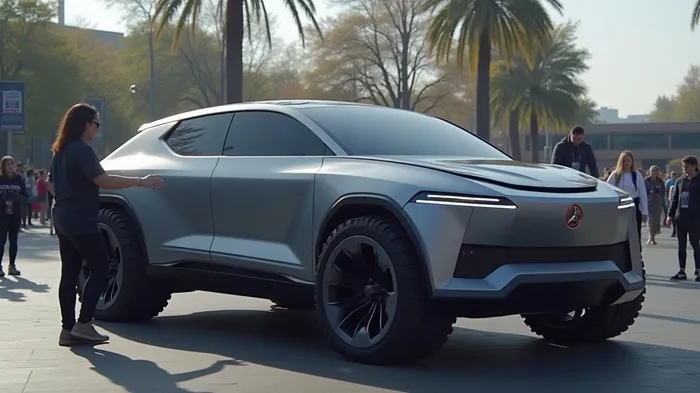
The R2, priced at $45,000, represents Rivian’s best hope for growth. By targeting a broader demographic, it could offset the premium market’s saturation and geopolitical risks. Early progress is promising: design validation builds are underway, and its Illinois factory is 50% expanded, backed by a $16 million state incentive for a supplier park. Yet delays or cost overruns here could derail the entire strategy.
The Bottom Line: Can Rivian Navigate the Storm?
Financially, Rivian remains in a precarious but improving position. Its Q1 gross profit hit $206 million—its second straight quarter of profitability—thanks to cost-cutting and software revenue (now $318 million annually). However, net losses widened to $541 million, though this marks a 63% improvement over . Free cash flow remains negative at $526 million, and capital expenditures have surged to $1.8–1.9 billion due to tariff-related logistics.
The company’s fate hinges on three variables:
1. Tariff Relief: A rollback or exemption could shave thousands off per-vehicle costs.
2. R2 Execution: Delays or underperformance here would leave Rivian overly dependent on its costly premium models.
3. Liquidity Management: Analysts warn that deliveries below 35,000 could strain cash reserves, though current levels—$7.2 billion—provide a “runway” through 2026.
Conclusion: A High-Stakes Gamble on Resilience
Rivian’s revised targets are a sobering admission of the challenges it faces. Yet, its strategic pivots—leveraging partnerships, slashing costs, and betting on the R2—suggest a path forward. If the R2 launches on time and tariffs ease, Rivian could stabilize its margins and reclaim momentum. But in a sector where execution is everything, the stakes are existential.
The numbers tell the story: a $22,600 per-vehicle cost reduction, $7.2 billion in cash, and $1 billion from Volkswagen buy time—but Rivian must turn the R2 into a runaway hit. For investors, this is a high-risk, high-reward play. The road to resilience is narrow, but for those willing to bet on Rivian’s vision, the payoff could be enormous.





Comentarios
Aún no hay comentarios