
Rivian's AI & Autonomy Day: A Strategic Leap in the EV and Autonomous Tech Race
Rivian Automotive's upcoming AI & Autonomy Day on December 11, 2025, marks a pivotal moment in the company's evolution as a leader in electric vehicles (EVs) and autonomous driving. With a roadmap that includes hands-free highway driving in 2025 and "eyes-off" capabilities by 2026, RivianRIVN-- is positioning itself as a formidable contender in the race to redefine mobility through artificial intelligence (AI) and autonomy. This analysis examines Rivian's strategic initiatives, competitive advantages, and financial commitments to determine its potential to disrupt the EV and autonomous tech markets.
Strategic Initiatives: Building a Foundation for Autonomy
Rivian's approach to autonomy is characterized by a phased rollout of features designed to incrementally enhance driver and passenger experiences. The company plans to debut a "Universal Hands Free" highway driving system in 2025, followed by an advanced "eyes-off" system in 2026 that will allow passengers to engage in activities like watching TV or sleeping during commutes according to CEO RJ Scaringe. This timeline aligns with CEO RJ Scaringe's vision of achieving full autonomy "well before 2030," emphasizing a focus on practical, consumer-oriented applications rather than speculative robotaxi systems.
Central to Rivian's strategy is its partnership with NVIDIANVDA--, which provides access to the NVIDIA DRIVE AGX™ platform for autonomous driving and RTX PRO™ GPUs for design workflows. This collaboration enables Rivian to develop photorealistic simulations and train large-scale AI models using data from its Gen 2 R1 vehicles, accelerating the refinement of its autonomy stack. Additionally, Rivian's recent opening of an AI and autonomous driving research hub in London 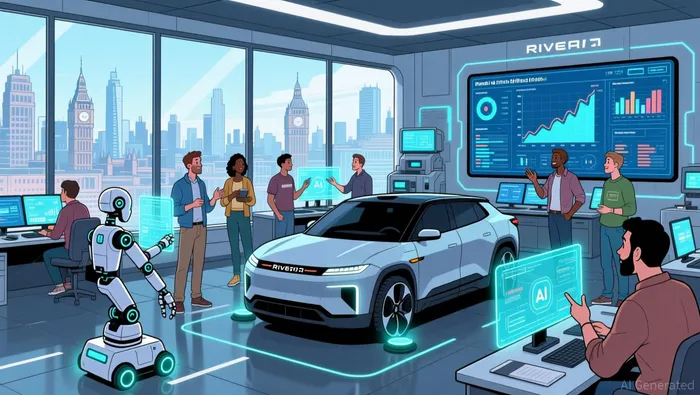 underscores its commitment to leveraging the UK's AI engineering talent to fast-track development according to company announcements.
Competitive Positioning: Differentiation in a Crowded Market
Rivian's strategy distinguishes itself from competitors like Tesla and Waymo through a dual focus on on-road and off-road autonomy. While Tesla's Full Self-Driving (FSD) system remains in supervised mode and faces regulatory scrutiny, Rivian's emphasis on rugged terrain capabilities-critical for its R1T pickup and R1S SUV-positions it to capture markets where Tesla's urban-centric approach falls short. Waymo, meanwhile, has established a foothold in Level 4 robotaxi services but relies on costly lidar technology and partnerships with automakers, which may slow deployment compared to Rivian's in-house development model.
Rivian's phased rollout also mitigates risks associated with overpromising. By prioritizing highway driving before expanding to complex urban environments, the company aligns with industry best practices for incremental autonomy adoption. This approach mirrors Waymo's cautious deployment but avoids the scalability challenges of Tesla's direct-to-consumer FSD model. Analysts note that Rivian's focus on cost efficiency-bolstered by its partnership with Volkswagen for zonal architecture-could provide a long-term edge in reducing hardware and software costs.
Financial Commitments: Balancing Investment and Profitability
Rivian's Q3 2025 financial report reveals a company aggressively investing in autonomy while navigating profitability challenges. Operating expenses for the quarter reached $1.007 billion, driven by R2 prototyping, autonomy training, and go-to-market initiatives. While the report does not specify AI/autonomy R&D spending, the company's emphasis on "end-to-end AI-centric" development and its spinoff of Mind Robotics-a $115 million-funded industrial AI venture-highlight its financial commitment to the sector.
Despite elevated costs, Rivian's revenue surged 78% year-over-year to $1.56 billion in Q3 2025, with software and services revenue growing 324% to $416 million according to Wards Auto. Analysts from Stifel have raised their price target for Rivian to $17, citing improved unit economics and software profitability as key drivers of long-term value. The company's R2 SUV, set to launch in early 2026, is expected to broaden its market reach with a more affordable price point, further supporting financial sustainability according to Electrek.
Future Outlook: Navigating Risks and Opportunities
Rivian's success in the autonomous tech space hinges on its ability to execute its roadmap while addressing regulatory and technical hurdles. The company's reliance on camera-based sensor fusion-rather than lidar-could reduce costs but may face challenges in complex environments. However, Rivian's use of fleet learning and AI-driven data training offers a scalable solution to improve performance over time according to company analysts.
Comparatively, Tesla's financial pressures and Waymo's partnership-driven model present both opportunities and risks. Rivian's balanced approach-combining strategic partnerships, in-house innovation, and a clear product roadmap-positions it to capitalize on the projected $1.4 trillion autonomous vehicle market by 2040 according to Mordor Intelligence.
Conclusion
Rivian's AI & Autonomy Day represents more than a product showcase; it is a declaration of intent to lead the next phase of mobility innovation. By leveraging NVIDIA's AI infrastructure, investing in global R&D hubs, and prioritizing cost-efficient autonomy, Rivian is building a foundation to compete with industry giants. While challenges remain, its strategic focus on incremental, consumer-centric features and a diversified financial model suggests strong growth potential in the evolving EV and autonomous tech landscape.





Comentarios
Aún no hay comentarios