
Rivian's 2026 Growth Play: 3 Reasons to Buy
Rivian's core growth thesis hinges on escaping its current niche. The company's recent delivery numbers underscore its limited scale: just 9,745 vehicles delivered in the fourth quarter of 2025. That volume, drawn almost entirely from the expensive R1T pickup and R1S SUV, is a fraction of what's needed to build a dominant automaker. The R2 SUV is the planned catalyst to change that equation.
The R2 is designed to expand Rivian's Total Addressable Market (TAM) substantially. With a starting price of $45,000, it targets the competitive mid-size SUV segment, a far broader customer base than the current R1 lineup. Needham analyst Chris Pierce captured the strategic shift, noting the R2 will "be substantially expanding RIVN's TAM (total addressable market) beyond the more expensive R1 vehicle." This isn't just a new model; it's a deliberate move to capture share in a segment dominated by established players like the Ford Mustang Mach-E and Tesla Model Y.
Wall Street's early reaction is bullish. Baird analyst Ben Kallo recently upgraded RivianRIVN-- to Outperform, citing the R2 launch as a key reason. He expects the vehicle to be a "boost for RIVN's brand, product demand, and thus by extension the stock as deliveries begin near mid-year." The company itself is signaling the importance of this launch, planning a dedicated event in early 2026 to showcase the full R2 lineup before deliveries begin in the first half of 2026.
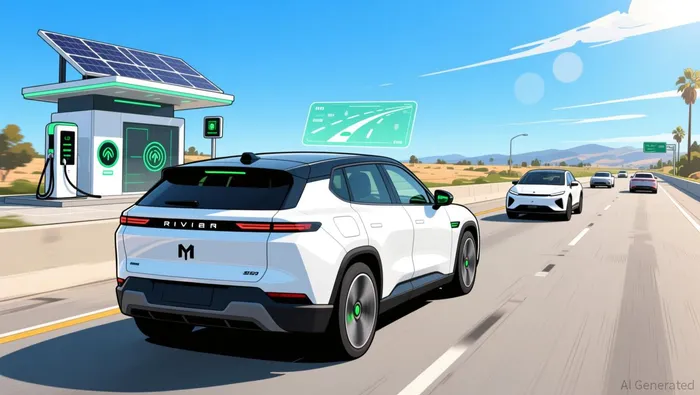
The bottom line is a clear market expansion play. Rivian is betting that a well-priced, mass-market SUV can transform its growth trajectory from a small-volume luxury brand into a scalable, volume-driven automaker. The R2 is the vehicle that will determine if that bet pays off.
Reason 2: A Scalable Software & Services Business Model
Rivian's long-term growth isn't just about selling more cars; it's about building a company where software and services drive the economics. The path to higher margins and scalability lies in its in-house technology stack, a deliberate move away from the thin margins typical of hardware-only automakers.
The centerpiece of this strategy is the Rivian Autonomy Processor 1 (RAP1) chip. By designing its own AI hardware, Rivian gains control over a critical, high-value component. This vertical integration is a key step toward a scalable software business model. The chip powers Rivian's autonomy platform, which was recently showcased at an "Autonomy & AI Day." As analyst George Gianarikas noted, the event "showcased years of development in autonomy and AI." This isn't just a feature for show; it's a foundational technology that can be monetized beyond the vehicle itself.
The company is already demonstrating this vision. A recent software update introduced "Universal Hands Free" capabilities for R1 owners, allowing hands-free driving on a vast network of roads. This service, likely delivered over-the-air, represents a direct revenue stream from software. More broadly, Rivian's long-term goal is Level 4 autonomy for its R2 vehicles, a capability that could command premium pricing and open new service markets.
Viewed another way, controlling the tech stack-from the RAP1 chip to the autonomy software-creates a moat. It allows Rivian to improve vehicle performance, reduce reliance on third-party suppliers, and, crucially, build recurring revenue streams. For a growth investor, this shift from a capital-intensive, low-margin vehicle seller to a tech-enabled mobility services company is the ultimate scalability play. The R2 SUV is the volume vehicle, but the software and autonomy platform are the engines for future profit growth.
Reason 3: Strategic Partnerships to Accelerate Scale
For a company scaling from a niche player to a mass-market automaker, execution risk is the biggest growth killer. Rivian is mitigating that risk through two powerful external alliances that provide both capital and proven scale. These partnerships are designed to accelerate the rollout of its technology and production, directly lowering the cost of owning an EV and speeding up market penetration.
The cornerstone of this strategy is the new joint venture with Volkswagen, valued at up to $5.8 billion. This isn't a simple partnership; it's a full-scale technology merger aimed at creating next-generation software and electrical architectures for both companies' future electric vehicles. By combining Rivian's industry-leading software and electrical hardware with Volkswagen's global manufacturing scale and platform expertise, the joint venture aims to reduce development costs and scale new technologies more quickly. The goal is to offer customers cutting-edge digital experiences at attractive prices, a direct path to lowering the total cost of ownership for EVs and accelerating adoption.
On the commercial side, Rivian has a near-term revenue anchor in its standing order for 100,000 delivery vans from Amazon. This long-term contract provides a guaranteed volume of sales, de-risking the company's near-term production plans and cash flow. It gives Rivian the stability to invest in its ambitious R2 launch and the Volkswagen JV without the pressure of securing volume sales from a new, unproven mass-market model.
Together, these alliances create a powerful flywheel. The Volkswagen JV provides the capital and engineering muscle to build scalable platforms faster and cheaper. The Amazon order provides the immediate revenue and production volume to fund that scaling. For a growth investor, this dual approach is critical: it reduces the execution risk of a solo bet on the R2 while simultaneously providing the resources to capture a larger share of the expanding EV market.





Comentarios
Aún no hay comentarios