
RiverNorth Managed Duration Municipal Income Fund's Dividend Signal and Municipal Bond Opportunities
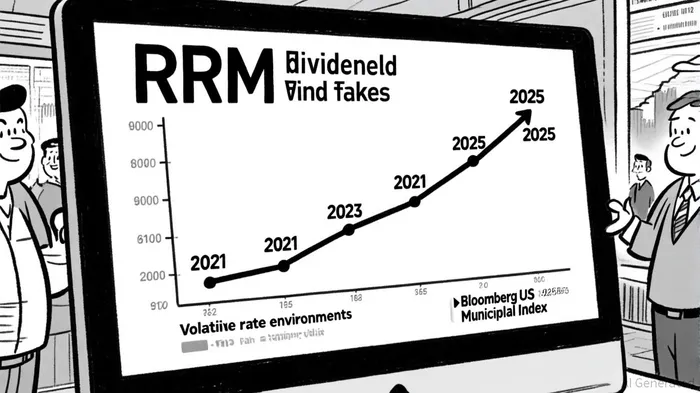
The RiverNorth Managed Duration Municipal Income Fund (RMM) has long been a fixture in the municipal bond landscape, offering investors a blend of tax-exempt income and tactical duration management. As of October 2025, the fund trades with a 7.69% yield, a figure that stands out against its historical averages of 4.81% to 5.37% over the past decade, according to Wisesheets data. This divergence raises critical questions about the sustainability of its dividend and the timing of entry for investors navigating a shifting interest rate environment.
Dividend Sustainability: A Delicate Balance
RMM's dividend structure has demonstrated remarkable consistency, with an annual payout of $1.09 per share in 2025, translating to monthly distributions of $0.0905, per the DividendInvestor history. Over the past five years, the fund has maintained a narrow range of payouts, fluctuating between $1.09 and $1.115 annually, according to DividendInvestor's dividend history. This stability is underpinned by its dual-strategy approach: a tactical municipal closed-end fund (CEF) sleeve managed by RiverNorth and a municipal bond income sleeve managed by MacKay Shields, as detailed on the RiverNorth fund page. The CEF sleeve, which constitutes roughly 40% of the portfolio, has historically provided a buffer during periods of bond market stress, as seen in 2024 when it offset losses from the leveraged bond sleeve, according to the RMMZ SEC filing.
However, the fund's reliance on leverage-maintained at approximately 40% of assets in recent years, as noted in the RMMZ SEC filing-introduces a layer of complexity. Leverage amplifies both gains and losses, and in a rising rate environment, it can strain cash flow. For instance, RMM's use of U.S. Treasury futures to hedge duration risk proved costly in 2025, detracting from returns as the municipal rate curve steepened (see the RMMZ SEC filing). This underscores a key challenge: while leverage enhances yield in stable conditions, it demands precise management to avoid eroding the dividend during volatility.
Historical data on RMM's dividend announcements reveals limited market reactivity. A RMM dividend backtest covering 2022–2025 found that the fund's dividend announcements showed an average 1-day price reaction of -0.20% and no statistically significant abnormal returns in the first week post-announcement. While a mild positive drift emerged after ~17 trading days, it remained statistically insignificant. These findings suggest that dividend announcements alone have not served as strong directional signals for RMMRMM-- during this period, reinforcing the need for investors to focus on broader structural factors-such as leverage management and duration positioning-rather than short-term event-driven patterns.
Interest Rate Strategy: Active Duration Management in Action
RMM's core strength lies in its active duration management, targeting a portfolio duration of ±3 years relative to the Bloomberg US Municipal Index (per RiverNorth's fund page). This approach allows the fund to shorten or lengthen its exposure based on rate forecasts, a critical tool in an era of unpredictable monetary policy. For example, during the 2023–2025 rate-hiking cycle, the fund's duration-adjusted strategy helped mitigate losses compared to long-duration peers, as described in the RMMZ SEC filing. Yet, the fund's net duration-extended to 12 years in 2025 due to leverage, per the RMMZ SEC filing-reveals a tension between income generation and capital preservation.
The fund's dual strategy also enables tactical shifts. In 2025, management signaled a potential reallocation toward actively managed municipal bonds if CEF valuations became less attractive, according to its Business Insider listing. This flexibility is a boon in a market where closed-end fund discounts and premiums can fluctuate rapidly with investor sentiment. However, the effectiveness of such pivots depends on the fund's ability to execute trades without incurring significant transaction costs-a risk in a low-liquidity environment.
Historical Performance and Entry Timing
RMM's performance during recent rate cycles offers mixed signals. From 2023 to mid-2025, the fund's net asset value (NAV) declined by 5.88% year-to-date, while its market price posted a modest 0.34% gain, per RiverNorth's fund page. This discount to NAV (-6.65% as of July 31, 2025, per RiverNorth's fund page) suggests undervaluation, potentially offering entry opportunities for income-focused investors. Yet, the fund's 12-month total return of -3.20% highlights the risks of holding long-duration municipal bonds in a rising rate environment.
The key to timing an entry lies in assessing the Federal Reserve's trajectory. With the Fed signaling potential rate cuts in 2026, RMM's long-duration exposure could become a tailwind. As management noted in 2025, "long-duration municipal exposure remains an important tool for delivering tax-exempt income and potential future price recovery when interest rates normalize" (see the RMMZ SEC filing). This implies that current discounts may reflect short-term pain rather than long-term weakness, provided the fund's leverage and duration remain under control.
Conclusion: A Calculated Bet
RMM's 7.69% yield is a siren song for income seekers, but its sustainability hinges on the fund's ability to navigate leverage and duration risks. The historical consistency of its dividend, coupled with its active management of rate sensitivity, suggests a resilient model. However, investors must weigh the fund's recent underperformance against its potential to capitalize on rate normalization. For those with a medium-term horizon and a tolerance for volatility, RMM presents an intriguing case study in balancing yield with strategic adaptability.





Comentarios
Aún no hay comentarios