
RiverNorth Capital's $15.9M Rights Offering: A Bullish Signal for Income Investors in Volatile Markets
The RiverNorth CapitalRSF-- and Income Fund (NYSE: RSF) recently closed its oversubscribed rights offering, raising $15.9 million at a 10% discount to net asset value (NAV), marking a significant vote of confidence in the fund's strategy amid market turbulence. For income-focused investors, this development underscores RSF's potential as a compelling valuation play, particularly given its current discount to NAV and its positioning to capitalize on alternative credit opportunities in a rising rate environment.
The Oversubscribed Offering: A Signal of Investor Conviction
The rights offering, which closed on July 7, 2025, was oversubscribed by 74%, with demand exceeding supply by nearly double. Investors subscribed at $14.39 per share—90% of the $15.99 NAV reported on the expiration date—a stark contrast to RSF's secondary market trading price, which historically trades at a discount to NAV. This discrepancy highlights a key opportunity: the fund's shares are currently undervalued relative to their intrinsic worth.
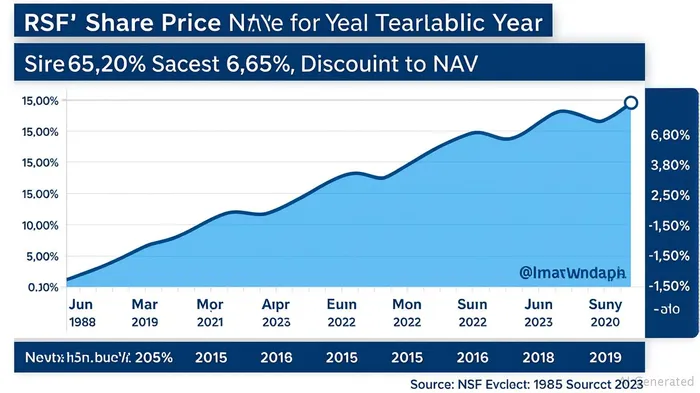
The oversubscription also reflects investor confidence in RiverNorth's ability to deploy capital profitably. The $15.9 million infusion arrives at a critical juncture, as the fund seeks to expand its portfolio of alternative credit instruments—unrated, high-yield loans often compared to “junk” bonds but avoiding subprime risk. These assets typically offer yields of 8-12%, far exceeding traditional fixed-income options, and their performance is less correlated with broader market swings.
Accretive Capital and the Path to Higher Distributions
The new capital is a strategic win for RSF's income-generating capacity. With 1.105 million shares issued, the fund's NAV per share will rise incrementally, while the expanded asset base allows RiverNorthRMI-- to pursue more high-yield opportunities. Notably, the dilution effect is mitigated by two factors:
- Growth-Driven NAV Expansion: The $15.9M influx provides dry powder to invest in accretive deals, potentially boosting NAV over time.
- Timely Distribution Participation: New shares will miss the June 2025 distribution but will receive the July payout, aligning with the fund's strategy to reinvest capital strategically.
The fund's 33.5% increase in shares outstanding (from 3.3MMMM-- to 4.4M) is a manageable dilution if NAV growth outpaces the share count expansion—a realistic scenario given the current yield environment.
Positioning in a Rising Rate World
RSF's focus on alternative credit is a double-edged sword: while these investments carry credit risk, they also offer a natural hedge against rising rates. Unlike traditional bonds, which decline in value as rates climb, alternative credit instruments often feature floating-rate structures or short durations, allowing yields to reset upward. This dynamic makes RSFRSF-- a potential beneficiary of the Federal Reserve's gradual rate hikes, which could keep income streams robust even in a slowing economy.
Why the NAV Discount is a Buying Catalyst
Closed-end funds like RSF often trade at discounts to NAV due to liquidity premiums and market sentiment. RSF's current discount of ~6.65% (as of July 2025) creates a margin of safety for income investors. Historically, discounts narrow when the fund's NAV grows, or when the market perceives undervalued assets—a scenario that could unfold here as the new capital is deployed.
Moreover, the rights offering's success—despite the recent market volatility—suggests that institutional and retail investors are pricing in RSF's long-term potential. The fund's manager, RiverNorth Capital Management, oversees $4.9 billion in assets and has a proven track record of navigating credit cycles, which adds credibility to RSF's prospects.
Risks and Considerations
No investment is without risk. RSF's portfolio includes unrated, unsecured loans with borrower default risks, and the fund's closed-end structure means its shares could remain discounted indefinitely. Additionally, rising rates could strain borrowers in sectors like real estate or energy, though RiverNorth's focus on non-subprime credits mitigates some of this exposure.
Investment Thesis and Call to Action
For income investors willing to accept moderate risk, RSF presents a compelling entry point. The fund's oversubscribed offering at a 10% NAV discount signals confidence in its strategy, while its alternative credit focus offers yield upside in a rising rate environment. Pair this with the current ~6.65% discount to NAV—a level below its five-year average—and the case for buying RSF grows stronger.
Recommendation:
- Income Seekers: Buy RSF with a 12-18 month horizon, targeting a narrowing discount and rising distributions.
- Risk Management: Set a stop-loss at the 10% discount level to protect against NAV underperformance.
- Diversification: Allocate no more than 5% of a portfolio to RSF to balance its high-yield, high-risk profile.
In conclusion, RiverNorth Capital's successful rights offering is a strategic win that strengthens its capacity to generate income in volatile markets. For investors prioritizing yield and undervalued closed-end funds, RSF's current discount and growth catalysts make it a name to watch in 2025 and beyond.





Comentarios
Aún no hay comentarios