
The Risks and Rewards of Long-Term XRP Exposure in Volatile Crypto Markets
In the evolving landscape of digital asset ecosystems, XRPXRP-- has emerged as a pivotal player in strategic treasury management, offering a unique blend of speed, regulatory clarity, and institutional adoption. As of 2025, XRP's role in cross-border payments, supply chain financing, and yield generation has positioned it as more than a speculative asset-it is increasingly viewed as infrastructure for enterprise liquidity. However, the path to long-term value creation is fraught with risks, from market volatility to regulatory uncertainties. This analysis explores the dual-edged nature of XRP exposure, balancing its strategic advantages against the challenges that persist in volatile crypto markets.
The Rewards of Long-Term XRP Exposure
1. Institutional Adoption and Infrastructure Integration
XRP's integration into corporate treasuries has accelerated dramatically in 2023–2025. Ripple's acquisition of GTreasury in 2025 connected XRP to $12.5 trillion in enterprise liquidity flows, embedding the token into real-time settlement systems for multinational corporations. This shift has transformed XRP into a critical tool for cross-border payments and payroll, with Ripple's On-Demand Liquidity (ODL) service processing $1.3 trillion in transactions. For institutional treasuries, XRP's 3–5 second settlement speed and low fees (often a fraction of a cent) offer a compelling alternative to traditional SWIFT systems.
2. Regulatory Clarity and ETF Momentum
The U.S. SEC's 2025 ruling classifying XRP as a digital commodity removed a major regulatory hurdle, unlocking $1.2 billion in ETF inflows. This development has normalized XRP's inclusion in institutional portfolios, with spot XRP ETFs launching in November 2025 and surpassing $1 billion in assets under management within four weeks. Legal clarity has also enabled banks and investment advisers to access XRP without legal risks, further solidifying its legitimacy. Analysts project that additional ETF approvals could inject $5–8 billion into liquidity pools, enhancing institutional interest. 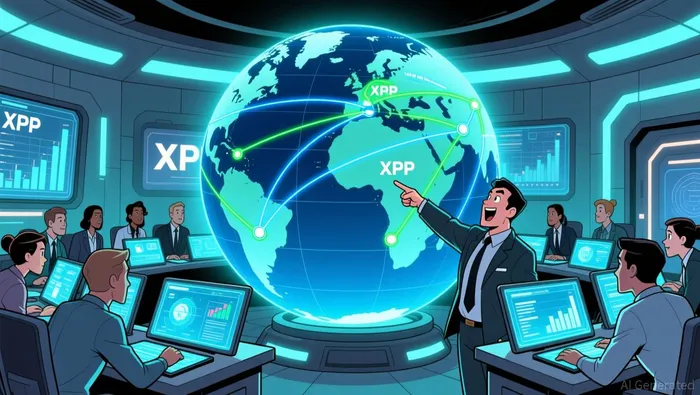
3. DeFi Integration and Yield Opportunities
XRP's tokenization into FXRP via the Flare Network has enabled $236 million in Total Value Locked, opening avenues for staking and lending. Corporate treasuries are now allocating XRP for yield generation, with planned investments exceeding $500 million leveraging DeFi and staking strategies. Projects like XRP Tundra's DAMM V2 aim to stabilize market volatility and ensure liquidity, addressing a key barrier to adoption. These innovations highlight XRP's potential to bridge traditional finance and blockchain ecosystems.
The Risks of Long-Term XRP Exposure
1. Market Volatility and Liquidity Challenges
Despite regulatory progress, XRP remains subject to sharp price fluctuations. For instance, its price surged 510% from January 2024 to January 2025, driven by ETF demand and geopolitical shifts. However, such volatility poses risks for treasury management, where price stability is critical. In October 2025, a $154.6 billion liquidation event-triggered by macro shocks like the U.S.-China trade war-wiped out $70 billion in open interest within two days. This underscores the fragility of derivatives markets and the concentration of liquidity in centralized exchanges (CEXs), which could exacerbate downside risks.
2. Regulatory Uncertainty and Legal Battles
While the SEC's 2025 ruling provided clarity, the agency's ongoing appeal of the 2023 decision and its broader litigation against Ripple Labs create lingering uncertainty. The outcome of these cases could redefine XRP's regulatory status, impacting ETF approvals and institutional adoption. Additionally, the derivatives market's systemic risks-such as default rates in DeFi credit markets-highlight the need for robust compliance frameworks.
3. Operational Risks in DeFi Ecosystems
XRP's integration with DeFi platforms faces challenges related to scalability and trust. DeFi credit markets, for example, struggle with default risks and limited on-chain identity verification. Furthermore, XRP's supply in profit fell to a one-year low in late 2025, signaling muted retail interest and heightened downside risks. These operational constraints could limit XRP's utility in decentralized finance, particularly in permissionless credit systems.
Balancing the Equation: Strategic Treasury Management in a Digital Age
For institutions considering long-term XRP exposure, the key lies in balancing its strategic advantages with risk mitigation. XRP's role as infrastructure for cross-border payments and its growing ETF liquidity offer tangible rewards, but these must be weighed against market volatility and regulatory headwinds. The recent launch of spot XRP ETFs and the SEC's legal clarity have reduced barriers to adoption, yet the broader crypto ecosystem remains interconnected and fragile.
In this context, strategic treasury management requires a dual focus: leveraging XRP's efficiency in real-time settlements while hedging against price swings through diversified portfolios and DeFi yield strategies. As AI models project XRP's price range between $5–$14 by 2026, institutions must also monitor macroeconomic trends and geopolitical shifts that could amplify volatility.
Conclusion
XRP's journey from speculative asset to strategic treasury tool reflects the maturation of digital asset ecosystems. Its institutional adoption, regulatory progress, and DeFi integration present compelling opportunities for long-term value creation. However, the risks-ranging from market turbulence to operational fragility-demand rigorous risk management. For enterprises and investors, the path forward lies in harnessing XRP's infrastructure potential while navigating the uncertainties of a rapidly evolving market.







Comentarios
Aún no hay comentarios