
Risks and Red Flags in Meme Coin Investments: The ATLAS Case Study
The memeMEME-- coin sector has long been a breeding ground for speculative frenzies, but 2025 has exposed a darker underbelly: systemic risks of insider trading and market manipulation. The ATLAS token, a flagship project of the Star Atlas ecosystem, offers a cautionary tale. By dissecting its on-chain data, wallet movements, and pre-launch anomalies, we uncover patterns that highlight the inherent dangers of investing in unregulated, hype-driven assets.
Pre-Launch Anomalies: A 47% Concentration of Power
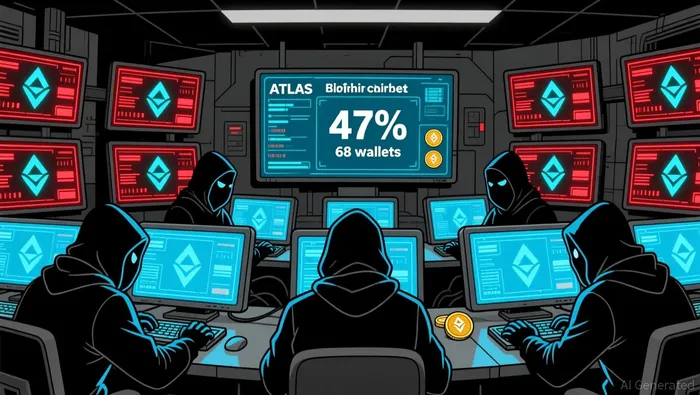
The most glaring red flag in ATLAS's trajectory emerged before its public launch. According to a report by Edgen Tech, 68 previously inactive wallets acquired 47% of the ATLAS token supply via ChangeNow, a non-custodial exchange platform. These wallets, which showed no prior on-chain activity, were funded in compressed time windows with similar ETH amounts, enabling them to snipe ATLAS tokens at launch. This level of pre-launch concentration-valued at approximately $1 million-raises urgent questions about fairness and transparency.
Such patterns are not unique to ATLAS. In February 2025, the $LIBRA token scandal demonstrated how social media-driven hype can mask coordinated efforts to inflate and then dump tokens, leaving retail investors with losses. While ATLAS's case lacks direct ties to fraudulent intent, the structural similarities-concentrated pre-launch distribution and lack of decentralization-underscore a systemic vulnerability in meme coin ecosystems.
Post-Launch Dynamics: Token Locks and Exchange Interactions
Post-launch, the 68 ChangeNow-funded wallets have maintained their grip on 47% of ATLAS, with limited token movement observed. This staticity suggests a strategic decision to hoard tokens, potentially to manipulate price volatility or liquidity. For instance, during the November 2025 XRP ETF launch window-a period of heightened market activity-these wallets exhibited no significant exchange interactions, despite the broader crypto market's turbulence.
This inaction contrasts sharply with the broader market's behavior. During the same period, Ripple's XRPXRP-- saw coordinated treasury transfers of 600 million tokens, interpreted as preparation for ETF-related demand according to X.com. The absence of comparable activity in ATLAS's 68 wallets implies a deliberate disengagement from market dynamics, further fueling suspicions of market manipulation.
Broader Implications: A Systemic Risk in Meme Coins
ATLAS's case is emblematic of a larger issue. The 2025 XRP ETF launches demonstrated how institutional-grade assets can gain legitimacy through regulatory frameworks, yet meme coins like ATLAS remain unmoored from such safeguards. The lack of pre-audit transparency, coupled with the ease of centralized token distribution, creates fertile ground for exploitation.
Consider the October 2025 Hyperliquid short position scandal, where a $1.1 billion Bitcoin and Ethereum short netted $200 million in profits just before a major U.S. policy announcement. While not directly linked to ATLAS, this incident illustrates how insider knowledge can distort markets-a risk amplified in meme coins with low barriers to entry and high retail participation.
Conclusion: A Call for Caution
The ATLAS case study reveals a troubling intersection of speculative hype and structural vulnerabilities. Investors must recognize that meme coins are not merely "fun" assets but high-risk instruments prone to manipulation. The 47% pre-launch concentration, the use of non-custodial platforms for token sniping, and the absence of post-launch liquidity all point to a systemically flawed model.
For regulators, the challenge lies in addressing these risks without stifling innovation. For investors, the lesson is clear: due diligence must extend beyond price charts to on-chain data and wallet analysis. In a space where "FOMO" often overrides fundamentals, the ATLAS saga serves as a stark reminder that not all that glitters is gold.







Comentarios
Aún no hay comentarios