
The Risks of Politicized Economic Data and Its Impact on Market Stability
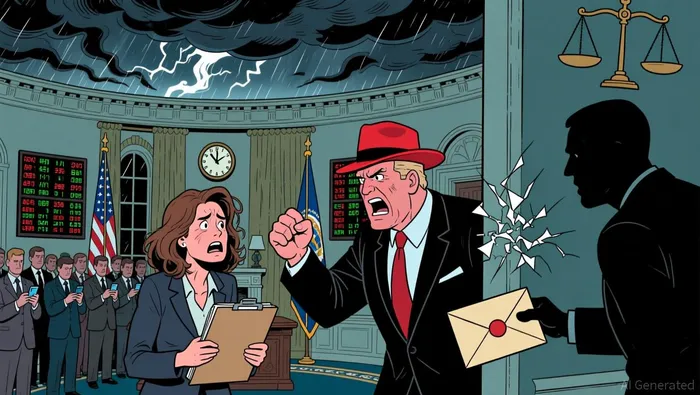
The integrity of economic data has long been a cornerstone of market stability and investor confidence. When data is perceived as neutral, it serves as a shared benchmark for decision-making. However, the 2026 pre-release of Bureau of Labor Statistics (BLS) jobs data by former President Donald Trump has sparked a critical debate about the risks of politicizing economic reporting. This incident, coupled with broader attacks on the BLS under Trump's administration, highlights how non-neutral data can distort investor behavior, amplify market volatility, and erode trust in institutional credibility.
The Trump-BLS Controversy: A Breach of Protocol
In January 2026, Trump shared confidential nonfarm payrolls data from the upcoming jobs report on Truth Social hours before its official release. According to a report by , this act violated federal policies prohibiting the disclosure of market-moving economic data prior to its scheduled publication. The White House initially defended the leak as an "inadvertent public disclosure," attributing it to routine pre-briefing procedures. However, economists like Justin Wolfers and Jason Furman condemned the incident as "unprecedented" and "egregious," warning that such breaches could undermine the neutrality of the BLS and distort market signals according to Fortune.
This was not an isolated incident. Trump's administration had already drawn scrutiny for its treatment of the BLS. In August 2025, Trump abruptly fired the BLS commissioner, Erika McEntarfer, following the release of weak jobs numbers. Former BLS leaders later stated that Trump's public criticism of the agency's data had eroded trust in its credibility. These actions created a perception that economic data could be manipulated or selectively disclosed to serve political narratives, a concern that directly impacts investor behavior.
Market Volatility and Investor Behavior: A Fragile Equilibrium
The pre-release of economic data can create informational asymmetry, allowing certain investors to act on non-public information before broader markets adjust. While no direct metrics linking Trump's 2026 leak to immediate S&P 500 volatility were identified, broader trends suggest heightened uncertainty. According to , U.S. manufacturing activity had declined for ten consecutive months by early 2026, and the unemployment rate rose to 4.6% amid Trump's tariff policies. These macroeconomic pressures, combined with the politicization of data, likely contributed to a volatile environment.
The VIX, or "fear index," provides further insight. indicates that the VIX's 13- and 26-week averages had risen sharply since mid-2024, reflecting growing investor anxiety over policy uncertainty and economic instability. While the S&P 500 reached record highs in January 2026, driven by sectors like AI and semiconductors, the index's cyclically adjusted price-to-earnings (CAPE) ratio hit 39.9-a level last seen during the dot-com bubble- raising concerns about overvaluation. This duality of optimism and caution underscores how politicized data can create conflicting signals for investors.
Erosion of Trust: A Long-Term Threat to Market Stability
Trust in economic data is not merely a theoretical concern; it has tangible financial implications. notes that private-sector firms have increasingly stepped in to provide alternative data sources, as investors grew skeptical of official reports following Trump's abrupt removal of the BLS commissioner. This shift reflects a broader erosion of confidence in institutions, which can lead to fragmented market reactions and reduced transparency.
The consequences extend beyond the U.S. For instance, distrust in inflation data threatens the $2 trillion market for inflation-linked securities. If investors lose faith in the accuracy of economic indicators, they may prioritize alternative data or hedge against policy-driven risks, further complicating market dynamics. highlights, the Federal Reserve itself acknowledged that Trump's tariffs could slow economic growth, adding another layer of uncertainty.
Regulatory Responses and the Path Forward
The Trump-BLS incident has prompted calls for stricter oversight. The Office of Management and Budget (OMB) has long enforced strict protocols against pre-releasing market-moving data, yet Trump's actions exposed vulnerabilities in enforcement. While the White House stated it was "reviewing protocols," critics argue that regulatory responses must go beyond reactive measures. Strengthening safeguards against political interference in data collection and dissemination is essential to preserving market fairness.
Moreover, investors must adapt to a landscape where data integrity is increasingly questioned. Diversifying data sources, prioritizing real-time indicators, and hedging against policy-driven volatility are becoming standard practices. However, these strategies cannot fully mitigate the risks of politicized data; they merely manage symptoms of a deeper institutional crisis.
Conclusion
The 2026 BLS data leak and Trump's broader attacks on the agency illustrate a dangerous precedent: when economic data is politicized, it undermines the very foundation of market stability. Investors face distorted signals, volatility increases, and trust in institutions erodes-a trifecta that can destabilize financial systems. As the VIX and alternative data markets suggest, the fallout from such breaches is already being felt. For markets to function effectively, policymakers and regulators must reaffirm the neutrality of economic data. Otherwise, the risks of politicization will continue to ripple through global financial systems, with no clear end in sight.







Comentarios
Aún no hay comentarios