
The Risks of Politician-Backed Cryptocurrencies and Liquidity Manipulation: Unmasking Liquidity Traps and Tokenomics Flaws in Politically Branded DeFi Projects
The intersection of politics and cryptocurrency has become a fertile ground for speculative hype, regulatory battles, and liquidity manipulation. As the crypto industry increasingly funds political campaigns to secure favorable policies, the risks of politically branded DeFi projects-particularly those reliant on celebrity endorsements or partisan agendas-have grown exponentially. This article examines the patterns of liquidity traps and tokenomics flaws in these projects, drawing on recent case studies and regulatory developments to highlight the dangers for investors.
Political Spending and Regulatory Favoritism: A High-Stakes Game
According to a report by the Center for Responsive Politics, crypto corporations spent over $119 million in 2024 to influence federal elections, with the majority of funds directed toward pro-crypto PACs like Fairshake PAC. This spending has effectively created a feedback loop: politicians who advocate for deregulation receive substantial financial support, while the industry reaps the rewards of a more lenient regulatory environment. For instance, during the second TrumpTRUMP-- administration, the president issued an executive order to dismantle Biden-era crypto policies and established a Strategic BitcoinBTC-- Reserve, signaling a stark shift in government support.
The market responded predictably. Bitcoin surged by over 5.63% following key political events, such as Trump's meetings with industry leaders. However, this artificial inflation masked a deeper issue: the crypto industry's reliance on political patronage to sustain value. A study by Columbia Law School found that the $200 million in campaign contributions by crypto firms yielded regulatory forbearance with a market value of potentially $167 billion-a staggering 800-to-1 return on political investment. This suggests that the value of many crypto assets is not driven by fundamentals but by the ability to manipulate regulatory outcomes through political influence.
Case Studies in Liquidity Manipulation: Argentina's $LIBRA and the TRUMP Memecoin
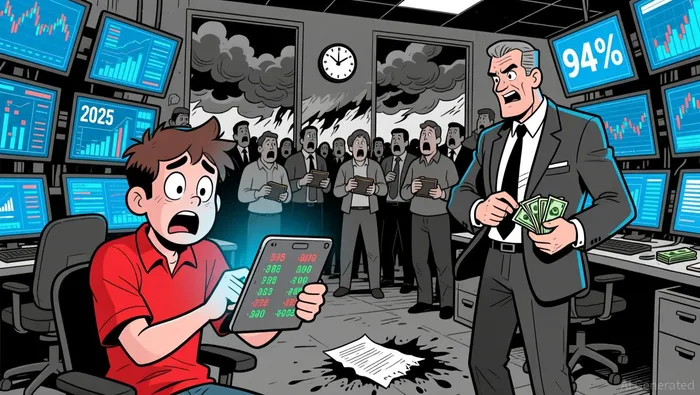
The risks of politically backed crypto projects are starkly illustrated by Argentina's $LIBRA memecoinMEME-- and the TRUMP memecoin. In 2025, Argentina's president, Javier Milei, promoted $LIBRA, a token tied to his libertarian economic agenda. The price surged initially, but insiders offloaded over $100 million worth of tokens, leading to a 94% collapse. This case drew criminal investigations for market manipulation, underscoring how political influence can distort liquidity and create artificial demand.
Similarly, the TRUMP memecoin, launched during the 2024 election cycle, exemplified the fragility of tokenomics models reliant on hype. Despite a brief surge driven by celebrity endorsements, trading volumes for TRUMP and similar tokens plummeted by 80–90% as regulatory scrutiny intensified. These projects lacked real-world utility, infrastructure, or sustainable tokenomics, making them vulnerable to market deleveraging and regulatory convergence.
Tokenomics Flaws and Liquidity Traps: The Hidden Costs of Political Branding
Politically branded DeFi projects often suffer from structural weaknesses that exacerbate liquidity risks. For example, many memecoins are designed with inflationary token supplies and no deflationary mechanisms, creating a dependency on continuous speculative inflows to maintain value. When political momentum wanes or regulatory clarity emerges, these projects face liquidity traps-situations where token holders are unable to exit without causing a collapse in price.
Wash trading and bot-driven manipulation further compound these risks. Chainalysis reported a surge in suspected wash trading across major blockchains in 2025, with politically motivated tokens being particularly vulnerable. By artificially inflating trading volumes, bad actors create the illusion of demand, luring retail investors into overvalued assets. When the manipulation is exposed or political support falters, the resulting sell-offs can be catastrophic.
Regulatory Convergence and the Path Forward
The collapse of speculative tokens like TRUMP and $LIBRA has prompted increased regulatory scrutiny. The U.S. Department of Justice has intensified its focus on crypto market manipulation, pursuing cases involving fraudulent ICOs and Ponzi schemes. Meanwhile, frameworks like the EU's MiCA and the U.S. GENIUS Act for stablecoins aim to create a more structured environment for institutional participation. However, these regulations also highlight the vulnerability of politically branded projects, which often lack the compliance infrastructure to survive in a more transparent market.
For investors, the lesson is clear: politically backed cryptocurrencies are inherently risky. Their value is tied to the volatility of political cycles and the credibility of their tokenomics. Projects that rely on celebrity endorsements or partisan agendas without addressing utility, governance, or liquidity sustainability are likely to face the same fate as TRUMP and $LIBRA.
Conclusion: Navigating the Political-Crypto Nexus
The rise of politician-backed cryptocurrencies underscores a broader trend: the conflation of political influence with financial value. While regulatory leniency may temporarily inflate prices, it also creates systemic risks through liquidity manipulation and tokenomics flaws. Investors must remain vigilant, prioritizing projects with robust fundamentals over those driven by political hype. As the crypto industry matures, the line between innovation and manipulation will become increasingly critical to navigate.






Comentarios
Aún no hay comentarios