
The Risks of Overleveraged Ethereum Derivatives Markets in a Stagnant Price Environment
The EthereumETH-- derivatives market in 2025 has become a double-edged sword: a testament to the asset's growing institutional adoption and a harbinger of systemic fragility. As leverage ratios and notional values have surged to historic levels, the market's stability has been increasingly compromised by a combination of concentrated whale positions, reduced spot liquidity, and cascading liquidation risks. In a stagnant price environment-where Ethereum's price has oscillated narrowly for months-these factors create a volatile undercurrent that could erupt into a full-scale crisis.
Leverage Outpaces Collateral, Amplifying Systemic Risk
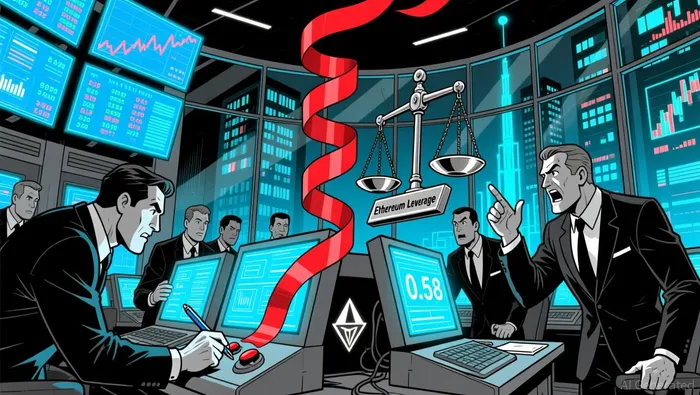
By late 2025, Ethereum's derivatives leverage ratio had reached 0.58, a record high by historical measures. This metric, which compares the notional value of leveraged contracts to the underlying collateral, indicates that the market's exposure to leveraged positions far exceeded the value of assets backing them. Such imbalances are inherently unstable, as even minor price movements can trigger cascading liquidations.
The notional value of ETH derivatives has also grown at an alarming rate. By December 2025, Ethereum futures open interest had climbed to $15 billion, while options open interest peaked at $770 million in notional value. However, this growth has been driven by concentrated whale activity, with large accounts amassing long positions in ETH at tight liquidation margins. These positions, often leveraged 10x or more, create a fragile equilibrium: a single large liquidation could trigger a chain reaction, forcing exchanges to execute mass deleveraging mechanisms that further destabilize prices.
Cascading Liquidations: A 2025 Case Study in Systemic Fragility
The risks of overleveraging were starkly exposed in two major liquidation events in 2025. On March 15, a $170 million wave of forced closures hit long positions across Ethereum, BitcoinBTC--, and SolanaSOL-- within 24 hours. This was followed by an even more severe crisis on October 10, when $19 billion in leveraged positions were liquidated in a single day amid a global risk event-a hypothetical 100% China tariff threat.
These events revealed critical flaws in the derivatives ecosystem. During the October crash, Bitcoin's top-of-book liquidity depth shrank by over 90%, while bid-ask spreads widened to unsustainable levels. Market makers either withdrew entirely or widened spreads to mitigate risk, leaving exchanges unable to absorb the flood of sell orders. The situation was compounded by stablecoin depegging: on Binance, the stablecoin USDe temporarily lost its $1 peg, triggering liquidations of accounts that would have otherwise remained solvent.
Risk Management in a Stagnant Market: A False Sense of Security
The current stagnant price environment-where Ethereum has traded in a narrow range for months-creates a dangerous illusion of stability. Open interest for Ethereum perpetual futures has stabilized around $50 billion, while options open interest has declined due to concentrated expirations. However, this apparent calm masks underlying vulnerabilities.
Reduced spot liquidity exacerbates the risks. Stablecoin inflows into exchanges have fallen by 50% from mid-2025 levels, meaning even moderate sell pressure could trigger sharp price swings. In a stagnant market, where whale positions dominate, such swings could rapidly escalate into full-blown liquidation cycles. For example, the $6,500 call option on Deribit-holding $380 million in notional open interest-represents a concentrated point of failure. A sudden price drop below this level could trigger a cascade of liquidations, further depressing ETH's value.
The Path Forward: Stress Tests and Infrastructure Overhauls
The 2025 crises have forced regulators and exchanges to confront the need for systemic stress tests and infrastructure upgrades. The Global Crypto Policy Review 2025/26 highlights accelerated efforts to regulate stablecoins and implement multi-venue oracles to prevent pricing anomalies. Exchanges like CMECME-- have also closed the gap with Binance in terms of open interest and trading volume, offering a more institutional-grade alternative to retail-heavy platforms.
However, these measures remain insufficient. Risk management frameworks must account for non-linear market depth, position concentration, and the fragility of collateral baskets. For traders, this means avoiding overleveraged positions in a stagnant market and diversifying across venues. For exchanges, it necessitates transparent ADL mechanisms and robust liquidity buffers to absorb sell-side shocks.
Conclusion
Ethereum's derivatives market in 2025 stands at a crossroads. While its growth reflects the asset's maturation, the risks of overleveraging and systemic fragility cannot be ignored. In a stagnant price environment, where liquidity is thin and whale positions dominate, even minor disruptions could trigger a cascade of liquidations with far-reaching consequences. The lessons of 2025-marked by March and October crises-underscore the urgent need for stress tests, infrastructure upgrades, and a rethinking of risk management paradigms. For investors, the message is clear: leverage is a tool, not a strategy, and in the current climate, caution is the only prudent course.





Comentarios
Aún no hay comentarios