
The Risks and Opportunities in Netcapital Inc's Surging Short Interest
The short interest in Netcapital Inc.NCPL-- (NCPL) has surged dramatically in late 2025 and early 2026, sparking debates about the stock's vulnerability to a short squeeze and the broader implications for market sentiment. As of December 2025, the company's short interest stood at 639,831 shares, representing 10.14% of its public float and 9.32% of its shares outstanding. This marks a 267.54% increase compared to earlier in the year, underscoring a sharp shift in investor sentiment toward pessimism.
Short Squeeze Dynamics: A Double-Edged Sword
The short interest ratio-a metric that estimates how many days it would take for short sellers to cover their positions based on average trading volume-has also evolved significantly. In November 2025, the ratio was 0.3 days, but by January 2026, it had spiked to 3.25 days. This suggests that short sellers would require over three days of average trading volume to unwind their positions, heightening the risk of a short squeeze if the stock experiences upward momentum. A short squeeze occurs when a rising stock price forces short sellers to buy shares to limit losses, potentially accelerating the price increase.
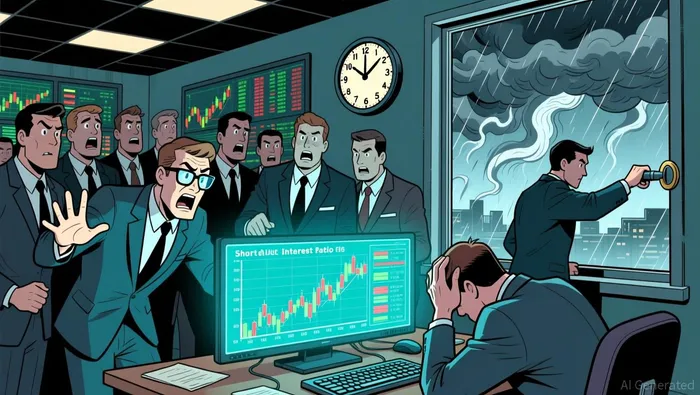 However, data from December 2025 complicates this narrative. At that point, the short interest ratio was reported as 0.04 days, implying that short sellers could cover their positions almost instantly. This discrepancy highlights the dynamic nature of short interest and the importance of real-time data for investors. While a high ratio (e.g., 3.25 days) raises short squeeze risks, a low ratio (e.g., 0.04 days) suggests short sellers may have already hedged or reduced exposure, mitigating such risks.
Market Sentiment: Bearishness Outpaces Peers
The surge in short interest reflects a broader bearish outlook on NCPLNCPL--. By January 2026, the stock's short interest as a percentage of float (10.09%) far exceeded the industry average of 0.77%, indicating that investors are more pessimistic about NCPL than its peers. This divergence could stem from concerns about the company's financial health, competitive positioning, or macroeconomic headwinds. For instance, NCPL's short interest surged by 154.8% in the month ending January 9, 2026, a sign of acute near-term skepticism.
Yet, such extreme bearishness can create opportunities. Historically, stocks with high short interest and deteriorating fundamentals often face downward pressure, but if the market's pessimism proves misplaced, a rebound could trigger a short squeeze. Investors must weigh whether the current short interest reflects rational concerns or overcorrection.





Comentarios
Aún no hay comentarios