
The Risks and Opportunities in Crypto-Finance: A Case Study of Iran's IRGC and UK-Based Exchanges
The integration of cryptocurrency into global capital markets has created unprecedented opportunities for innovation and financial inclusion. However, it has also exposed systemic vulnerabilities, particularly in under-regulated ecosystems. A recent case study involving Iran's Islamic Revolutionary Guard Corps (IRGC) and UK-based exchanges underscores the risks of exploiting crypto infrastructure for sanctions evasion, money laundering, and terrorist financing. This analysis examines the IRGC's operations, contextualizes them within broader systemic risks, and evaluates the implications for global financial stability.
The IRGC's Crypto Strategy: Exploiting Regulatory Gaps
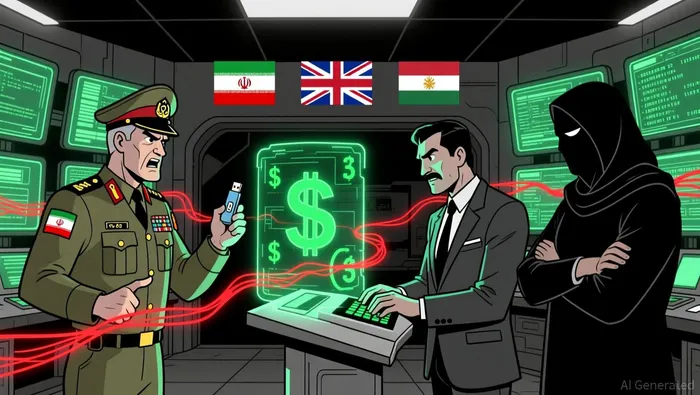
According to a report by TRM Labs, the IRGC has leveraged two UK-registered exchanges-Zedcex and Zedxion-to move approximately $1 billion in digital assets since 2023, primarily using TetherUSDT-- (USDT) on the TronTRX-- blockchain. These platforms, though incorporated separately, functioned as a single enterprise, with IRGC-linked transactions accounting for 56% of their total volume between 2023 and 2025. The operations grew exponentially, from $24 million in 2023 to $619 million in 2024, before stabilizing at $410 million in 2025 as non-IRGC activity increased.
The IRGC's strategy relied on a network of intermediaries, including offshore wallets, major Iranian exchanges like Nobitex and Wallex, and the Turkey-based payment processor Zedpay, which has faced scrutiny for anti-money laundering violations. A key figure in these operations was Babak Zanjani, a sanctioned financier previously involved in laundering oil revenue for the regime. After repaying embezzled funds and being released from prison in 2024, Zanjani now leads DotOne Holding Group, a conglomerate with interests in crypto and telecommunications.
Direct transfers exceeding $10 million were also identified from IRGC wallets to Sa'id Ahmad Muhammad al-Jamal, a Yemeni national sanctioned by the U.S. Treasury for funding the Houthis via smuggling networks. These transactions bypassed intermediaries or mixers, highlighting the direct use of crypto for terrorist financing.
Systemic Risks in Under-Regulated Crypto Infrastructure
The IRGC case exemplifies broader risks in under-regulated crypto ecosystems. As noted in the , the lack of harmonized regulations creates opportunities for illicit actors to exploit unregulated or loosely supervised technologies. For instance, stablecoins like USDTUSDT--, which are pegged to fiat currencies, have become critical tools for cross-border transactions but also pose risks to monetary policy and capital flow management.
The Bybit hack of 2024, where $1.5 billion in EthereumETH-- tokens were stolen and laundered through unregulated channels, further illustrates the vulnerabilities of fragmented oversight. Similarly, the integration of crypto into traditional financial services-such as retirement plans and banking infrastructure-has exposed middle-class investors to risks without adequate consumer protections. Regulatory weaknesses and political entanglements have compounded these issues, raising concerns about conflicts of interest and enforcement gaps.
Global Implications and Regulatory Responses
The IRGC's operations and similar cases have prompted calls for stronger international coordination. Jurisdictions with robust frameworks, such as the EU's Markets in Crypto-Assets (MiCA) regulation and the U.S. GENIUS Act, demonstrate that regulatory clarity can drive institutional adoption while mitigating risks. Conversely, the absence of such frameworks in regions like the UK and Turkey has enabled bad actors to exploit jurisdictional arbitrage.
Initiatives like the Basel Committee's review of crypto prudential rules and the FATF's guidance on asset recovery highlight the need for global consistency. However, progress remains uneven. For example, while Tether blocklisted 42 addresses linked to the IRGC in July 2025, the broader Iranian crypto ecosystem has continued to expand, with 10 million Iranians now using or owning cryptocurrency and 1.4% of the country's GDP flowing through digital assets. Iran's control of 4.2% of global Bitcoin mining power-much of it illegal-further underscores the scale of the challenge.
Conclusion: Balancing Innovation and Risk Mitigation
The IRGC's exploitation of UK-based exchanges reveals a critical flaw in the current crypto landscape: the inability of fragmented regulatory regimes to counter sophisticated illicit finance networks. While crypto offers transformative potential, its under-regulated infrastructure poses systemic risks that could destabilize global capital markets. Investors must weigh these risks against opportunities, recognizing that regulatory clarity-not just technological innovation-will define the sector's future.
For policymakers, the imperative is clear: harmonizing regulations, enhancing cross-border cooperation, and enforcing strict anti-money laundering (AML) standards are essential to safeguarding financial stability. For investors, due diligence must extend beyond market fundamentals to include assessments of regulatory environments and geopolitical risks. In a world where $1 billion can be moved through crypto in under a year, the stakes have never been higher.






Comentarios
Aún no hay comentarios