
The Risks of Leverage in DeFi: Lessons from an $11.41M Aave Whale Liquidation
The Anatomy of the Liquidation
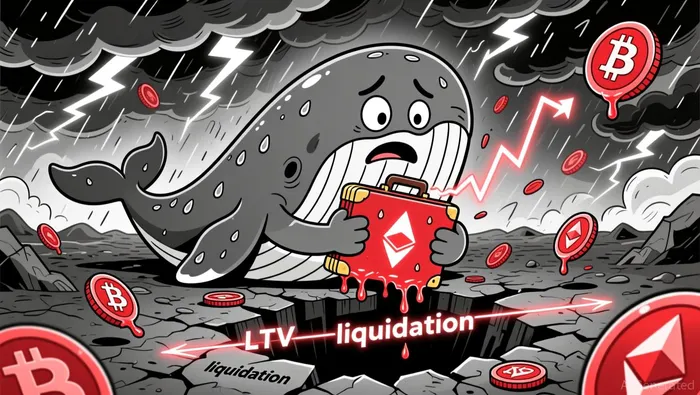
The liquidation was precipitated by Bitcoin's drop to $80,000, pushing the borrower's loan-to-value (LTV) ratio beyond Aave's safety threshold. The account held $10.55 million in wrapped BitcoinWBTC-- (wBTC), 116.66 wrapped Ether (wETH), and over $9.9 million in Aave-related tokens as collateral. As Bitcoin's price fell, the value of the collateral eroded rapidly, leading to the seizure of 56.61 ETH (worth $154,000 each) in two separate liquidation events. The total loss included both repayment of borrowed assets and the forfeiture of collateral, illustrating how leverage amplifies downside risk in highly volatile markets.
This incident occurred amid broader macroeconomic headwinds. WhiteHorse Finance, a collateral asset referenced in the case, reported a 3.6% quarterly decline in net asset value (NAV) due to $6.7 million in realized and unrealized losses. The firm attributed this to interest rate cuts and spread compression, which pressured earnings and prompted a $15 million share buyback program to stabilize shareholder value. These macro trends highlight how external market conditions can compound the risks of leveraged positions.
Strategic Risk Management: A Missed Opportunity
The whale's approach lacked key risk mitigation strategies that could have averted the liquidation. Collateral diversification, for instance, is a cornerstone of DeFi risk management. By concentrating exposure in Bitcoin and EthereumETH--, the account left itself vulnerable to correlated price movements. Best practices recommend spreading collateral across uncorrelated assets to reduce systemic risk.
Hedging strategies also appear absent. Advanced traders often use options, inverse ETFs, or protective puts to offset potential losses. For example, a long position in Bitcoin could be paired with a short position in Ethereum to hedge against cross-asset volatility. Similarly, options collars-combining long puts and short calls-can limit downside while capping upside gains, a trade-off that might have preserved capital during the Bitcoin selloff.
Position sizing and margin buffers are equally critical. The whale's leveraged exposure suggests insufficient margin to absorb sudden price swings. Industry guidelines recommend limiting leveraged positions to 1-2% of total capital per trade, with additional buffers to withstand 10-15% price fluctuations. In this case, the lack of margin likely accelerated the liquidation process, as the account had no room to weather even moderate volatility.
Broader Lessons for DeFi Investors
The Aave liquidation serves as a microcosm of systemic risks in leveraged DeFi. Whales, despite their size, are not immune to market forces. A 2023-2025 analysis of whale strategies reveals a reliance on technical indicators like MACD and 25-delta skew to time entries, yet these tools cannot eliminate the inherent risks of leverage. For instance, a $54.5 million 20x Bitcoin position, while potentially lucrative, requires near-perfect execution to avoid catastrophic losses.
Moreover, the incident underscores the importance of monitoring funding rates, liquidation prices, and trading volume-metrics that can signal impending volatility (https://blofin.com/academy/blofin-courses/whale-s-insight-accumulation-or-exit). Whales who failed to track these indicators may have entered positions during periods of overextension, only to face forced closures as markets corrected.
Conclusion
The $11.41 million Aave liquidation is a stark reminder of leverage's double-edged nature. While it can amplify gains, it equally magnifies losses when market conditions shift. Strategic risk management-through diversification, hedging, and disciplined position sizing-is not optional but essential. As DeFi platforms evolve, investors must adapt by integrating advanced tools like blockchain-based payment systems and gas-free transactions to optimize risk-adjusted returns (https://www.okx.com/learn/whale-leverage-profit-strategies).
For now, the lesson is clear: leverage demands respect. In the words of one industry expert, "The difference between a whale and a casualty is not the size of the position, but the depth of the risk management strategy."






Comentarios
Aún no hay comentarios