
Risks to Financial Stability from Overvalued U.S. Markets and Crypto Assets in 2025
Overvaluation in U.S. Equities: A Ticking Time Bomb
The U.S. equity market's forward price-to-earnings (P/E) ratio for the S&P 500 stands at 22.5 as of Q4 2025, significantly above its 5-year average of 19.9 and 10-year average of 18.6. This overvaluation is compounded by the Crestmont Research P/E ratio and the Q ratio, which suggest the market is overvalued by 120% to 198%. The disconnect between valuation expansion and earnings growth is stark: one-third of the market's recent gains stem from rising P/E ratios rather than fundamentals.
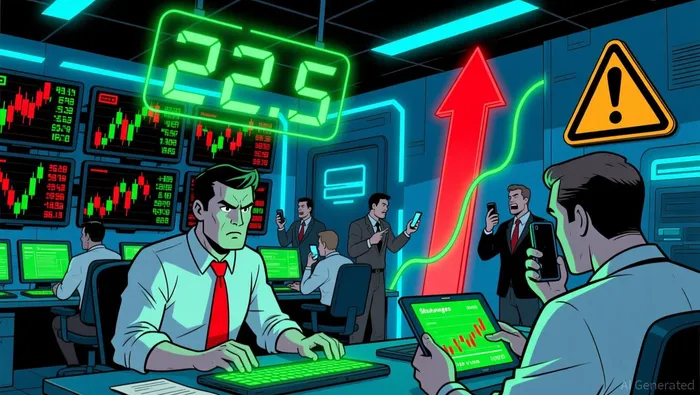
Analysts warn that this fragile equilibrium is vulnerable to earnings disappointments, which could trigger a "multiple compression" event-a rapid contraction in valuations as investor sentiment shifts. The risk is amplified by decelerating earnings growth and overly optimistic forward projections, leaving little room for error.
Crypto Assets: Hype vs. Hedging in a Volatile Ecosystem
The crypto market, while maturing, remains a double-edged sword. Bitcoin (BTC) and Ethereum (ETH) are being scrutinized through advanced tools like AI-driven analytics platforms, which track on-chain data and technical indicators to assess volatility. Michael Saylor of MicroStrategy has made bold predictions, forecasting BTC could reach $150,000 by late 2025, driven by institutional adoption and improved risk-management tools. However, such optimism contrasts with the reality of overvaluation risks, particularly as macroeconomic uncertainties persist.
Saylor's long-term vision-projecting BTCBTC-- to hit $1 million within four to eight years-rests on assumptions of sustained 30% annual growth. Yet, this trajectory hinges on regulatory clarity and macroeconomic stability, both of which remain uncertain. For investors, the key lies in balancing exposure to crypto's growth potential with robust hedging strategies.
Strategic Positioning: Mitigating Risks in a Correction-Prone Environment
To navigate these risks, investors must adopt a multi-pronged approach:
Hedging with Gold and China Stocks
Michael Hartnett of Bank of America recommends gold and China stocks as hedges against U.S. market overvaluation. Gold, a traditional safe haven, offers protection against inflation and currency devaluation, while China's undervalued equities present opportunities amid U.S. market complacency.Diversified Crypto Portfolios
Institutional-grade crypto portfolios in 2025 emphasize diversification: 60-70% in core assets (BTC, ETH), 20-30% in altcoins, and 5-10% in stablecoins. This structure balances growth with risk mitigation. Active managers also employ arbitrage, sector rotation, and momentum trading to enhance returns.Alternative Investments as a Buffer
Alternative assets like real estate, private equity, and commodities are gaining traction for their low correlation to traditional markets. These investments act as inflation hedges and diversifiers during volatility. Tokenization has further democratized access, enabling broader participation.Contrarian Trades and Macro Bets
Hartnett suggests contrarian strategies, such as betting on a tightening of financial conditions in Q4 2025 or shorting hyperscaler bonds in 2026. These positions capitalize on market complacency and macroeconomic shifts.Bitcoin's Role in Uncertain Times
Research underscores Bitcoin's value as a diversifier during high economic policy uncertainty (EPU) periods. However, its inclusion in portfolios becomes less impactful-or even detrimental-when EPU is low. Aligning crypto allocations with macroeconomic conditions is critical.
Conclusion: Proactive Risk Management in a High-Stakes Year
The overvaluation of U.S. markets and crypto assets in 2025 demands a disciplined, strategic approach. Investors must balance optimism for growth with caution against corrections. By leveraging gold, diversified crypto portfolios, alternative assets, and contrarian trades, they can position themselves to weather volatility while capitalizing on emerging opportunities.
As the year progresses, vigilance and adaptability will be the cornerstones of financial stability. The markets may be overvalued, but with the right strategies, the risks can be managed-and even turned into advantages.







Comentarios
Aún no hay comentarios