
The Risks of Centralization in Token Governance: Lessons from the WLFI Freeze Controversy
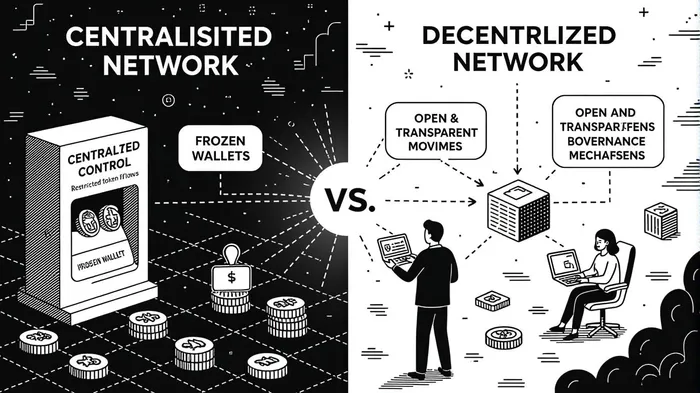
The recent controversy surrounding World Liberty Financial (WLFI) and its unilateral freeze of Tron founder Justin Sun’s $100 million in tokens has ignited a global debate about centralization risks in blockchain governance. This incident, where WLFI blacklisted Sun’s wallet after he transferred $9 million in tokens to an exchange, underscores a critical flaw in many blockchain projects: the illusion of decentralization. While WLFI marketed itself as a decentralized finance (DeFi) platform, its ability to arbitrarily restrict token movements without consensus or transparency has exposed vulnerabilities that institutional investors and regulators must address.
Centralization Risks in Token Governance
WLFI’s actions highlight a paradox in blockchain governance: projects often retain centralized control mechanisms under the guise of decentralization. By freezing Sun’s tokens—arguing it was to prevent market manipulation—the project demonstrated how administrators can override user rights, violating core blockchain principles of immutability and trustlessness [1]. Critics, including Polygon developers, have likened such actions to “new-age mafia” tactics, emphasizing the lack of recourse for affected parties [5].
This incident aligns with broader concerns about re-centralization in blockchain ecosystems. As noted by Brookings Institution researchers, dominant actors in blockchain platforms can amass disproportionate influence over governance, leading to monopolistic control and reduced competition [1]. For institutional investors, this raises red flags: if a project’s governance structure allows unilateral decisions, it undermines the very value proposition of decentralized systems.
Institutional Investor Protection: Strategies and Challenges
Institutional investors are increasingly allocating capital to digital assets, but the WLFI freeze underscores the need for robust protection mechanisms. According to a 2025 report by The Economist, 80% of crypto hedge funds now rely on regulated custodians to secure assets, reflecting a shift toward institutional-grade safeguards [5]. However, custodians alone cannot mitigate governance risks. The WLFI case reveals that even with secure custody, investors remain vulnerable if governance protocols lack transparency or accountability.
Best practices for institutional investors include:
1. Due Diligence on Governance Models: Projects must demonstrate verifiable decentralization, such as on-chain voting mechanisms and open-source code audits [6].
2. Legal Recourse Frameworks: Investors should prioritize projects with clear dispute-resolution processes, such as smart contracts that require multi-signature approvals for asset freezes [3].
3. Diversification: Avoid overexposure to projects with concentrated token ownership or opaque governance structures.
Regulatory Preparedness: A Global Imperative
Regulators are beginning to respond to centralization risks, but progress remains uneven. In the U.S., the SEC’s Spring 2025 Rulemaking Agenda includes modernized custody rules for crypto assets, while the CFTC’s CLARITY Act defines digital commodities under its oversight [1]. These measures aim to clarify investor protections and enforce accountability for market manipulation.
Globally, South Korea’s new virtual asset lending guidelines—prohibiting excessive leverage—offer a model for balancing innovation with investor safety [4]. However, regulatory fragmentation remains a challenge. As highlighted by a 2025 study in Frontiers in Blockchain, divergent approaches to AML/KYC enforcement and asset classification create compliance hurdles for multinational blockchain projects [1].
Governance Best Practices: Lessons from the WLFI Controversy
The WLFI freeze also highlights the importance of transparent governance. For instance, the proposed AaveAAVE-- acquisition of 7% of WLFI tokens—executed without stakeholder consultation—further eroded trust [1]. To prevent such scenarios, blockchain projects should adopt:
- Open-Source Governance Protocols: Enable real-time audits of governance decisions.
- Stakeholder Involvement: Require token holders to vote on major decisions, such as asset freezes or token sales.
- Decentralized Autonomous Organizations (DAOs): While DAOs are not inherently immune to centralization, they provide a framework for distributed decision-making [6].
Conclusion: A Call for Vigilance and Innovation
The WLFI freeze is a wake-up call for institutional investors and regulators. Centralization risks in token governance are not theoretical—they are real and actionable. As blockchain ecosystems evolve, stakeholders must prioritize transparency, accountability, and legal clarity. For investors, this means scrutinizing governance models as rigorously as financial metrics. For regulators, it means closing loopholes that allow projects to exploit the “decentralization” label while retaining centralized control.
In the end, the promise of blockchain—true decentralization—can only be realized if we confront these risks head-on. The WLFI controversy is not an outlier; it is a symptom of a larger issue. By learning from it, we can build a future where digital assets deliver on their potential without compromising the principles of trust and autonomy.
Source:
[1] The hidden danger of re-centralization in blockchain platforms [https://www.brookings.edu/articles/the-hidden-danger-of-re-centralization-in-blockchain-platforms/]
[2] Justin Sun Battles World Liberty Financial Over Frozen [https://coincentral.com/justin-sun-battles-world-liberty-financial-over-frozen-wlfi-tokens/]
[3] WLFI Asset Freeze Sparks Outrage: Polygon Developer Decries 'New-Age Mafia' Tactics [https://www.mexc.com/en-GB/news/wlfi-asset-freeze-sparks-outrage-polygon-developer-decries-new-age-mafia-tactics/87444]
[4] Blockchain & Cryptocurrency Laws & Regulations 2025 [https://www.globallegalinsights.com/practice-areas/blockchain-cryptocurrency-laws-and-regulations/usa/]
[5] Digital assets as the new alternative for institutional investors [https://impact.economist.com/new-globalisation/digital-assets-new-alternative-institutional-investors]
[6] Defining Blockchain Governance: A Framework for ... [https://www.tandfonline.com/doi/full/10.1080/10580530.2020.1720046]






Comentarios
Aún no hay comentarios