
The Risk of a Jobless Recovery in 2026: Structural Labor Market Imbalances and Sectoral Implications
The specter of a "jobless recovery" in 2026 looms large, driven by structural labor market imbalances that are reshaping global and U.S. economies. As growth emerges from a cooling post-pandemic landscape, the disconnect between economic activity and employment gains underscores a critical risk for consumer-driven sectors. Structural challenges-including aging populations, youth unemployment, and AI-driven displacement-are compounding labor supply constraints while dampening consumer demand. For investors, understanding these dynamics is essential to navigating sector-specific vulnerabilities and opportunities.
Structural Imbalances: Aging Populations and Youth Unemployment
The OECD Employment Outlook 2025 highlights a demographic time bomb: the old-age dependency ratio in OECD countries has surged from 19% in 1980 to 31% in 2023, with projections of 52% by 2060. This aging population is straining labor markets, reducing GDP per capita growth by nearly 40% if unaddressed. Meanwhile, youth unemployment remains a persistent issue, particularly in Sub-Saharan Africa, where 71.7% of young workers are trapped in insecure, informal employment. In the U.S., the youth unemployment rate for those aged 16–19 rose by 17% from June 2024 to June 2025, reflecting broader labor market rigidity. These trends create a dual challenge: older workers remain in the workforce longer, crowding out younger entrants, while automation and sectoral shifts further erode entry-level job opportunities.
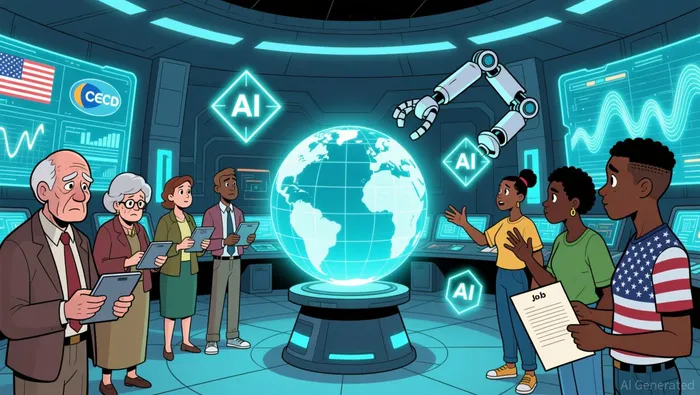
AI-Driven Displacement and Sectoral Divides
Artificial intelligence and automation are accelerating labor market polarization. Administrative and clerical roles are being phased out, while high-skill sectors demand reskilling. The federal workforce purge, which eliminated 277,000 jobs in 2025, exemplifies how policy and technological shifts can abruptly reshape employment. This has left the U.S. labor market in a "no-hire" and "low-fire" equilibrium, with November 2025 job gains at a modest 64,000 and unemployment rising to 4.6%-the highest since 2021.
Sectoral divides are stark. Healthcare and green energy continue to expand, with healthcare projected to grow by 8.4% over the next decade due to aging populations and chronic disease management demands. Conversely, manufacturing, logistics, and public education face job declines, while warehousing and federal employment see sharp reductions. This bifurcation creates uneven risks and opportunities for consumer-driven sectors.
Consumer-Driven Sectors: Retail, Hospitality, and Healthcare
Retail is grappling with a "value-focused" shift as consumers trade down due to affordability concerns. Real consumer spending growth is projected at 1.5% in 2026, with retailers like Dollar Tree benefiting from multiprice strategies. However, automation and hiring freezes have led to job losses, with retail shedding 25,000 positions in December 2025. The sector's reliance on low- and middle-income workers-many of whom are young-exposes it to prolonged labor shortages and wage stagnation.
Healthcare remains a bright spot, adding 38,500 jobs in December 2025 and projected to grow steadily. However, the sector faces its own hurdles, including difficulty in attracting young workers and retaining staff amid burnout and AI-driven efficiency pressures.
Policy and Investment Implications
Investors must weigh the interplay of policy interventions and technological adoption. Tax cuts and interest rate reductions could stimulate hiring, but their efficacy depends on addressing skills gaps and integrating underrepresented groups into the workforce. For example, healthcare's growth hinges on resolving labor shortages through training programs, while retail and hospitality may benefit from AI-driven efficiency gains that offset wage pressures.
The key risk lies in a prolonged "jobless recovery," where economic growth decouples from employment gains, eroding consumer confidence and spending. Sectors like healthcare and green energy offer resilience, but retail and hospitality remain vulnerable to affordability constraints and labor market rigidity.
Conclusion
The 2026 labor market is a microcosm of broader structural imbalances. Aging populations, youth unemployment, and AI-driven displacement are not just economic headwinds-they are reshaping the very fabric of consumer-driven sectors. For investors, the imperative is clear: prioritize sectors aligned with demographic and technological trends while hedging against the risks of a labor market in transition.







Comentarios
Aún no hay comentarios