
Risk Horizon Expanding: How Trump's Tax Legacy Threatens Healthcare and Investor Portfolios
The Tax Cuts and Jobs Act (TCJA) of 2017, once hailed as an economic stimulus, has morphed into a fiscal time bomb with profound implications for healthcare accessibility, federal debt sustainability, and investor exposure to systemic risks. As provisions of the TCJA expire by year-end 2025, the interplay of rising debt, interest rate volatility, and healthcare sector instability creates a volatile landscape for markets. This analysis explores these dynamics and their investment ramifications.
The Debt Avalanche and Its Economic Toll
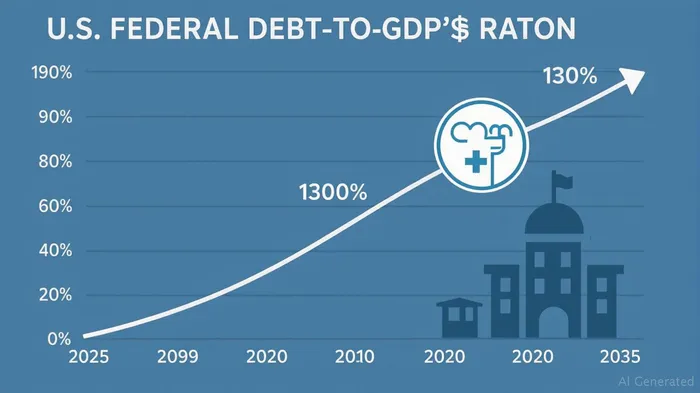
The TCJA's $1.5 trillion price tag exacerbated federal debt, which the Congressional Budget Office (CBO) projects will hit 100% of GDP by 2025, rising to 130% by 2035 if the One Big Beautiful Bill Act (OBBBA) extensions are enacted. This trajectory creates a self-reinforcing cycle:
- Interest Costs: By 2034, interest payments could balloon to $1.9 trillion annually, consuming 28% of federal revenue.
- Crowding Out Effect: Higher borrowing costs could displace investment in public goods, slowing long-term economic growth.
Healthcare Accessibility Under Siege
The OBBBA's proposed Medicaid cuts—projected to leave 11.8 million more Americans uninsured by 2034—threatens healthcare sector stability. Hospitals and insurers face dual pressures:
1. Revenue Pressures: Reduced reimbursements from government programs could strain margins, particularly for rural providers.
2. Demand Shifts: A sicker uninsured population may overwhelm emergency rooms, increasing uncompensated care costs.
Investors in healthcare stocks like UnitedHealth Group (UNH) or Humana (HUM) should monitor Medicaid enrollment trends and policy revisions. Meanwhile, telehealth platforms (e.g., Teladoc Health) might see demand spikes if in-person care becomes less accessible, but their profitability hinges on regulatory clarity.
Consumer Spending: A Fragile Foundation
The TCJA's expiration in 2025 could trigger a $2.1 trillion tax increase for 62% of taxpayers, dampening consumer spending—the economy's main engine.
- Wealth Disparity: The top 1% gained disproportionately from tax cuts, while middle-class households face regressive impacts like the retained $10,000 SALT deduction cap.
- Retail Exposure: Sectors like discretionary retail (e.g., Walmart (WMT), Target (TGT)) could see reduced sales if disposable income shrinks.
Interest Rate Volatility: The Silent Risk Multiplier
The debt explosion elevates systemic risks tied to interest rates:
- Bond Market Stress: Rising Treasury yields could force the Federal Reserve to delay rate cuts, prolonging economic pain.
- Corporate Borrowing Costs: High-yield bonds (e.g., energy or real estate firms) face downgrades as credit spreads widen.
Investors should avoid overexposure to high-yield ETFs (e.g., HYG) and prioritize investment-grade bonds (e.g., LQD).
Portfolio Strategy: Navigating the Storm
- Healthcare: Diversify Revenue Streams
- Favor pharma giants (e.g., Pfizer (PFE)) with global sales or specialty providers (e.g., Quest Diagnostics (DGX)) less reliant on U.S. subsidies.
Avoid hospital stocks (e.g., Tenet Healthcare (THC)) vulnerable to Medicaid cuts.
Defensive Plays
Utilities (e.g., NextEra Energy (NEE)) and consumer staples (e.g., Procter & Gamble (PG)) offer stability amid fiscal uncertainty.
Interest Rate Hedging
- Use inverse rate ETFs (e.g., TLT) or gold (GLD) to hedge against inflation and rate volatility.
Conclusion: A High-Water Mark for Fiscal Prudence
The TCJA's legacy is a stark reminder that tax cuts without offsets create generational fiscal liabilities. Investors must account for rising interest costs, healthcare sector fragility, and consumer spending headwinds. Proactive portfolio adjustments—favoring defensive sectors, quality healthcare stocks, and interest-rate hedges—are critical to weathering the storm. The clock is ticking: with $1.9 trillion in tax cuts set to expire in 2025, legislative choices will define both economic stability and market direction.
Stay vigilant, stay diversified.





Comentarios
Aún no hay comentarios