
Risk Exposure in Government Contractor Stocks Amid Rising Political and Regulatory Volatility
The intersection of immigration enforcement, political polarization, and corporate accountability has never been more volatile than in 2025. As the Trump administration's aggressive ICE operations-marked by high-profile incidents like the fatal shooting of Renee Good in Minneapolis-sparked nationwide protests and regulatory scrutiny, defense and immigration tech firms face a perfect storm of reputational, legal, and financial risks. For investors, the implications are clear: the sector's exposure to ICE-related contracts and technologies is now a double-edged sword, with political and regulatory shifts threatening to upend long-term profitability.
Political Polarization and ICE's Expanding Footprint
The 2025 ICE incidents have crystallized a deepening political divide. Liberal Democrats, led by figures like Senator Elizabeth Warren, have demanded independent investigations into ICE's conduct and called for stricter oversight of private contractors like GEO GroupGEO-- and CoreCivicCXW--. Meanwhile, the Trump administration has doubled down on its hardline agenda, allocating $170.7 billion to ICE and immigration enforcement, including sweeping detention and deportation measures under the Laken Riley Act and the Preventing Violence Against Women by Illegal Aliens Act. This bifurcated approach has created a regulatory environment where contractors face both sudden policy tailwinds and existential headwinds.
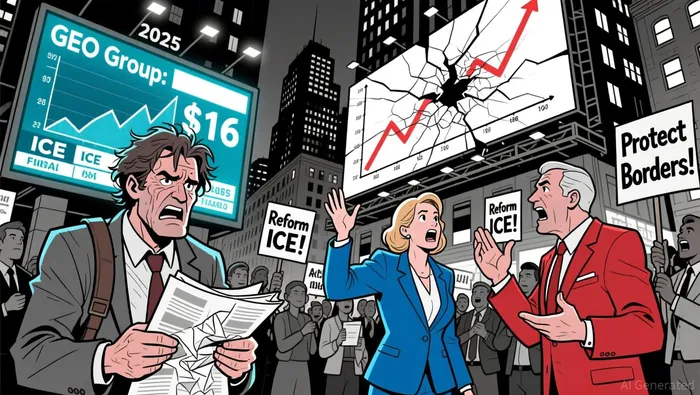
For example, GEO Group and CoreCivic initially saw investor optimism after Trump reversed Obama-era restrictions on private detention facilities. However, by year-end, their stock prices had plummeted from $36.46 to $16 for GEO Group, as the anticipated surge in ICE detention capacity failed to materialize. This volatility underscores the fragility of a business model reliant on politically charged policies.
Regulatory Erosion and Oversight Gaps
The Department of Homeland Security's (DHS) decision to eliminate key oversight bodies-such as the Office of the Immigration Ombudsman and the Office of Civil Rights and Civil Liberties-has further amplified risks for contractors. These cuts, justified by the administration as a cost-saving measure, have removed critical checks on ICE's use of force and surveillance technologies. For firms like Clearview AI, which secured a $3.75 million ICE contract for facial recognition tools, this regulatory erosion has enabled rapid expansion but at the cost of heightened public backlash and legal scrutiny.
Clearview AI's controversial database of billions of scraped images, already the subject of a $51.75 million privacy settlement in 2025, now faces renewed criticism as ICE deploys its tools to track immigrants and protesters. Privacy advocates argue that such technologies risk violating constitutional rights, while lawmakers have raised concerns about ICE's use of AI-generated reports in law enforcement, citing inaccuracies and ethical lapses.
Technological Overreach and Market Reckonings
The Trump administration's push to militarize immigration enforcement has also driven ICE to invest heavily in surveillance technologies. In 2025, ICE spent over $300 million on tools like social media monitoring, license plate readers, and skip-tracing services, with contracts potentially reaching $1 billion by 2027. While these investments have boosted short-term revenue for tech firms, they have also exposed contractors to reputational damage. For instance, ICE's use of Zignal Labs to monitor anti-ICE activists and its labeling of protesters as "domestic terrorists" have drawn sharp criticism from civil liberties groups.
Moreover, the administration's directive to track financial support for dissenters-highlighted by acting ICE Director Todd Lyons-has raised alarms about ethical boundaries. For investors, this signals a growing risk of regulatory pushback, as states and municipalities begin to restrict the use of such technologies.
Investment Implications and Strategic Considerations
The 2025 ICE incidents and their fallout highlight three critical risks for investors:
1. Policy Uncertainty: Legislative battles over ICE funding and oversight could lead to abrupt shifts in contract demand. For example, Democrats' threat to shut down the government over ICE funding underscores the fragility of current arrangements.
2. Regulatory Scrutiny: As Warren and others investigate potential conflicts of interest in ICE contracts, firms like GEO Group and Clearview AI may face investigations or penalties.
3. Public Backlash: Protests and media coverage of ICE's actions have eroded public trust, potentially leading to boycotts or divestment campaigns against contractors.
Investors should also monitor the long-term viability of ICE's enforcement strategies. While the administration's $170.7 billion funding package appears ambitious, logistical challenges-such as the underutilization of detention beds and the high cost of mass deportations- could strain budgets and force policy reversals.
Conclusion
The 2025 ICE incidents have exposed the inherent risks of investing in government contractors tied to politically charged sectors. While short-term gains may materialize from policy tailwinds, the combination of regulatory erosion, public backlash, and political polarization creates a landscape of unpredictable volatility. For investors, the lesson is clear: diversification and rigorous due diligence are essential in a sector where policy shifts can erase value overnight.





Comentarios
Aún no hay comentarios