
Rising Whale Activity in Toncoin and Quant: Signals of Institutional Inflow or Market Speculation?
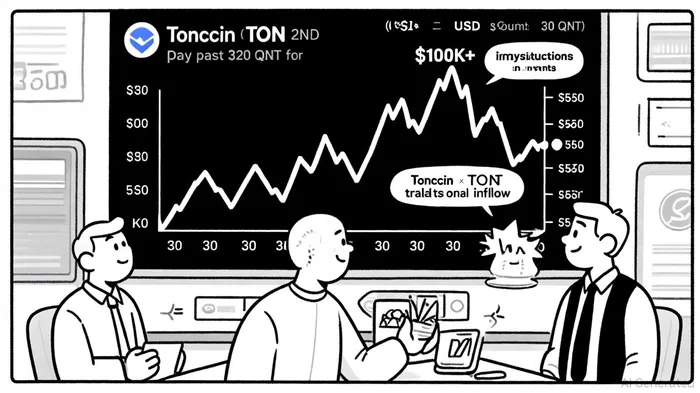
The cryptocurrency market has long treated whale activity as a barometer for institutional interest and speculative fervor. Recent on-chain data for Toncoin (TON) and Quant (QNT) reveals a surge in large transactions, raising questions about whether these movements reflect genuine institutional inflow or short-term speculative bets. By dissecting transaction patterns, technical indicators, and market sentiment, we can assess the validity of these signals.
Toncoin (TON): Institutional Backing or Whale-Driven Hype?
Toncoin has seen a notable uptick in whale activity, with over $100K+ transactions spiking in recent weeks. Santiment notes that such whale movements historically precede price volatility or trend reversals[1]. A single $70 million whale transaction further underscores this trend, suggesting potential institutional involvement[3].
Institutional interest appears to corroborate this narrative. TON StrategyTONX-- Co.'s $558 million private investment vehicle (PIPE) offers a hybrid of staking yields (4.86%) and appreciation, attracting firms like Pantera Capital and Kraken[1]. This capital influx aligns with TON's hybrid treasury model, which has drawn substantial institutional capital. However, TON's price remains range-bound between $3.00 and $3.33, with a 13% monthly decline[2]. While bullish technical indicators like a MACD crossover and rising RSI hint at upward momentum[2], the lack of sustained volume growth raises doubts about the sustainability of this optimism.
Quant (QNT): Mixed Signals in a Consolidating Market
Quant's whale activity mirrors TON's, with large transactions exceeding $100K signaling potential directional shifts[2]. Santiment's analysis links these spikes to historical volatility, though QNT's price remains constrained by key technical levels—resistance at $106.72 and support at $99.50[1].
Institutional inflow data for QNT is less clear. While some reports highlight declining EthereumETH-- outflows to Binance, others suggest QNT's liquidity is stifled by broader altcoin weakness (Bitcoin dominance at 57.63%)[1]. This ambiguity complicates the interpretation of whale activity: Are these transactions driven by long-term conviction or opportunistic trading in a low-liquidity environment?
Market Sentiment and On-Chain Trends
Both projects show correlations between whale activity and on-chain sentiment. TON's weekly transaction volume has risen 32%, with fees climbing as network usage intensifies[2]. For QNT, the lack of similar on-chain growth metrics weakens the case for institutional adoption.
However, market sentiment remains a double-edged sword. TON's historical 15-20% price gains post-whale activity[1] contrast with QNT's stagnant performance, suggesting divergent narratives. While TON's institutional backing and hybrid yield model provide a structural advantage, QNT's reliance on technical breakouts makes it more susceptible to speculative cycles.
Conclusion: Distinguishing Signals from Noise
The surge in whale activity for TON and QNT reflects broader crypto market dynamics. For TON, the alignment of institutional capital, on-chain growth, and bullish technicals points to a plausible breakout scenario—if volume and sentiment sustain. QNT, meanwhile, remains trapped in a consolidation phase, where whale movements may signal short-term speculation rather than long-term conviction.
Investors should approach these signals with caution. Whale activity is a leading indicator, but its interpretation depends on contextual factors: liquidity, institutional alignment, and macroeconomic trends. In TON's case, the pieces seem to align for a meaningful move. For QNT, the jury is still out.





Comentarios
Aún no hay comentarios