
Rising Treasury Yields: The Hidden Fiscal Risk Premium and Its Market Implications
The U.S. 10-year Treasury yield, a cornerstone of global fixed income markets, has defied economic gravityG-- in 2025. Despite slowing GDP growth, rising unemployment pressures, and persistent tariff-driven inflation, yields have stabilized near 4.5%, defying expectations of a meaningful decline. This disconnect between weakening fundamentals and climbing yields signals a seismic shift in investor sentiment—one driven by a newly emerging fiscal risk premium. Below, we dissect this paradox and its implications for investors.
The Disconnect: Rising Yields vs. Deteriorating Data
As of July 2025, the U.S. economy is navigating a treacherous path. GDP contracted 0.5% in Q1, marking the largest quarterly decline since 2020, while core inflation (PCE deflator) remains stubbornly elevated at 3.6%. Unemployment, though still low at 4.1%, has begun to drift upward, with long-term joblessness hitting pandemic-era highs. Yet the 10-year Treasury yield, a benchmark for everything from mortgages to corporate debt, refuses to retreat.
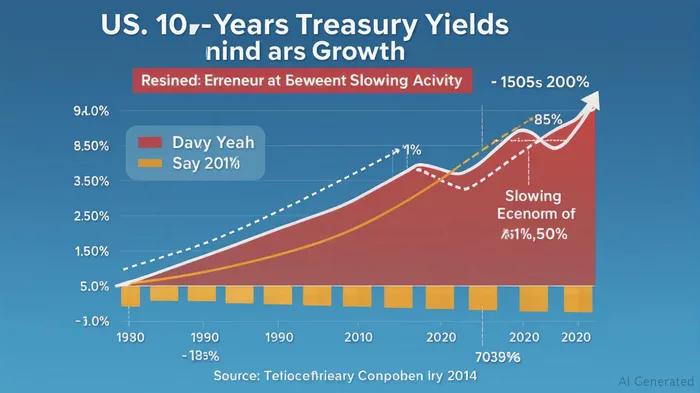
Why the disconnect? Three factors are at play:
- Tariff-Induced Inflation: Trade tensions have created a cost-push inflation spiral, with tariffs on China and the EU adding an estimated 0.7% to annual inflation. Investors now price in persistent inflation risks, even as growth slows.
- Fiscal Risk Premium: The federal deficit is projected to hit 6.4% of GDP in 2025, fueled by extended tax cuts and spending offsets. Markets are pricing in the long-term cost of higher debt servicing, particularly if recessionary pressures force further fiscal stimulus.
- Fed Policy Uncertainty: Despite softening data, the Fed has delayed rate cuts due to inflation concerns. Forward guidance suggests yields will remain elevated until 2026, even as growth stagnates.
The Fiscal Risk Premium: A New Paradigm
The Treasury market is now pricing in not just inflation or growth expectations, but a novel risk premium tied to policy missteps and debt sustainability.
- Debt Dynamics: With public debt exceeding 125% of GDP, investors demand higher yields to compensate for the risk of fiscal austerity or inflation-driven dilution of returns.
- Trade Policy Volatility: Tariffs are no longer just an economic irritant but a market-moving macro variable. The downside scenario—where tariffs rise to 25%—could push yields above 5%, as bond markets anticipate recessionary fiscal stimulus.
This premium explains why yields have held firm even as GDP and corporate earnings weaken. Investors are now hedging against a "lose-lose" scenario: either inflation stays elevated (requiring higher yields), or a recession forces the government to borrow more (raising default risks).
Investment Implications: Navigating the New Reality
The disconnect between yields and economic data creates both risks and opportunities for fixed income investors:
1. Reduce Exposure to Long-Term Bonds
The 10-year Treasury's elevated yield reflects a structural shift, not a cyclical blip. With the fiscal risk premium here to stay, long-duration bonds face headwinds.
Action: Shift to short-term Treasuries (e.g., 2-5 year maturities) or floating-rate instruments to minimize duration risk.
2. Hedge Against Inflation and Fiscal Stress
Inflation-linked bonds (TIPS) and commodities (e.g., gold, energy) offer protection against the twin risks of tariffs and rising debt.
Action: Allocate 5-10% of fixed income portfolios to inflation hedges.
3. Avoid Overweighting Rate-Sensitive Sectors
Real estate and utilities, which rely on low rates, face valuation pressure as yields remain elevated.
Action: Underweight REITs and utility stocks; favor sectors insulated from tariff impacts, such as healthcare (e.g., Johnson & Johnson (JNJ), Moderna (MRNA)) or technology firms with pricing power (e.g., Microsoft (MSFT)).
4. Monitor Fiscal Policy Closely
A resolution to trade wars or a credible deficit reduction plan could collapse the risk premium. Conversely, a recession-driven fiscal stimulus surge would validate higher yields.
Watch:
- The U.S.-China trade talks timeline.
- Federal deficit projections post-2026.
- Fed Chair Powell's communications on rate cuts.
Conclusion: The New Fixed Income Playbook
The Treasury market's refusal to retreat signals a paradigm shift: fiscal risk is now a core pricing input. Investors must abandon traditional yield-growth correlations and instead focus on policy volatility, debt dynamics, and inflation persistence.
For now, the path forward is clear: shorten maturities, hedge inflation, and avoid rate-sensitive sectors. The fiscal risk premium isn't just a blip—it's the new normal for fixed income markets.
Stay vigilant. Stay diversified.
Disclaimer: Past performance does not guarantee future results. Consult a financial advisor before making investment decisions.







Comentarios
Aún no hay comentarios