
The Rising Tide of Climate Resilience: Why Flood Mitigation Tech is a Must-Buy Now
In 2025, the world is waking up to a new reality: cities are drowning. From New York to Miami, Dubai to Paris, urban centers are grappling with the escalating fury of climate-driven floods. The aftermath of Hurricane Sandy and the 2024 deluges in New York City have become a harbinger of things to come. But in this crisis lies an opportunity. The global flood mitigation market is surging, driven by AI, IoT, and policy-driven investments. For investors, the question isn't whether to act—it's how to position for the inevitable.
The Catalyst: Policy, Panic, and Public-Private Partnerships
New York City's Climate Resiliency Design Guidelines, mandated by Local Law 41(2021), are a case study in urgency. By 2026, the city will have spent billions retrofitting infrastructure to withstand 21st-century weather. The guidelines require new projects to factor in future flood risks, from sea-level rise to 100-year storm surges. The result? A $1.5 billion pipeline of climate-resilient infrastructure, with 40% of projects targeting environmental justice neighborhoods.
Miami, meanwhile, has taken a different but equally bold approach. Its $400 million “forever bond” and the appointment of the world's first chief heat officer signal a shift from reactive to proactive governance. The city's S&P rating improved from “AA-” to “AA” in 2023, proving that resilience isn't just a moral imperative—it's a financial one.
The Market: From Panic to Profit
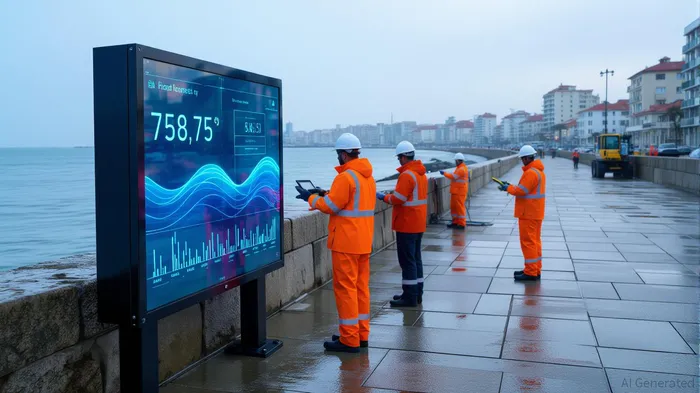
The North America Flood Panel Market is projected to grow at a 9.2% CAGR through 2033, reaching $3.2 billion. This isn't just about concrete barriers. It's about AI-driven predictive models, real-time IoT monitoring, and modular systems that adapt to dynamic threats.
Consider FloodMapp, a startup that's revolutionized flood forecasting. Its NowCast platform maps live flood extent and depth, while ForeCast predicts risks up to seven days in advance. FEMA integrated its data into the National Flood Insurance Program in 2023, and Waze now alerts drivers to flooded roads using FloodMapp's tech. The company's 85% accuracy rate in identifying inundated properties has made it a darling of city planners and insurers alike.
Similarly, AEM Elements® 360—a platform combining AI, real-time sensors, and high-resolution rainfall data—has been deployed in Raleigh, Charlotte, and Tarrant County. Its three-day predictive window allows cities to pre-position sandbags and evacuate residents.
The Winners: Who to Watch
The Smart Water Management Market, valued at $20.15 billion in 2024, is expected to hit $59.58 billion by 2032. Here are the key players:
- Xylem (XYL): A global leader in AI-powered water analytics and IoT-based conservation. With $8.3 billion in 2024 revenue, Xylem's predictive models are being used in over 150 countries.
- Suez (SESG.PA): France's infrastructure giant is expanding into AI-driven desalination and digital twins for water networks. Its 2024 revenue ($9.5 billion) reflects growing demand for sustainable solutions.
- Itron (ITI): This Liberty Lake-based firm dominates in advanced metering infrastructure (AMI) and leak detection. Its AMI systems are cutting water waste in cities like Dallas and Phoenix.
- FloodMapp (private): While not publicly traded, the company's integration with FEMA and Waze signals explosive growth potential. Investors should watch for an IPO or acquisition by a larger tech firm.
Beyond the US: A Global Trend
The urgency isn't confined to North America. Dubai's $8.2 billion stormwater overhaul post-2024 floods and France's Eau du Ponant reducing non-revenue water by 50% using SmartBall technology show that flood mitigation is a global priority. Hong Kong's digital twins and Arup's AI-driven heat and flood tools are reshaping urban planning.
The Investment Case: Act Now
The $194 billion funding gap in the U.S. municipal water sector by 2030 isn't just a risk—it's an opportunity. Companies like XylemXYL-- and American Water WorksAWK-- (AWK) are already seeing returns. AWK's $40–$42 billion capex plan is paying off: first-quarter 2025 earnings hit $1.05/share, up 11% YoY.
For long-term investors, the message is clear: the flood is coming, and those who prepare will thrive. Flood mitigation isn't a niche sector—it's the new infrastructure.
Conclusion: The Only Way Forward
The cost of inaction is rising faster than sea levels. But for those who recognize the scale of the challenge—and the opportunity—it's time to invest in the companies building tomorrow's cities. From AI-powered flood panels to smart water meters, the tools to outsmart climate change are here. The question is, are you ready to ride the wave?







Comentarios
Aún no hay comentarios