
The Rising Strategic Value of Skilled Nursing Real Estate in Aging-Dominated Markets
The U.S. skilled nursing facility (SNF) market is undergoing a seismic shift, driven by the collision of an aging population and a tightening supply of long-term care beds. As the baby boomer generation advances into its senior years, demand for specialized care is surging. According to a report by Senior Housing Business, occupancy rates in the top 31 NIC MAP primary markets hit 85.9% in Q1 2025, a stark indicator of pent-up demand [1]. Meanwhile, the U.S. Department of Health and Human Services estimates that 70% of individuals turning 65 today will require long-term care services in their later years [1]. Yet, the supply of SNF beds has contracted by over 25,000 units between 2021 and 2025 [1], creating a critical imbalance that is reshaping investment dynamics in the sector.
HUD-Insured Financing: A Strategic Leverage Point
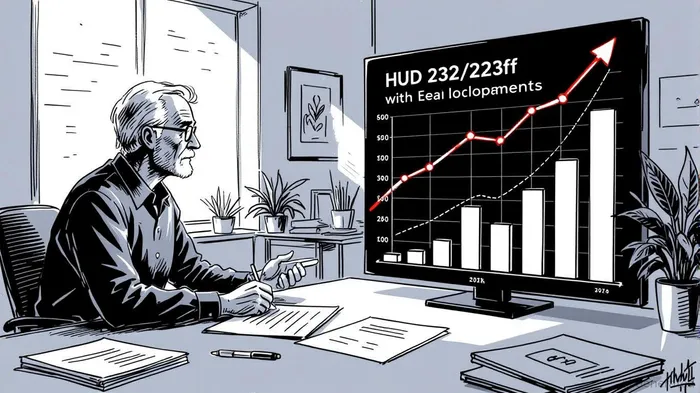
The constrained supply and robust demand have amplified the strategic value of SNF real estate, particularly for investors leveraging HUD-insured financing. HUD’s 232 and 223(f) programs offer long-term, nonrecourse loans with up to 80% financing and lower interest rates compared to conventional debt products [2]. These programs have become a lifeline for developers and operators seeking to recapitalize, acquire, or stabilize facilities in high-growth markets. In FY 2024, HUD 232/223(f) loan volume surged by 25% year-over-year [3], a trend that lenders anticipate will persist in 2025 due to improved operating fundamentals and a backlog of maturing loans [3].
Recent transactions underscore this momentum. Forbright Bank’s Q2 2025 refinancing of a Georgia-based SNF via a HUD 232/223(f) loan exemplifies how these programs enable operators to replace costly bridge financing and fund operational upgrades [1]. Similarly, Dwight Capital’s $68 million loan for four Florida SNFs—totaling 480 beds—highlights the scalability of HUD financing in addressing regional demand gaps [2]. These deals reflect a broader industry shift toward leveraging HUD’s assumable loan terms and favorable interest rates to mitigate risks in a volatile capital market.
Market Projections and Technological Tailwinds
The demographic tailwinds are only intensifying. By 2030, the 80+ age group is projected to reach 18.8 million, driving exponential growth in demand for memory care and chronic condition management [3]. This surge is already translating into market expansion: the global elderly care services market, valued at $41.05 billion in 2024, is forecasted to grow at a 6.78% CAGR through 2033 [4]. In the U.S., the long-term care provider market alone is valued at $12.08 billion in 2025 and expected to reach $22.03 billion by 2033, reflecting a 10.53% CAGR [5].
Technological advancements are further enhancing the sector’s appeal. AI-driven care analytics, telehealth platforms, and remote monitoring systems are improving operational efficiency and resident outcomes [3], making SNFs more attractive to both investors and regulators. These innovations, coupled with HUD’s financing flexibility, position skilled nursing real estate as a resilient asset class in an aging-dominated economy.
Conclusion: A Convergence of Opportunity
The interplay of demographic inevitability, supply constraints, and HUD’s financing tools has created a unique inflection point for skilled nursing real estate. Investors who act decisively can capitalize on this convergence by acquiring or developing assets in high-occupancy markets, leveraging HUD’s low-cost, long-term capital to optimize returns. As the sector navigates regulatory and operational challenges, the strategic use of HUD-insured financing will remain a cornerstone of sustainable growth—a testament to the enduring value of aligning capital with societal needs.
Source:
[1] Skilled Nursing Operators Navigate Array of Challenges [https://seniorshousingbusiness.com/skilled-nursing-operators-navigate-array-of-challenges/]
[2] Financing Options for Senior Housing Facilities [https://www.lsglending.com/blog/financing-options-for-senior-housing-facilities-a-comprehensive-guide/]
[3] Why HUD Lenders Believe the Wind is at Their Back [https://seniorshousingbusiness.com/with-improving-occupancies-limited-supply-and-favorable-demographics-hud-lenders-have-the-wind-at-their-backs/]
[4] Elderly Care Services Market Size | Global Forecast To 2033 [https://www.marketgrowthreports.com/market-reports/elderly-care-services-market-112754]
[5] And USA Long Term Care Provider Market by Applications [https://www.linkedin.com/pulse/usa-long-term-care-provider-market-applications-hgfsf/]







Comentarios
Aún no hay comentarios