
Why Rising Spot Rates May Signal a Market Mispricing Opportunity
In fixed-income markets, rising spot rates often trigger a cascade of investor behavior that can create mispricing opportunities. While traditional theory posits an inverse relationship between bond prices and yields, real-world dynamics reveal a more nuanced picture. Recent research and historical case studies demonstrate that periods of rising rates are not merely about price declines-they are fertile ground for identifying undervalued assets and exploiting market inefficiencies driven by behavioral biases and structural constraints.
Investor Behavior and Structural Constraints: Catalysts for Mispricing
When spot rates rise, investors often react with a mix of panic and opportunism. During the first half of 2025, for instance, U.S. Treasury rates surged amid geopolitical tensions and tariff uncertainty, yet market conditions stabilized as investors recalibrated their portfolios toward income-generating and relative-value strategies, as noted in the Goldman Sachs outlook. This shift underscores how investor sentiment-particularly asymmetric trading behaviors (e.g., ease of buying versus shorting)-can amplify mispricing. A four-factor model developed in The Review of Financial Studies highlights that mispricing factors are strongly predicted by investor sentiment, especially for short legs of the factors, a point also made in the Goldman SachsGS-- outlook. Such asymmetries create arbitrage opportunities for sophisticated investors who can identify over- or undervalued securities.
Structural constraints further exacerbate mispricing. During the 2008–2012 period, corporate bonds guaranteed by the U.S. government exhibited a persistent 20.07 basis point mispricing, driven by intermediary limitations such as capital and liquidity constraints, according to a ScienceDirect study. These constraints reduce dealers' ability to arbitrage price discrepancies, allowing mispricing to persist. Similarly, in 2020, institutional investors turned to fixed-income ETFs during market stress, with trading volumes in high-yield ETFs surging to $7.8 billion per day-nearly triple the 2019 average, according to a Verus Investments analysis. This reliance on ETFs during liquidity crunches highlights how market structure can distort pricing, particularly in over-the-counter bond markets.
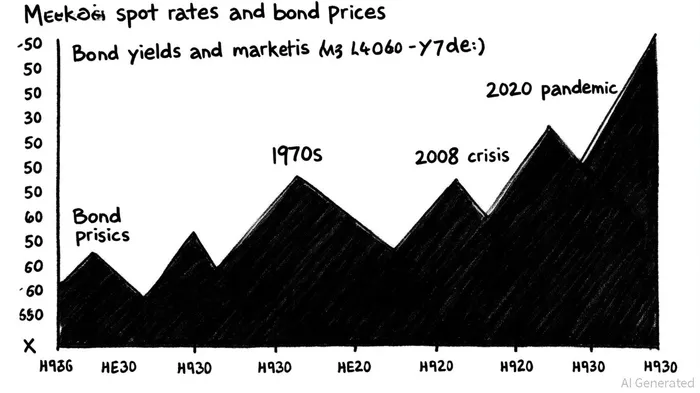
Historical Precedents: Lessons from the 1970s, 2008 Crisis, and 2020 Pandemic
The 1970s provide a stark example of mispricing during rising rate environments. As inflation spiraled, the Federal Reserve hiked rates to 15% by 1981, causing long-term government bonds to lose 8.6% in 1979 alone, as reported by Verus Investments. However, this period also created opportunities for investors who recognized the disconnect between bond yields and inflation expectations. Those who shifted to shorter-duration bonds or inflation-linked securities (e.g., TIPS) capitalized on the mispricing.
The 2008 financial crisis offers another lens. While rising rates typically depress bond prices, the Fed's aggressive rate cuts (from 5.25% in 2006 to 0.25% by 2008) led to a flight to safety, with high-quality bonds surging in price despite deteriorating fundamentals, a behavior noted in the Goldman Sachs outlook. This behavioral anomaly-where investors prioritize liquidity over yield-created mispricing in lower-quality bonds, which underperformed by 28.2% compared to the Aggregate Index's 5.2% return, according to Verus Investments.
The 2020 pandemic further illustrates how market stress and rising rates interact. As the Fed raised rates in 2022–2023, municipal bond yields became increasingly attractive relative to Treasuries, with spreads widening to levels not seen since the 2008 crisis, a trend highlighted by Verus Investments. Investors who recognized this divergence could exploit relative value opportunities in sectors like infrastructure or education, where credit fundamentals remained robust despite broader market pessimism.
Strategic Opportunities in a Rising Rate Environment
For investors, rising spot rates present three key opportunities:
1. Yield Curve Steepening: In 2025, European and U.S. markets saw steepening yield curves as investors sought longer-duration assets for income, an observation echoed in the Goldman Sachs outlook. This dynamic creates opportunities in sectors like utilities or infrastructure, where cash flows are less sensitive to rate hikes.
2. Relative Value Arbitrage: Divergences in central bank policies (e.g., the Fed's cautious stance versus the ECB's rate cuts) have expanded the fixed-income opportunity set, a theme discussed in the Goldman Sachs outlook. Investors can exploit mispricing between developed and emerging market bonds, particularly in local currency debt with attractive carry.
3. Credit Selection: Historical data shows that higher-quality bonds outperform during rate hikes. For example, the Bloomberg U.S. Aggregate Index returned 3.7% annually during the 2003–2006 tightening cycle, while high-yield bonds lagged, as noted by Verus Investments. This suggests that credit selection-favoring investment-grade or inflation-linked bonds-can mitigate downside risk.
Conclusion
Rising spot rates are not merely a threat to fixed-income portfolios; they are a signal of market inefficiencies shaped by investor behavior and structural constraints. By leveraging historical precedents, advanced models like the four-factor framework, and a deep understanding of liquidity dynamics, investors can identify mispricing opportunities that others overlook. As the 2025 market environment demonstrates, the key to navigating rising rates lies not in avoiding them, but in harnessing their volatility to build resilient, high-conviction portfolios.





Comentarios
Aún no hay comentarios