
Rising Risks of Supply Chain Attacks in Global Tech Infrastructure
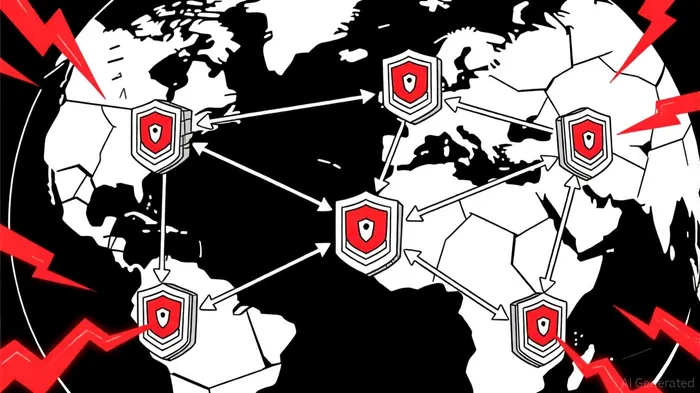
The global tech infrastructure is under siege. As supply chains become increasingly digitized and interconnected, the attack surface for cybercriminals has expanded exponentially. In 2025, supply chain attacks are no longer a niche concern—they are a systemic risk to enterprises, governments, and economies. According to a report by MarketsandMarkets, the global cybersecurity market is projected to grow from USD 227.59 billion in 2025 to USD 351.92 billion by 2030, driven by the urgent need to defend against sophisticated threats like ransomware-as-a-service (RaaS) and AI-powered malware . For investors, this crisis presents a compelling opportunity: strategic investments in cybersecurity and supply chain resilience firms are no longer just defensive plays—they are foundational to long-term value creation.
The Market's Urgent Transformation
The cybersecurity supply chain resilience market is witnessing a paradigm shift. Traditional perimeter-based security models are being replaced by zero-trust architectures, continuous third-party risk monitoring, and AI-driven threat detection. A 2025 analysis by Fortune Business Insights highlights that 55.6% of businesses now prioritize cybersecurity as a cornerstone of supply chain resilience, reflecting a tectonic shift in risk management priorities . This is not merely a response to recent high-profile breaches but a proactive adaptation to a threat landscape where adversaries exploit trusted vendors, open-source dependencies, and hybrid work environments as entry points .
The financial stakes are staggering. In 2024 alone, over 30,000 vulnerabilities were disclosed, with supply chain attacks accounting for 23% of all breaches . As a result, enterprises are reallocating budgets to adopt technologies like blockchain for real-time tracking, IoT for predictive maintenance, and cloud-based platforms for agile risk mitigation . The Asia-Pacific region, in particular, is emerging as a growth engine, with rapid industrialization and cross-border trade driving demand for resilient infrastructure .
Strategic Investment Opportunities
Leading firms in the cybersecurity and supply chain resilience space are capitalizing on this transformation. IBMIBM--, for instance, is leveraging its hybrid cloud and AI capabilities to embed security into digital workflows, while OracleORCL-- is doubling down on cloud infrastructure and AI integration for enterprise applications . Emerson, a leader in industrial automation, is prioritizing digital transformation to secure critical infrastructure against disruptions . These companies exemplify a broader trend: cybersecurity is no longer an afterthought but a core component of enterprise strategy.
Investors should also consider the rise of Cybersecurity-as-a-Service (CaaS), which is democratizing access to advanced protection. Smaller firms and startups in this space, such as CrowdStrikeCRWD-- and Palo Alto NetworksPANW--, are seeing robust demand as businesses seek scalable, on-demand solutions . Meanwhile, regulatory tailwinds like the EU's NIS 2 Directive and AI Act are forcing supply chain stakeholders to adopt transparent, auditable security practices—a trend that will accelerate market consolidation and innovation .
Navigating Challenges and Risks
Despite the optimism, challenges persist. Budget constraints, third-party risk management, and a global shortage of skilled cybersecurity professionals remain significant hurdles . However, these pain points also highlight areas for innovation. For example, AI-driven automation is reducing the burden on human resources by enabling real-time threat detection and response . Additionally, the shift toward multi-shoring strategies—diversifying suppliers across regions—mitigates geopolitical risks while enhancing operational agility .
Conclusion: A Resilience-First Future
The rise of supply chain attacks is a wake-up call for global tech infrastructure. For investors, the path forward lies in backing firms that are not only addressing today's threats but redefining the future of security. As AI, quantum computing, and IoT reshape the landscape, companies that prioritize resilience—both in their products and their operations—will outperform peers. The market's growth trajectory, regulatory momentum, and technological innovation make cybersecurity and supply chain resilience a must-own sector for forward-thinking portfolios.







Comentarios
Aún no hay comentarios