
Rising Risks in EVM Wallet Security: Implications for Crypto Investors
The EthereumETH-- Virtual Machine (EVM) ecosystem has long been a cornerstone of decentralized finance (DeFi), but 2025 has exposed a troubling evolution in wallet security threats. As attackers refine their tactics, the financial stakes for investors have never been higher. According to a report by DeepStrike, wallet compromises-such as private key theft and seed phrase exposure-accounted for 69% of total losses in the first half of 2025, with over $1.71 billion stolen across 34 incidents. Phishing attacks, meanwhile, have surged by 40%, driven by fake exchange sites and AI-generated social engineering campaigns. These trends underscore a critical need for investors to reassess their portfolio protection strategies.
The Evolving Threat Landscape
The sophistication of EVM wallet attacks has outpaced traditional cybersecurity measures. For instance, the July 2025 crypto attacks report highlights the Future Protocol hack, where a business logic flaw in the FPC token's design allowed attackers to manipulate liquidity pools and siphon $4.6 million. Such incidents reveal that vulnerabilities are no longer limited to wallet infrastructure but extend to protocol-level weaknesses.
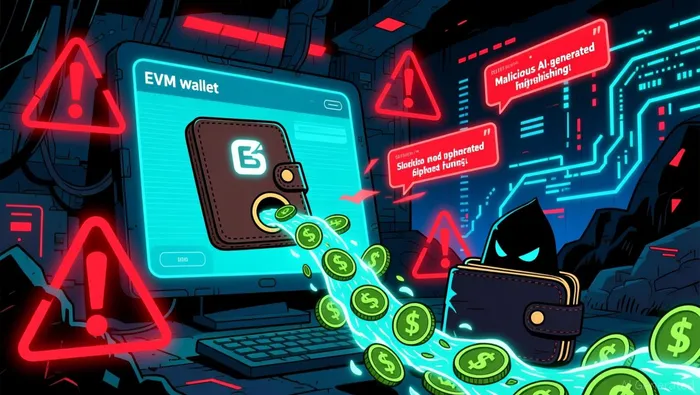
Perhaps the most alarming development is the role of AI in amplifying social engineering risks. Chainalysis notes that North Korea-linked actors exploited compromised IT personnel and AI-driven phishing campaigns to execute the ByBit breach-a $1.5 billion theft that alone accounted for 69% of all service-based losses in 2025. These attacks leverage large language models (LLMs) to craft hyper-personalized scams, including deepfakes and spoofed wallet interfaces, making it harder for users to distinguish between legitimate and malicious interactions.
Implications for Portfolio Protection
The growing complexity of threats demands a multi-layered defense strategy. Cold storage remains the gold standard for safeguarding assets. Hardware wallets like the SecuX V20 and W20, which offer military-grade encryption and EVM compatibility, have emerged as critical tools for investors. These devices isolate private keys from online environments, mitigating risks from malware and remote exploits.
For larger portfolios, multi-signature wallets add an additional barrier by requiring multiple approvals for transactions, reducing the impact of a single compromised key.
However, technology alone is insufficient. The Kroll Cyber Threat Landscape Report emphasizes that 40% of phishing losses in 2025 stemmed from user error, such as approving fake token contracts or clicking malicious links. Investors must adopt behavioral safeguards, including rigorous verification of dApp permissions and regular software updates to patch known vulnerabilities. Two-factor authentication (2FA) should also be enabled across all platforms, as it significantly reduces the risk of account takeovers.
Proactive Measures in an AI-Driven Era
As AI-generated threats become more pervasive, proactive education is paramount. ISACA's 2025 survey found that 63% of cybersecurity professionals now rank AI-driven social engineering as their top concern. Investors should prioritize awareness training to recognize AI-generated deepfakes, synthetic voice scams, and AI-powered phishing lures. Institutions, meanwhile, must implement AI governance frameworks and conduct regular penetration testing to identify protocol-level weaknesses (https://www.kroll.com/en/reports/cyber/threat-intelligence-reports/threat-landscape-report-lens-on-crypto).
Regulatory compliance also plays a role. The EU's Digital Operational Resilience Act (DORA) mandates stringent security protocols for crypto platforms, a move that could indirectly benefit individual investors by raising industry-wide standards. However, investors cannot rely solely on external measures; personal vigilance remains the first line of defense.
Conclusion
The 2025 crypto crime landscape is a stark reminder that EVM wallet security is no longer a technical niche but a central concern for all investors. With losses exceeding $2.17 billion in just six months, the cost of complacency is prohibitively high. By combining cold storage, multi-signature solutions, and AI-aware security practices, investors can mitigate risks while navigating the evolving threat environment. As the line between innovation and vulnerability continues to blur, the mantra for 2026 must be clear: protect your keys, verify every interaction, and stay ahead of the curve.






Comentarios
Aún no hay comentarios