
Rising Risks in DeFi Security: How Private Key Leaks and Smart Contract Vulnerabilities Are Undermining Returns
The decentralized finance (DeFi) sector has long been hailed as a disruptive force in global finance, promising democratized access to financial tools and services. Yet, as the ecosystem matures, a darker undercurrent has emerged: a surge in security breaches that are eroding investor confidence and returns. From 2023 to 2025, DeFi protocols have lost over $2 billion across 149 documented incidents, with private key leaks and smart contract vulnerabilities accounting for the lion's share of losses. For investors, these risks are no longer abstract-they are existential.
The Private Key Problem: A Silent Drain on Value
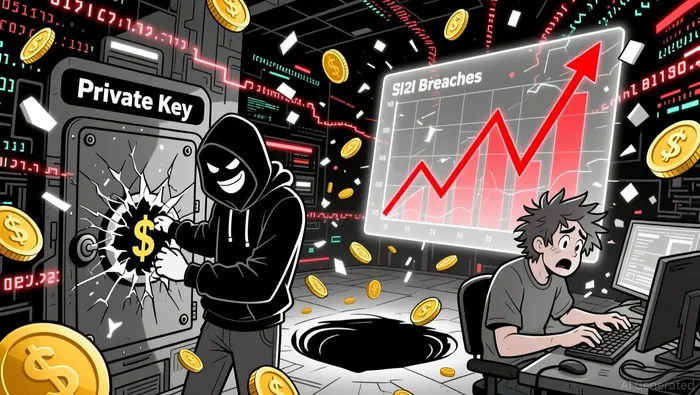
Private key leaks have become a critical vulnerability in DeFi, with compromised accounts responsible for 55.6% of attacks and 80.5% of stolen funds in 2024. The mechanics are straightforward: once an attacker gains access to a private key, they can drain wallets, mint tokens, or manipulate smart contracts. In September 2025 alone, Seedify suffered a $1.7 million hack after a developer's private key was compromised, while UXLINK lost $41 million when multi-sig wallet keys were stolen. These incidents underscore a harsh reality: even the most sophisticated protocols are only as secure as their key management practices.
The solution lies in advanced frameworks for key security. Hardware wallets, multi-signature (multi-sig) systems, and role-based access controls are table-stakes measures according to industry analysis. But investors must also adopt proactive incident response protocols. For example, crypto-specific threat intelligence platforms can detect anomalous activity in real time, while pre-approved on-chain actions-such as freezing compromised wallets-can limit damage according to industry experts. As one industry report notes, "The immutableIMX-- nature of blockchain demands rapid, precise responses to breaches, with actions taken directly on-chain to prevent further asset loss" according to the report.
Smart Contract Vulnerabilities: The Code That Eats Itself
Smart contract flaws have also plagued DeFi, with reentrancy attacks, overflow checks, and logic errors causing hundreds of millions in losses. The Cetus DEX hack in May 2025, for instance, exploited a missing overflow check to siphon $223 million, while the GMXGMX-- V1 exploit in July 2025 leveraged a reentrancy vulnerability in GLP pools to steal $40–42 million according to security analysis. These cases highlight a systemic issue: many protocols prioritize speed to market over rigorous code validation.
To mitigate this, investors must demand protocols adopt formal verification-a mathematical method to prove smart contract correctness-and continuous monitoring tools. Independent audits are no longer sufficient; protocols must also engage in bug bounty programs and incentivize community-driven security testing. For example, decentralized oracles like ChainlinkLINK-- have emerged as a critical layer of defense, ensuring that off-chain data inputs (e.g., price feeds) are tamper-proof according to security experts. Similarly, multi-party computation (MPC) mechanisms and institutional-grade wallets with governance policy engines can eliminate single points of failure according to industry standards.
Strategic Mitigation: Beyond the Basics
While cold storage and audits are foundational, strategic risk mitigation requires a layered approach. Investors should prioritize protocols with decentralized governance structures, as centralized chains with few validators are more susceptible to collusion and attacks . Additionally, MEV (maximal extractable value) protection tools are gaining traction, shielding protocols from front-running and sandwich attacks that exploit transaction ordering according to security research.
For individual investors, diversification is key. Avoiding protocols with unproven governance models or centralized control reduces exposure to systemic risks. As one analysis from the Enterprise Ethereum Alliance (EEA) notes, "Security in DeFi is not a one-time fix but a continuous process of adaptation and innovation" according to industry findings. This means staying informed about emerging threats and supporting projects that prioritize transparency and community governance.
Conclusion: Risk as a Cost of Entry
DeFi's promise of financial autonomy comes with a steep price tag: the need for relentless vigilance. For investors, the path forward lies in adopting advanced frameworks that address both private key leaks and smart contract vulnerabilities. From multi-sig wallets and formal verification to decentralized oracles and MEV protection, the tools exist to mitigate these risks. But as the 2025 breach statistics make clear, complacency is no longer an option. In a world where code is law, security must be the first line of defense.






Comentarios
Aún no hay comentarios