
The Rising Risks of Browser-Based Crypto Wallets and the Implications for Crypto Security Infrastructure
The crypto ecosystem is at a crossroads. While browser-based wallets have democratized access to digital assets, they have also become a prime vector for cyberattacks. In 2025, the risks associated with these wallets have escalated dramatically, with phishing attacks increasing by 40% and over $2.17 billion stolen from personal wallets in the first half of the year alone. These vulnerabilities-ranging from private key leakage to social engineering exploits-highlight a critical gap in the security infrastructure of the crypto space. For investors, this crisis presents a paradox: the same innovation that has made crypto accessible to millions now demands a reevaluation of how assets are protected.
The Anatomy of Browser-Based Wallet Risks
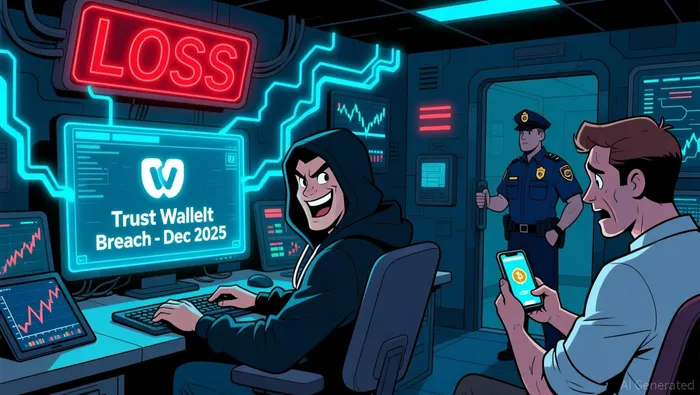
Browser-based wallets, such as MetaMask and Trust Wallet, operate within the browser environment, making them inherently exposed to phishing, malware, and compromised extensions. A 2025 report by Kroll underscores the scale of the problem, noting that nearly $1.93 billion was stolen in crypto-related crimes in the first half of the year. One illustrative case is the December 2025 Trust Wallet browser extension incident, where a malicious update led to a $6 million theft after users imported seed phrases into the compromised version.
 The vulnerabilities are systemic. A systematic review by Kirobo identifies replay attacks, weak password protocols, and insecure key storage as recurring issues. Meanwhile, Chainalysis' mid-year 2025 report reveals that personal wallet compromises now account for 23.35% of all stolen fund activity. These trends are exacerbated by the rise of AI-driven phishing tools, which enable attackers to craft hyper-targeted scams with unprecedented precision.
The Shift to Decentralized, Non-Custodial Protocols
The growing insecurity of browser-based wallets has accelerated demand for decentralized, non-custodial security protocols. Unlike traditional custodial models, these protocols eliminate single points of failure by allowing users to retain control over their private keys while leveraging smart contracts for asset management. Protocols like Lido, AaveAAVE--, EigenLayerEIGEN--, and UniswapUNI-- have emerged as leaders in this space, offering solutions that align with the core principles of decentralization and self-custody.
Lido, for instance, dominates the liquid staking market with $38 billion in staked ETH, enabling users to earn yield without sacrificing liquidity. Aave, the leading DeFi lending protocol, manages $11.8 billion in TVL across 13 blockchains, while EigenLayer's restaking mechanism has secured $14.1 billion in ETH, enhancing capital efficiency. Uniswap, with $6.2 billion in TVL and 1.9 million weekly active users, exemplifies the scalability of non-custodial trading infrastructure. These protocols are not only addressing security gaps but also redefining the economics of crypto asset management.
Investment Case: Metrics, Partnerships, and Institutional Adoption
The financial performance of these protocols underscores their investment potential. In Q1-Q3 2025, liquid staking and restaking protocols accounted for 45% of total DeFi TVL, up from 37% in the prior quarter. Aave's TVL grew by 19.78% in 30 days, driven by its multi-chain strategy and institutional adoption. Meanwhile, the Uniswap Foundation reported $140.3 million in Q1 revenue from donations, dividends, and interest.
Strategic partnerships further strengthen their cases. The Ethereum Protocol Advocacy Alliance, formed by Aave, Lido, and other DeFi leaders, advocates for policies protecting decentralized infrastructure. Additionally, buyback programs-such as Aave's $50 million annual treasury-driven buybacks and Uniswap's plan to retire 100 million UNIUNI-- tokens-signal a shift toward aligning token value with fundamentals. These initiatives reflect a broader trend of DeFi protocols adapting to institutional demand, offering deeper liquidity and higher-yield opportunities.
Regulatory Tailwinds and Market Potential
Regulatory clarity is another tailwind. The EU's MiCA and the US' GENIUS Act have created frameworks that incentivize institutional participation in non-custodial protocols. Over 80% of jurisdictions reviewed in 2025 saw financial institutions announce digital asset initiatives, signaling a maturing market. In DeFi, Aave and EigenLayer are pioneering utility-driven applications like liquid staking and cross-chain solutions, while NFTs are evolving from speculative assets to tools for real-world asset tokenization and gaming economies.
Conclusion: A Strategic Inflection Point
The rising risks of browser-based wallets are not just a technical challenge but a market opportunity. As cyberattacks grow in sophistication, the demand for robust, decentralized security infrastructure will only intensify. Protocols like Lido, Aave, EigenLayer, and Uniswap are uniquely positioned to meet this demand, combining institutional-grade security with innovative financial tools. For investors, the case is clear: the future of crypto security lies in non-custodial solutions, and the protocols leading this transition are poised for significant growth.







Comentarios
Aún no hay comentarios