
Rising Regulatory Scrutiny and Market Anomalies in Crypto-Backed Corporate Disclosures
The crypto market in 2025 is navigating a complex regulatory landscape that's reshaping both short-term volatility and long-term risk profiles for firms holding crypto assets. The U.S. Securities and Exchange Commission (SEC) has shifted its approach from aggressive enforcement to a more measured strategy, but this pivot has introduced new uncertainties. For instance, the SEC's dismissal of high-profile cases against firms like CoinbaseCOIN--, Kraken, and Ripple—without penalties or admissions of wrongdoing—has signaled a pivot toward clarity over broad enforcement[1]. However, this shift has coincided with short-term market instability, as seen in Q1 2025, when EthereumETH-- plummeted 45% and BitcoinBTC-- dropped 11.82% amid regulatory ambiguity[4].
Short-Term Volatility: The Cost of Regulatory Uncertainty
The SEC's 2025 strategy has prioritized deregulation, halting non-final rulemaking and reducing staff, which has created a vacuum in expectations for corporate disclosures[4]. This uncertainty is compounded by the SEC's retreat from its 2023 climate disclosure rules and the withdrawal of proposed ESG regulations[1]. For firms holding crypto assets, the lack of clear guidelines on how to report custodied assets—now treated as off-balance-sheet items—has muddied financial transparency[1].
Meanwhile, the Department of Justice (DOJ) has maintained a hardline stance on criminal enforcement. In Q2 2025, the SEC filed complaints against individuals involved in insider trading schemes and accounting fraud, including a $17.5 million illicit profit case[5]. These actions highlight that while the SEC is pivoting, criminal enforcement remains a potent risk for firms engaging in opaque or manipulative practices.
Long-Term Regulatory Risk: A New Framework or a False Dawn?
The SEC's recent guidance on staking activities—clarifying that certain liquid staking arrangements don't implicate securities laws—has provided some clarity[4]. However, private litigation remains a wildcard. Courts have ruled that Decentralized Autonomous Organizations (DAOs) may be treated as general partnerships, exposing participants to joint and several liability[1]. This legal ambiguity could deter institutional participation in decentralized finance (DeFi) projects.
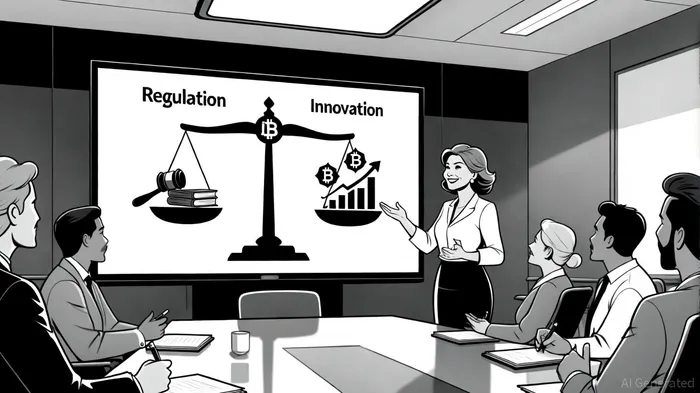
Longer-term, the regulatory landscape is beginning to stabilize. The SEC's formation of a Crypto Task Force and the Cyber and Emerging Technologies Unit (CETU) under Commissioner Hester Peirce suggests a commitment to balancing innovation with investor protection[1]. Additionally, the July 2025 passage of the GENIUS Act, which provided clarity for payment stablecoins, contributed to Ethereum's 16% outperformance in August[2]. Globally, Europe's MiCA framework and the U.S. SEC-CFTC Joint Statement have reduced legal uncertainties for exchanges and institutional investors[3].
Investment Considerations: Navigating the New Normal
For investors, the key takeaway is that regulatory risk is no longer binary. Firms must now navigate a patchwork of evolving rules, from staking disclosures to DAO liability. Short-term volatility will persist as markets adjust to the SEC's deregulatory pivot and DOJ enforcement actions[4]. However, long-term opportunities are emerging. The GENIUS Act and MiCA have already spurred institutional adoption, with Bitcoin ETFs and exchange-traded products (ETPs) gaining traction[2].
Yet, challenges remain. Regulatory fragmentation across the U.S., U.K., and Asia complicates compliance for global investors[3]. Firms must also contend with the risk of private litigation, particularly in jurisdictions where DAOs are treated as partnerships[1].
Conclusion
The crypto market in 2025 is at an inflection point. While the SEC's shift toward clarity has reduced some friction, the interplay between deregulation, criminal enforcement, and private litigation creates a volatile environment. Investors must weigh short-term risks against long-term opportunities, prioritizing firms with robust compliance programs and transparent disclosures. As global regulatory frameworks converge, the sector's legitimacy—and its potential for growth—will depend on how well companies adapt to this evolving landscape.





Comentarios
Aún no hay comentarios