
Rising Rates, Whale Accumulation, and Bitcoin's Contrarian Growth Signal
While BitcoinBTC-- has been drawing investor attention, corporate borrowing conditions are turning increasingly challenging. Corporate interest expenses are projected to rise in 2024–2025 as the Federal Reserve's rate hikes from 2022-2023 come into full effect. Non-financial firms took on significant fixed-rate debt during the pandemic, much of which is set to mature over the next three years, with peak maturity periods between 2024 and 2027. This means companies will need to refinance at significantly higher rates. Current leverage ratios have returned to pre-pandemic levels, and interest coverage ratios remain stable, providing a temporary buffer. However, rising borrowing costs could strain firms as they face higher interest payments and the pressure to refinance maturing debt.
The situation is further complicated by uncertainty in monetary policy, with multiple scenarios for interest rates and inflation in 2025 that could exacerbate the strain on corporate budgets, particularly in wage inflation and benefits according to SHRM insights.
Meanwhile, Bitcoin has been a contrasting asset class in the current environment, drawing investor attention amid the corporate stress.
Whale Accumulation Defies Corporate Stress
While traditional markets show signs of corporate unease, institutional Bitcoin accumulation tells a different story, signaling underlying confidence amid recent price dips. Whale investors have bought more than 375,000 BTCBTC-- over the past month, a volume representing four times the weekly mining supply, while long-term holder addresses doubled to 262,000. This aggressive buying coincided with over 102,000 transactions exceeding $100,000 and nearly 29,000 transactions surpassing $1 million, according to Santiment and Glassnode data. Analysts interpret this as a disciplined "dip-buying" strategyMSTR--, with whales accumulating significant positions in wallets holding over 1,000 BTC, anticipating future price appreciation.
The accumulation surge contrasts sharply with emerging risks. Massive $7.5 billion in Bitcoin inflows to Binance over 30 days mirror patterns seen before sharp corrections, potentially setting the stage for selling pressure once prices stabilize. This tension reflects a classic market dynamic: institutional confidence versus exchange liquidity risks. While the whale accumulation has helped establish a psychological $100,000 support floor, especially as U.S. spot ETFs like BlackRock's IBIT saw $240 million net inflows, the simultaneous concentration of supply on exchange platforms raises concerns about future downward pressure. Historical parallels to 2021-2022 bear markets and growing derivatives short positions further complicate the outlook, suggesting any breakout above $150,000 might face significant resistance. This dichotomy between on-chain accumulation and exchange dynamics sets the stage for analyzing how macroeconomic factors, particularly interest rate movements, will ultimately steer Bitcoin's trajectory.
The Rate-Bitcoin Correlation Dilemma
Historically, rising interest rates triggered liquidity crunches that pressured Bitcoin as investors fled risk assets for safer yields. Higher borrowing costs squeezed corporate budgets and redirected capital away from speculative markets, weakening Bitcoin's price momentum. Yet today's dynamics are shifting-a disconnect is emerging between monetary policy signals and Bitcoin's resilience.
Whale accumulation patterns now challenge traditional narratives. During late 2025's rate-driven volatility, whales aggressively bought Bitcoin below $90,000, with over 102,000 large transactions ($100,000+) and 29,000 mega-deals ($1M+). Their strategy-accumulating four times the weekly mining supply during dips-contrasts sharply with past sell-offs, signaling long-term confidence amid macro uncertainty. Santiment and Glassnode data show wallets holding over 1,000 BTC swelling, a classic dip-buying playbook that historically precedes bull runs. Institutional flows are further fracturing the old correlation. U.S. spot Bitcoin ETFs like BlackRock's IBIT saw $240M net inflows in just weeks, reversing earlier outflows, while corporations added BTC to portfolios. This institutional demand has reinforced a $100,000 support floor, loosening the historical link between Fed rate hikes and Bitcoin weakness. Analysts note that whale buying now tightens exchange supply more than retail panic sells it-a shift that could delay $150,000–$170,000 targets into 2026, though macro risks linger.
Institutional flows are further fracturing the old correlation. 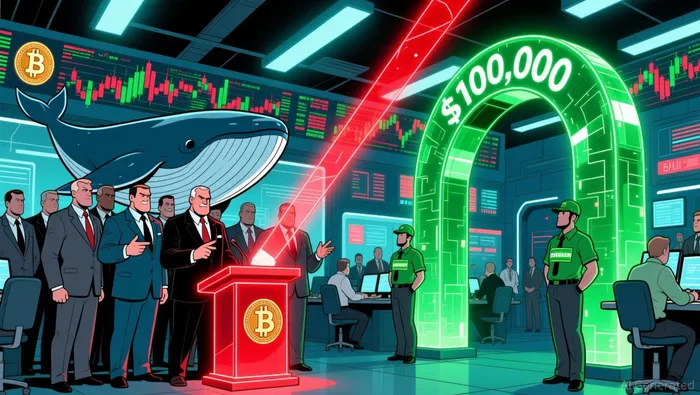 . U.S. spot Bitcoin ETFs like BlackRock's IBIT saw $240M net inflows in just weeks, reversing earlier outflows, while corporations added BTC to portfolios. This institutional demand has reinforced a $100,000 support floor, loosening the historical link between Fed rate hikes and Bitcoin weakness. Analysts note that whale buying now tightens exchange supply more than retail panic sells it-a shift that could delay $150,000–$170,000 targets into 2026, though macro risks linger.
Yet exchange deposits remain a wildcard. Whale inflows to Binance hit $7.5 billion in 30 days-a mirror of March 2025's $102,000-to-$70,000 crash. Such deposits historically precede sharp selloffs, especially with thin liquidity and rising derivatives short positions. While persistent $7–8B+ inflows could deepen downturns, they also highlight the market's fragile duality: institutional accumulation vs. exchange-side selling pressure.
For investors, the takeaway is two-fold. First, the old rate-Bitcoin inverse correlation is weakening but not dead-geopolitical shocks and Fed policy still weigh on risk sentiment. Second, whale behavior now dominates short-term price direction, with institutional ETFs adding structural demand. Watch exchange flows as a trailing indicator of stress, while long-term holders' accumulation streaks remain a leading signal of bottoming phases. The narrative is evolving: Bitcoin's fate may hinge more on whale strategy than Wall Street interest rates.
Growth Risks and Guardrails: Scenarios
While whale inflows initially suggested strong accumulation, recent data reveals significant risks to this thesis. Recent whale inflows to Binance hit $7.5 billion over 30 days, mirroring March 2025 patterns that preceded a sharp price decline from $102,000 to $70,000. This magnitude of deposit often signals potential selling pressure, especially when liquidity is thin and long-term holders reduce supply.
On-chain activity further complicates the picture. In late 2025, whale transactions surged, with over 102,900 transfers exceeding $100,000 and 29,000 above $1 million according to TradingView analysis. Whale addresses holding 1,000 BTC or more rose 2.2% to 1,384, but smaller holders declined, suggesting institutional positioning rather than broad accumulation. Analysts debate whether this reflects buying or forced liquidations, with mixed on-chain flows adding uncertainty.
Rapid rate hikes could amplify these risks by triggering risk-off sentiment, compounding thin liquidity and derivatives shorts noted in historical bear markets. While growth signals remain, these frictions highlight that the long-term logic may not hold if corrections accelerate. As we turn to the investment outlook, a balanced approach is essential-one that acknowledges upside potential while guarding against downside shocks from these emerging threats.
Bitcoin Price Targets: Catalysts and Risks
Bitcoin's near-term trajectory hinges on whether accumulated institutional buying can overcome historical bearish signals. Whale accumulation of over 375,000 BTC in 30 days alongside $240 million in U.S. spot Bitcoin ETF net inflows established a perceived $100,000 support floor. This positions the bull case for $120,000 to $170,000 targets, contingent on sustained buying pressure and macro catalysts like strategy refinancing. Such refinancing could unlock institutional capital, accelerating price momentum toward these highs. However, a significant headwind emerges from contrasting whale behavior: $7.5 billion worth of BTC moved to Binance in the same 30-day window, directly mirroring patterns preceding the sharp drop from $102,000 to $70,000 in March 2025. This deposit surge signals potential future selling pressure, especially as long-term holder supply dwindles and derivatives short positions climb.
The bear case for $70,000-$80,000 hinges critically on whether this exchange accumulation translates into realized selling. Thin market liquidity amplifies the risk; if selling pressure overwhelms buying interest, the fragile support at $100,000 could break, triggering deeper corrections. Historical parallels to the 2021-2022 bear market dynamics add weight to this scenario. Institutional accumulation provides a floor but doesn't guarantee upward momentum if exchange risks dominate. For investors, the key uncertainty is the net balance: can the confidence-driven buying in id_3 sustainably outpace the distribution signals in id_5? The outcome likely depends on macroeconomic shifts and the resolution of exchange liquidity concerns. While catalysts like refinancing could reignite the bull case, market participants should prepare for significant volatility and potential downside until the narrative around whale accumulation and exchange flows clarifies.





Comentarios
Aún no hay comentarios