
Rising Rates, Shifting Strategies: How Treasury Yields Signal a New Investment Paradigm
The U.S. Treasury market has entered a pivotal phase, with yields surging as investors reassess the Federal Reserve's policy trajectory. Recent data, particularly the robust June jobs report, has upended expectations of imminent rate cuts, sparking a dramatic unwinding of bullish Treasury bets. This shift underscores a critical inflection pointIPCX-- for bond markets, Fed policy, and investment strategies. Let's dissect the dynamics at play and explore actionable positions to capitalize on this evolving landscape.
The Catalyst: Strong Data and Fed Resolve
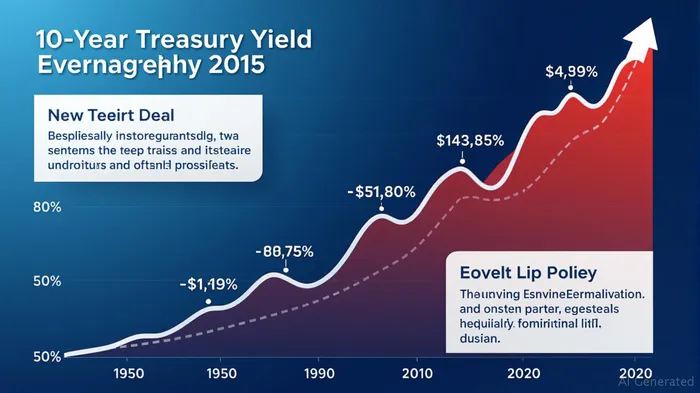
The June nonfarm payroll report, which showed 147,000 jobs added and an unemployment rate dipping to 4.1%, was a game-changer. These figures, far exceeding consensus estimates, reinforced the Fed's “higher-for-longer” stance. With inflation at 2.35%—still above the 2% target—the Fed has little incentive to cut rates, despite earlier market pricing of three cuts by December 2025. The 10-year Treasury yield, a key benchmark, rose to 4.35% by July 3, up from 4.26% a month prior, reflecting this recalibration.
Bond Market Dynamics: The Unraveling of Duration Bets
Investors who had piled into long-dated Treasuries on expectations of rate cuts are now scrambling to exit. The 10-year-2-year yield spread, a recession barometer, widened to 0.56%, signaling reduced near-term downturn risks. However, the 10-year-3-month spread remains inverted at -0.10%, highlighting lingering uncertainties. This mixed messaging has created volatility, with yields spiking on positive economic data and dipping on geopolitical jitters (e.g., U.S.-Vietnam trade tensions).
The unwinding of duration-heavy portfolios has amplified this volatility. Funds holding long-dated bonds face mark-to-market losses as yields rise, creating a feedback loop of selling pressure. For example, the iShares 20+ Year Treasury Bond ETF (TLT) has dropped 8% year-to-date, underscoring the risks of prolonged duration exposure.
Fed Policy: The “Higher-For-Longer” Reality
The Fed's messaging has shifted decisively. Gone are the days of “data-dependent” cuts; instead, policymakers emphasize sustaining restrictive rates to anchor inflation. Chair Powell's June statement—“We will not cut rates unless we're confident inflation is on a sustained downward path”—left little room for misinterpretation. This stance aligns with the Fed's dot plot, which projects rates to remain at 4.25-4.50% through 2025.
Investors must now reconcile this hawkishness with the $3.3 trillion fiscal stimulus signed into law, which could stoke demand and inflation. The interplay of fiscal expansion and tight monetary policy creates a “Goldilocks” scenario: yields may rise further as growth holds up, but risks of a policy misstep remain.
Investment Strategies: Navigating the New Reality
To profit from these trends, investors should adopt shorter-duration strategies and curve-steepening trades, while hedging against volatility.
Shorten Duration:
Favor short-term Treasuries (e.g., 1-3 year maturities) to insulate against rising rates. The SPDR Portfolio Short-Term Treasury ETF (SPTS) offers exposure with minimal interest-rate sensitivity. Avoid long-dated bonds unless hedged via options.Curve Steepeners:
Capitalize on the yield curve's potential steepening by going long 10-year Treasuries (e.g., iShares 7-10 Year Treasury Bond ETF (IEF)) while shorting 2-year notes (e.g., SPDR Portfolio Short-Term Treasury ETF (SPTS)). This bet profits if long-term yields rise more than short-term rates, a likely outcome if the economy avoids a sharp slowdown.Inflation Hedging:
Consider TIPS (Treasury Inflation-Protected Securities) or the iShares TIPS Bond ETF (TIP) to mitigate inflation risks amplified by fiscal stimulus.Risk Management:
Use put options on bond ETFs (e.g., puts on TLT) or inverse ETFs (e.g., ProShares UltraShort 20+ Year Treasury (TBT)) to hedge against unexpected rate hikes. Diversify into high-quality corporate bonds (e.g., iShares iBoxx $ Investment Grade Corp Bond ETF (LQD)) for yield pickup without excessive duration risk.
The Risks: Volatility and Policy Missteps
While the Fed's resolve is clear, risks remain. A sudden economic slowdown or geopolitical flare-up (e.g., trade wars with Vietnam) could reignite rate-cut expectations, causing yields to drop. Additionally, the $3.3 trillion fiscal package could overshoot inflation targets, forcing the Fed to tighten further. Investors must monitor monthly CPI reports and nonfarm payrolls closely.
Conclusion: Position for Volatility, Not Certainty
The Treasury market's recent volatility signals a new era of Fed credibility and fiscal activism. Investors should prioritize flexibility over fixed bets. Short-duration exposure, curve-steepening trades, and hedging tools will be critical to navigating this environment. As the Fed's “higher-for-longer” mantra takes hold, remember: in bond markets, patience—and tactical positioning—are virtues.
Stay vigilant, stay agile, and avoid the siren song of long-dated duration. The yield curve is whispering a new message—one that demands respect.







Comentarios
Aún no hay comentarios