
Rising Oil Prices: Navigating Shale Declines, Economic Strength, and Strategic Opportunities
The global oil market is at a pivotal juncture, with U.S. shale production declines, resilient U.S. economic demand, and OPEC+'s strategic shifts creating a landscape of volatility and opportunity. For investors, this confluence of factors presents a nuanced yet compelling case for selective exposure to energy assets. Let's dissect the drivers, risks, and investment pathways.
The Shale Slowdown: A Supply-Side Shift
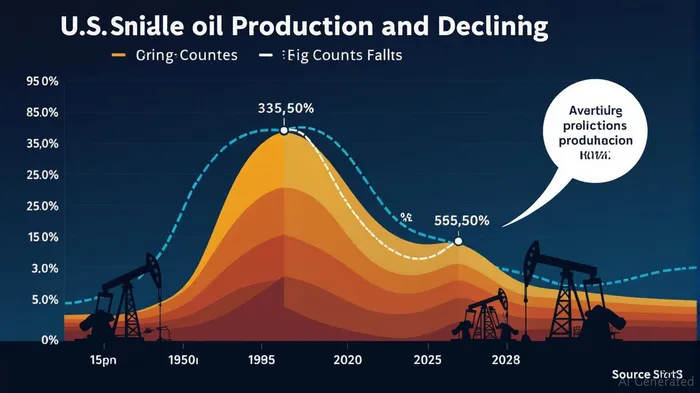
The U.S. shale boom is waning. The EIA forecasts U.S. crude production to drop from 13.5 million barrels per day (b/d) in Q2 2025 to 13.3 million b/d by Q4 2026, driven by fewer drilling rigs and lower break-even prices. Rystad Energy adds that non-OPEC production may peak by 2027 due to geological limits, high costs, and reduced investment. Tier 2/3 shale plays in Texas and Utah now require wells costing up to $30 million, with marginal returns. This structural decline in unconventional output is tightening global supply, a stark contrast to earlier oversupply fears.
Demand Resilience: U.S. and Emerging Markets Power Through
The U.S. economy, while moderating, remains a critical demand driver. Q2 2025 GDP is projected to grow 1.5%—a slowdown from 2024 but still positive—supported by robust consumer spending and petrochemicals.
Meanwhile, emerging markets like India and China are fueling incremental demand. India's oil consumption grew 3.2% in 2025, driven by infrastructure projects, while China's petrochemical feedstock demand (naphtha, LPG) is up 4%–6%, accounting for 70% of its oil growth. This structural shift toward industrial use insulates prices from purely cyclical demand swings.
OPEC+'s Double-Edged Sword: Market Share vs. Price Stability
On July 7, OPEC+ agreed to increase production by 548,000 b/d in August—a move aimed at reclaiming market share from U.S. shale and Brazil. While this initially sent Brent to $68/b, the decision highlights a strategic pivot: prioritizing volume over price. However, compliance risks loom. Internal overproduction by Iraq, Kazakhstan, and Russia (880,000 b/d in May) could dilute the impact. Should prices dip below $60/b, OPEC+ may reverse course, cutting production to stabilize markets.
Investment Opportunities: Energy Equities and ETFs to Watch
The interplay of supply constraints and demand resilience creates a floor for oil prices, favoring select energy assets. Here's how to position:
- Oil Majors: Steady Earnings in Volatility
- ExxonMobil (XOM) and Chevron (CVX) have strong balance sheets and exposure to stable Middle Eastern production. Both firms are capital-disciplined, focusing on returns over growth.
Rationale: Their dividends and production resilience make them less sensitive to short-term price swings.
U.S. Shale: Wait for the Bottom
Names like EOG Resources (EOG) and Pioneer Natural Resources (PXD) could rebound if prices stabilize above $60/b. However, high breakeven costs ($60+/b for 80% of shale wells) mean patience is key.
ETFs: Diversify with Purpose
- XLE (Energy Select Sector SPDR Fund): Tracks a basket of oil and gas equities, including majors and refiners.
- USO (United States Oil Fund): Tracks WTI futures; use put options to hedge downside risk.
Petrochemical Plays: China and India's Growth Engine
- Sinopec (SHI) and Reliance Industries (RELIANCE.NS) benefit from petrochemical demand tied to naphtha and LPGLPG--.
Risks to Monitor
- OPEC+ Overproduction: Non-compliance could swamp markets, pushing prices below $60/b.
- Economic Downturn: A U.S. recession (37% chance in Q2 2025) or Chinese property sector collapse could crater demand.
- Geopolitical Upsets: Escalation in the Israel-Iran conflict or new sanctions on Russia could disrupt supply.
Conclusion: A Balanced Approach to Energy Exposure
The oil market's future hinges on shale's decline, OPEC's discipline, and demand from emerging economies. While risks exist, the structural tightening of supply and petrochemical-driven demand create a supportive environment for prices above $60/b. Historically, this support has been validated by strong energy stock performance: since 2022, energy equities like XOM and CVXCVX-- delivered a maximum return of 152.83% when oil stayed above $60, with short-term strategies showing a 70% win rate over three days and 65% over ten days. These results underscore the strategic importance of $60 as a price floor for sustained outperformance.
For investors, a diversified portfolio of oil majors (XOM, CVX) and emerging market refiners (SHI, RELIANCE.NS) offers steady exposure. Pair these with USO puts to hedge against OPEC+ overproduction. Avoid pure shale plays until prices stabilize—this is a long game.
The energy transition remains a backdrop, but for now, crude's fundamentals are ripe for selective opportunism.
Final advice: Allocate 5–10% of a diversified portfolio to energy, with stops below $55/b for crude-linked instruments.





Comentarios
Aún no hay comentarios