
Rising Oil Prices and the Energy Crossroads: Navigating Geopolitics and Transition Risks in 2025
The global energy sector is at a pivotal crossroads. As geopolitical tensions and structural shifts in supply-demand dynamics push oil prices higher, investors face a complex landscape of risks and opportunities. With Brent crude hovering near $70/barrel amid Middle Eastern volatility and renewables commanding record investment, the question is no longer whether to invest in energy—but where and how.
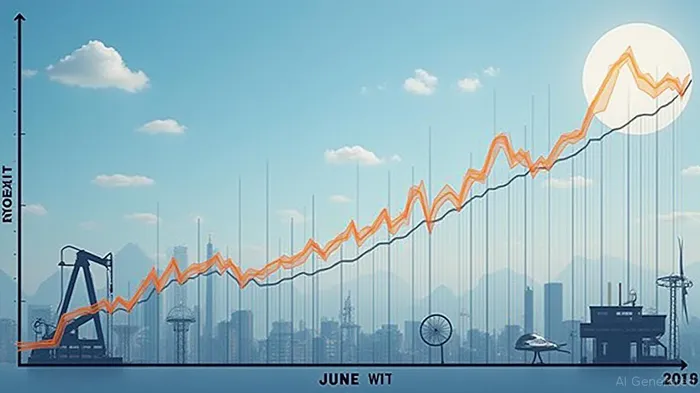
Geopolitical Drivers: A Volatile Floor for Oil Prices
The Israel-Iran conflict has emerged as the single largest geopolitical wildcard. Israel's June 13 air strikes on Iranian nuclear and energy infrastructure—damaging the South Pars gas field and Shahran oil depot—sent Brent prices to a six-month high. Traders now factor in a $5–$10/barrel geopolitical premium, with fears that Iran's threats to close the Strait of Hormuz could disrupt up to 7 million barrels/day (mb/d) of global oil exports. Even a partial disruption, such as attacks on Iraq's 4.5 mb/d oil exports, could sustain elevated prices.
The market's sensitivity is underscored by hedge funds increasing net long positions in crude futures. Yet, the risk of a sudden de-escalation—such as a U.S.-brokered ceasefire—could trigger a sharp correction. Investors should monitor geopolitical developments closely, as the Strait of Hormuz remains a “chokepoint” for 25% of global oil trade.
Supply and Demand: A Structural Shift, But Not Yet a Decline
While oil's long-term structural decline is inevitable, near-term dynamics favor upstream players. Non-OPEC+ producers, led by U.S. shale at 13.2 mb/d, are offsetting demand growth. However, OPEC+ compliance remains uneven: Saudi Arabia underperformed its May 2025 targets, while Russia's exports fell by 230 kb/d year-on-year. The International Energy Agency (IEA) forecasts a “comfortably supplied” market through 2030, with supply outpacing demand by 9.2 mb/d.
Yet, traders must balance this with geopolitical tailwinds. For instance, Iranian oil output—pre-June 13 attacks—was already constrained to 3.3 mb/d, and further sanctions could exacerbate supply gaps. The takeaway: Short-term volatility favors oil stocks, but long-term secular decline requires hedging.
Renewables: The Dominant Investment Theme, With Caveats
The renewable energy sector is booming, but unevenly. Global clean energy investments hit $2.2 trillion in 2025, with solar PV leading at $450 billion. Policy tailwinds—such as the U.S. Inflation Reduction Act (IRA)—are accelerating this shift, incentivizing solar, wind, and battery storage. However, critical mineral shortages (lithium, cobalt) and regional disparities threaten progress:
- Africa: Energy investment has fallen 33% since 2015, with debt servicing consuming 85% of energy budgets. Without blended finance tools—such as GuarantCo's guarantees for Africa GreenCo—growth will lag.
- Supply Chains: Cybersecurity threats to energy grids and bottlenecks in transformer production add operational risks. .
Investment Strategies: Balance Geopolitical Bets and Transition Plays
Upstream Energy: Short-Term Gains, Long-Term Caution
- OPEC+ Producers: Saudi Aramco (SA:2224) and Gazprom (MCX:GAZP) benefit from geopolitical premiums but face ESG-driven divestment pressures.
- U.S. Shale: Stocks like Pioneer Natural Resources (PXD) and Continental Resources (CLR) offer leverage to high oil prices, though capex discipline limits upside.
- Hedging Tool: Use energy ETFs (e.g., XLE) to gain diversified exposure while monitoring geopolitical de-escalation risks.
Renewables: The Future, But Navigate Risks
- Solar & Wind: Invest in firms with access to critical minerals (First Solar (FSLR), NextEra Energy (NEE)) and grid infrastructure plays (Dominion Energy (D)).
- Policy Plays: Back firms benefiting from IRA tax credits (e.g., Tesla (TSLA) battery storage, Bloom Energy (BE)).
- Risk Mitigation: Use options to hedge against mineral supply shocks or regulatory backtracking. .
The Middle Ground: Energy Transition Plays
- Oil Majors with Renewables: BP (BP) and Shell (RDS.A) are pivoting to renewables, offering a hybrid investment thesis.
- Critical Minerals: Invest in mining firms like Southern Copper (SCCO) or lithium plays such as Albemarle (ALB), but watch for geopolitical competition over resource control.
Key Risks to Monitor
- Geopolitical De-escalation: A sudden easing of tensions in the Middle East could drop oil prices 15–20% within weeks.
- Renewable Overcapacity: By 2030, refining overcapacity may pressure margins, while oversupply in solar panels could depress returns.
- Policy Shifts: U.S.-China trade disputes or a U-turn on climate policies could disrupt clean energy momentum.
Conclusion: The Energy Portfolio of 2025
Investors must balance geopolitical volatility in oil with the irreversible march toward renewables. Short-term gains lie in OPEC+ resilience and U.S. shale, but long-term wealth will accrue to those backing solar, wind, and grid infrastructure. The transition is not seamless—critical mineral bottlenecks and regional imbalances demand cautious, diversified bets. As always, the energy crossroads favors those who see both the storm clouds and the horizon.
Final Note: Stay agile. Geopolitics and policy can turn markets overnight.







Comentarios
Aún no hay comentarios