
Rising Momentum in Centralized Perpetual Derivatives: The Hyperliquid Phenomenon
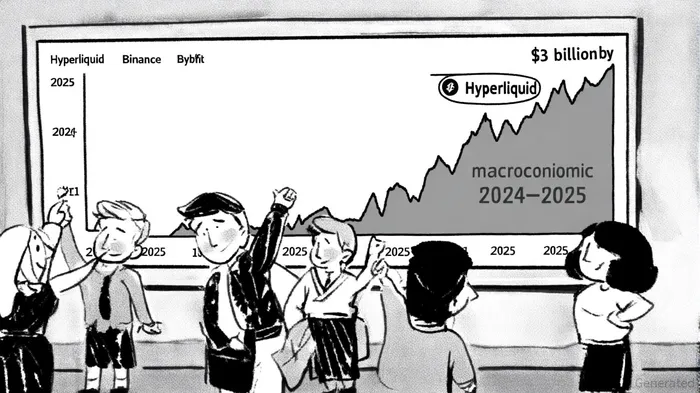
The crypto market's evolution in 2023–2025 has been defined by a seismic shift in user behavior and capital allocation. Traditional HODL strategies, once the cornerstone of crypto investing, have given way to a “quick in, quick out” mentality driven by volatile macroeconomic conditions and the collapse of trust in centralized finance (CeFi) giants like FTX[2]. In this environment, platforms like Hyperliquid have emerged as disruptors, redefining capital efficiency and user adoption dynamics in the perpetual derivatives space.
Capital Efficiency: The New Edge in CeFi 2.0
Hyperliquid's rise is rooted in its ability to address the inefficiencies of traditional CeFi models. While centralized exchanges (CEXs) like Binance and Bybit dominate market share, they often rely on opaque margin requirements and rigid leverage structures that limit liquidity. Hyperliquid, by contrast, introduces a novel approach to capital efficiency through dynamic margin mechanisms and settlement security innovations[2]. These features reduce the capital burden on traders, enabling higher leverage ratios without compromising risk management.
For instance, Hyperliquid's use of Eigen-layered settlement protocols ensures that margin requirements are adjusted in real-time based on market volatility, a stark contrast to the static models of legacy CEXs[2]. This adaptability allows traders to deploy capital more aggressively during high-liquidity periods, a critical advantage in a market where timing is everything. While exact leverage ratios remain undisclosed, anecdotal evidence suggests Hyperliquid's offerings rival or exceed those of Bybit, which has struggled with liquidity depth despite early adoption of pre-market trading[3].
User Adoption: Volume, Velocity, and the “CeFi 2.0” Migration
Hyperliquid's user base has grown exponentially, driven by its focus on operational flexibility and low-latency execution. As of mid-2025, its average daily trading volume consistently exceeds $3 billion, a figure that outpaces many traditional CEXs during peak market cycles[3]. This growth is not merely a function of aggressive marketing but a reflection of broader user sentiment: traders are increasingly prioritizing platforms that align with the “CeFi 2.0” ethos—transparency, speed, and reduced counterparty risk[2].
The shift is further amplified by the decline of DeFi in favor of hybrid models. While DeFi platforms once promised trustless trading, their complexity and gas costs have pushed users toward CeFi 2.0 solutions that blend the best of both worlds. Hyperliquid's user interface, for example, mirrors the simplicity of traditional CEXs while embedding decentralized security measures, making it accessible to both retail and institutional traders[2].
Challenges and the Road Ahead
Despite its momentum, Hyperliquid faces headwinds. Regulatory scrutiny remains a wildcard, as governments grapple with how to classify perpetual derivatives and margin mechanisms[2]. Additionally, competition from entrenched players like Binance—whose market share remains formidable—poses a long-term threat. However, Hyperliquid's agility in adapting to market conditions and its focus on capital efficiency position it to capture a significant slice of the derivatives market, particularly among short-term traders who dominate the current landscape[3].
Conclusion
The Hyperliquid phenomenon underscores a fundamental truth: in a market defined by velocity and adaptability, capital efficiency is the ultimate differentiator. As CeFi 2.0 continues to evolve, platforms that prioritize liquidity optimization and user-centric design will outperform those clinging to outdated models. For investors, Hyperliquid represents not just a speculative play but a strategic bet on the future of derivatives trading—a space where speed, transparency, and innovation converge.







Comentarios
Aún no hay comentarios