
Rising Jobless Claims and Their Implications for Equity and Bond Markets
The U.S. labor market has entered a period of heightened scrutiny as recent jobless claims data signals a potential softening in economic momentum. For the week ending December 6, 2025, initial jobless claims surged by 44,000 to 236,000-the largest increase since March 2020-raising concerns about the resilience of the labor market amid seasonal adjustment challenges and holiday-related volatility. While officials caution against overinterpreting the spike, the broader trend of declining job-finding rates and elevated unemployment expectations underscores the Federal Reserve's delicate balancing act between supporting growth and curbing inflation.
Assessing Labor Market Weakness and Fed Policy Path
The Federal Reserve's December 2025 rate cut of 25 basis points, which lowered the federal funds rate to 3.50%–3.75%, reflects a divided FOMC grappling with mixed signals. Fed Chair Jerome Powell has emphasized "significant downside risks," including historically low job creation and re-employment rates, while acknowledging that inflation remains stubbornly above the 2% target. The central bank's projections now anticipate the unemployment rate to stabilize at 4.5% in 2025 before easing slightly to 4.4% in 2026 according to Reuters reports, a trajectory that suggests policymakers are prioritizing inflation control over aggressive stimulus.
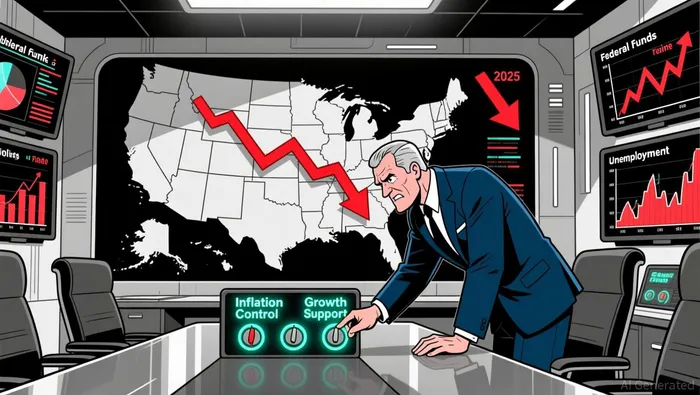
External factors further complicate the Fed's outlook. Reduced immigration, import tariffs, and rapid AI adoption have created structural shifts in labor demand, dampening hiring activity and prolonging job transitions. These dynamics imply that even a pause in rate cuts may not immediately reignite economic momentum, leaving markets to navigate a prolonged period of uncertainty.
Market Reactions: Resilience Amid Divergence
Despite the labor market's fragility, equity markets have remained remarkably resilient, with U.S. stocks hovering near all-time highs as investors price in the Fed's "insurance cut" to avert a sharper slowdown. The bond market has also responded favorably to the central bank's easing bias, with yields on longer-dated Treasuries declining to reflect expectations of prolonged low-rate policy. Sectoral performance highlights this divergence: financial services and banking stocks have surged, benefiting from improved net interest margins and reduced default risks in a lower-rate environment.
However, the resilience masks underlying vulnerabilities. Continuing claims fell by 99,000 to 1.838 million, signaling a gradual erosion of labor market durability. While the unemployment rate remains near multi-decade lows, the projected rise to 4.5% by year-end could trigger a reassessment of risk assets, particularly in small-cap and cyclical sectors.
Repositioning Portfolios for a Prolonged Policy Pause
Investors must now navigate a landscape where the Fed's policy flexibility is constrained by both inflationary pressures and structural labor market challenges. According to Morgan Stanley's Mike Wilson, the key lies in "repositioning toward sectors poised to benefit" from aggressive Fed action while maintaining a disciplined, diversified approach. Strategic allocations could include:
- Small- and Mid-Cap Equities: These segments often outperform during periods of monetary easing, as smaller firms are more sensitive to rate cuts and economic stimulus.
- Consumer Discretionary Sectors: A potential rebound in consumer spending, supported by lower borrowing costs, could buoy sectors like retail and travel according to Morgan Stanley analysis.
- Defensive Bonds: High-quality corporate and government bonds may offer a buffer against equity market volatility, particularly as inflation expectations moderate.
Conversely, investors should remain cautious about overexposure to rate-sensitive sectors such as real estate and utilities, which could face headwinds if the Fed's pause extends into 2026.
Conclusion: Navigating Uncertainty with Prudence
The surge in jobless claims and the Fed's cautious policy stance highlight the need for a nuanced approach to portfolio management. While the labor market's fundamentals remain intact, the interplay of structural shifts and monetary policy uncertainty demands agility. By prioritizing sectors aligned with the Fed's easing bias and maintaining a diversified stance, investors can position themselves to weather near-term risks while capitalizing on potential opportunities as the economic landscape evolves.







Comentarios
Aún no hay comentarios